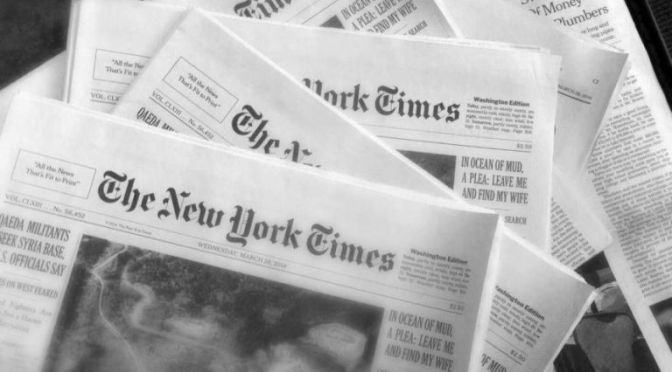
Tag Archives: Politics

THE NEW YORK TIMES MAGAZINE – JULY 13, 2025

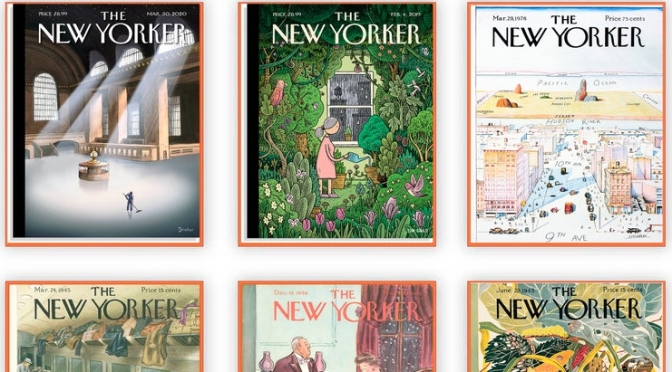
Current cover

THE NEW YORK TIMES MAGAZINE: The 7.13.25 Issue features Emily Bazelon and Mattathias Schwartz on Amir Ali’s first months as a federal judge under the Trump administration; Ted Conover on the truth of the gang problem in Aurora, Colorado; M.H. Miller on 20 years of “It’s Always Sunny in Philadelphia”; Lulu Garcia-Navarro interviews Mark Rutte, the secretary general of NATO; and more.

How Netanyahu Prolonged the War in Gaza to Stay in Power

Secret meetings, altered records, ignored intelligence: the inside story of the prime minister’s political calculations since Oct. 7.

Inside the Collapse of the F.D.A.

How the new health secretary, Robert F. Kennedy Jr., is dismantling the agency. By Jeneen Interlandi

What to Know About the Collapse of the F.D.A.

The regulatory agency confronts a future determined by a health secretary hostile to its mission. By Jeneen Interlandi

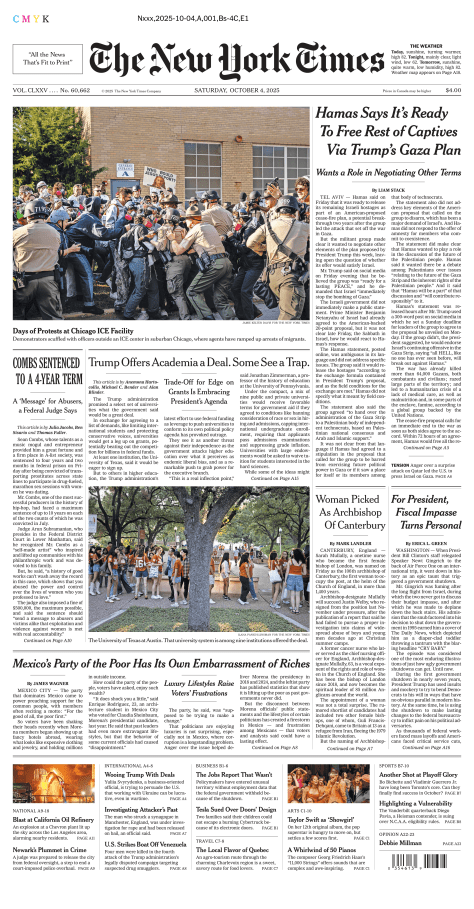
THE NEW YORK TIMES – SATURDAY, JULY 12, 2025

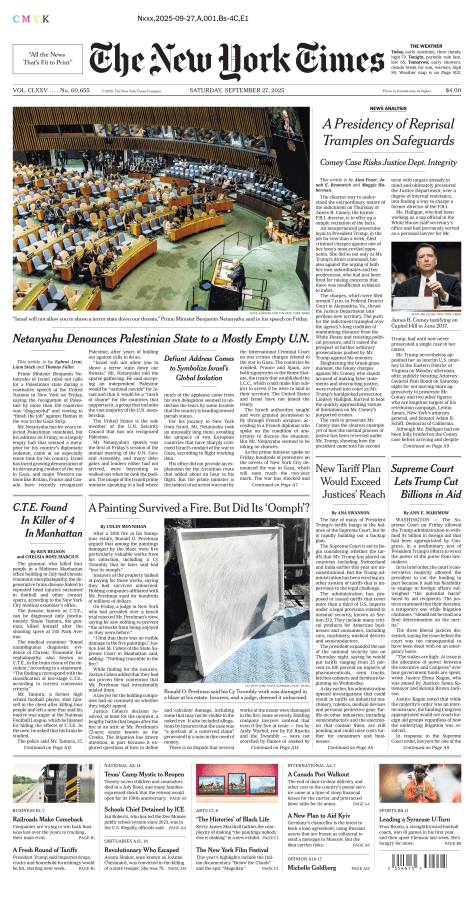
Tariffs or Deals? Trump Seems Content With Punishing Levies.

President Trump’s supporters portray him as a top dealmaker. But, at least for now, far more trading partners have gotten stiff tariffs than trade deals.

Around the World, Flash Flood Disasters Are the ‘Hardest Kind to Prevent’

Scholars and designers of early warning systems say that there are still huge gaps in the ability to predict flash floods and warn those at risk.

An Army of Searchers Combs the Banks of the Guadalupe for the Missing

Judge Blocks Trump Administration Tactics in L.A. Immigration Raids

A federal judge temporarily halted the administration from making indiscriminate arrests based on race and denying detainees access to lawyers.

President Trump’s Birthright Citizenship Ban Faces New Threat: Class Actions

In last month’s decision limiting one judicial tool, universal injunctions, the court seemed to invite lower courts to use class actions as an alternative.

THE NEW YORK TIMES – FRIDAY, JULY 11, 2025

How Netanyahu Prolonged the War in Gaza to Stay in Power

Secret meetings, altered records, ignored intelligence: the inside story of the prime minister’s political calculations since Oct. 7.

Before Tragedy, Texas Repeatedly Rejected Pleas for Flood Alarm Funding

Kerr County repeatedly failed to secure a warning system, even as local officials remained aware of the risks and as funds were available for similar projects.

Trump’s Seesawing on Tariffs Gives the World Whiplash

Blunt letters dictating terms posted to social media and changes late in negotiations have left trading partners wondering what President Trump will do next.

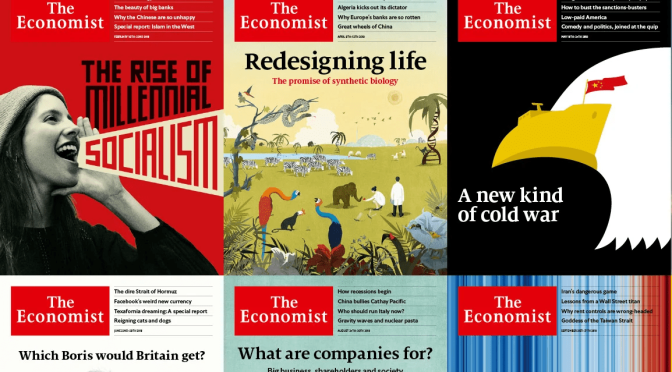
THE ECONOMIST MAGAZINE – JULY 12, 2025 PREVIEW

THE ECONOMIST MAGAZINE: The latest issue features ‘Scrap the asylum systemAnd build something better…

Scrap the asylum system—and build something better

Rich countries need to separate asylum from labour migration

America cannot dodge the consequences of rising tariffs for ever

Their economic impact has been delayed but not averted

After another leader is brought low, Thailand’s voters need a real choice

The kingdom is stagnating while its elites squabble

Sex hormones could be mental-health drugs too

If they can be liberated from ignorance and hucksterism

THE NEW YORK TIMES – THURSDAY, JULY 10, 2025

Texas Camp’s Cabins Stood in an ‘Extremely Hazardous’ Floodway

An analysis of Camp Mystic shows that several buildings were in known hazard zones. A $5 million expansion in 2019 did nothing to alleviate the problem.

As Texas Flood Raged, Camp Mystic Was Left to Fend for Itself

Flash floods hit during the night, but many local officials appeared unaware of the unfolding catastrophe, initially leaving people near the river on their own.

China Surveys Seabeds Where Naval Rivals May One Day Clash

Research ships are studying the seas for science and resources, but the data they gather could also be useful in a conflict with Taiwan or the U.S.

U.K. and France Agree to First-Ever Nuclear Weapons Pact to Fend Off Threat to Europe

Prime Minister Keir Starmer of Britain and President Emmanuel Macron of France are set to confirm a strengthened defense relationship at a summit today.

THE NEW YORK TIMES – WEDNESDAY, JULY 9, 2025

With Taxes and Tariffs in Place, Trump Takes Reins of U.S. Economy

President Trump has achieved much of his agenda, leaving the fate of the economy squarely in his hands.

At Least 173 People Remain Missing After Texas Floods

Officials said the search for remains would continue until all victims were accounted for. In the hardest-hit county, no survivors have been found since Friday.

Trump Got the Green Light to Fire Federal Workers. Now, They Wait.

A court-ordered pause in May had covered nearly two dozen federal agencies at different stages of executing President Trump’s directive for mass layoffs.

The ‘Trump Pump’: How Crypto Lobbying Won Over a President

The Unholy Offspring of Economic Theory: The Far Right’s Neoliberal Roots

The following essay is AI -generated, edited by Intellicurean, as part of our “The Cynic & The Dandy” series, of an interview article published on July 6, 2025 on the Toynbee Prize Foundation website titled Hayek’s Bastards and the Global Origins of the Far Right: An Interview with Quinn Slobodian.

One finds oneself, much like a seasoned playgoer observing a particularly convoluted modern drama, grappling with the profound complexities of our age. The curtain, it seems, has risen on “Trump 2.0,” a performance so bewildering in its contradictions that even the most astute critics of human folly might pause for breath. This curious administration simultaneously seeks to disentangle itself from global commitments while igniting fresh international disputes; it endeavours to depreciate the dollar to boost exports whilst clinging to its status as the world’s reserve currency; and it champions a reduction in global economic reliance while striving to unilaterally dictate global economic terms. The American colossus, one might observe, appears caught in a most perplexing dance with its own identity, and the global audience watches, utterly transfixed.

It is into this very contemporary conundrum that Quinn Slobodian, a historian of capitalism whose intellectual acuity is as sharp as a well-honed epigram, strides with his latest volume: Hayek’s Bastards: Race, Gold, IQ, and the Capitalism of the Far Right (Princeton University Press, 2025). This title, one must concede, possesses a certain Wildean flourish, hinting at the delightful audacity within its pages. Slobodian, with the keen eye of a diagnostician, posits that the apparent contradiction of the Far Right simultaneously embracing pro-market liberalism and social hierarchies – facilitating the free movement of capital but not of people – is, in fact, no contradiction at all. He argues that neoliberalism has always possessed the intellectual elasticity to accommodate such a narrative.


The Unruly Offspring of Thought: “Bastards” and “Volk Capital”

Slobodian’s current work builds upon his earlier seminal analyses in Globalists: The End of Empire and the Birth of Neoliberalism (Harvard University Press, 2018) and Crack-up Capitalism: Market Radicals and the Dream of a World Without Democracy (Metropolitan, 2023). However, Hayek’s Bastards shifts its chronological focus decisively to the 1990s, illuminating this pivotal decade through the lens of figures not previously central to his explorations. If Globalists dissected the intellectual elite of the Mont Pèlerin Society, and Crack-Up Capitalism examined market radicals within the broader globalisation context, this new work turns its penetrating gaze to paleo-libertarianism. This intriguing ideological fusion, combining libertarian disdain for global governance with paleo-conservative traditionalism and isolationism (a distinct contrast to the more recent neoconservative branch of the Republican Party), forms the crux of Slobodian’s argument.

At the heart of Slobodian’s contention lies a startling conclusion: the rise of the Far Right is an acceleration, not a rejection of capitalism; a frontlash, not a backlash. He meticulously demonstrates how right-wing libertarians of the 1990s, through their convergence with paleoconservatives and their burgeoning interest in biology, IQ, and gold, inadvertently laid the intellectual foundations for our present reality.

In a recent conversation with Asensio Robles of Comillas Pontifical University, Slobodian elucidated the two primary concepts underpinning his book. The notion of “bastards,” he explains, serves as a vivid metaphor for the generations of intellectual influence, where adherents, though inspired by mentors, may diverge significantly from the original spirit and content of their masters’ work. In the case of Friedrich Hayek, Slobodian points to those who, in their pursuit of his scientific and complexity-focused ideas, veered into domains such as scientific racism or the belief in human nature as an absolute organizing principle. These, Slobodian asserts, represent the “illegitimate” heirs who strayed far enough to betray Hayek’s fundamental principles.

Friedrich Hayek, a Nobel laureate in Economics (1974) and a leading figure of the Austrian School of economics, is perhaps best known for his fervent defense of free-market capitalism and his critiques of central planning, notably articulated in his seminal 1944 work, The Road to Serfdom. Hayek argued that economic coordination arises not from central design, but from a “spontaneous order” – the result of millions of individuals making decisions based on dispersed, localized knowledge communicated primarily through the price system. He believed that any attempt by the state to centrally plan the economy would inevitably lead to a loss of individual liberty and, ultimately, totalitarianism, because such planners could never possess the vast, tacit knowledge embedded within a decentralized market.

The second crucial concept is “Volk capital.” Slobodian critiques the common, overly generalized understanding of neoliberalism as simply advocating for the commodification of all things and the reduction of all humans to an interchangeable substance. By adopting a narrower, more historically precise definition, focusing on a discrete group of thinkers (including those within the Mont Pèlerin Society, which Hayek co-founded in 1947), he reveals a significant inflection point in the 1960s and 1970s. This period saw a shift in neoliberal thought towards an emphasis on human difference, rather than equality.

Slobodian argues that the universalizing concept of human capital became “re-grounded” in specific genetic populations or cultural groups. He observes the re-emergence of 19th-century notions of the “Volk”—the idea of an essential character of a kinship group—fused with economic categories. This, he contends, transforms “human capital” into “Volk capital,” demonstrating how an ideology often associated with abstract market principles could regress to antiquated distinctions. For instance, by the 1980s, Hayek himself, often considered a progenitor of neoliberalism, suggested a unique quality of the Western world in producing an “optimal economic actor.”


A “Frontlash” Unveiled: Beyond the “Left-Behinds” Narrative

Slobodian further clarifies the genesis of these two books, revealing they were initially conceived as a single grand volume. The political shocks of 2016-2017 – the election of Donald Trump, the Brexit “Leave” vote, and the rise of parties like Alternative for Germany – prompted his inquiry. He expresses dissatisfaction with mainstream interpretations that viewed these developments as a revolt against neoliberal capitalism by those “left behind” by globalisation. This narrative, he argues, incorrectly positioned figures like Trump and Boris Johnson as unexpected challengers to the neoliberal consensus.

To counter this, Slobodian first introduced the concept of the “zone” in Crack-up Capitalism. This refers to more fluid spaces for investor capital within nations, such as freeports in the United Kingdom or the proliferation of Special Economic Zones in countries like China and India. He notes that in 2017-2018, much of the apparent economic nationalism was, in fact, about creating these spaces for capital mobility. For example, as of 2023, there were over 7,000 Special Economic Zones globally, employing tens of millions of people and contributing significantly to trade and investment, illustrating this practical application of “zones.”

He then sought to integrate the observation that many within the alt-right in 2016 originated from the paleo-libertarian camp. These individuals, skeptical of both global and national governments, sought a fracturing of the state system. The “grand narrative” of bundling these ideas proved “quixotic,” leading to the separate publication of Crack-up Capitalism and Hayek’s Bastards, the latter focusing on the paleo-alliance between dissident right-wing figures and the neoliberal movement.


The Unseen Hand of Difference: Chronology and Community

The chronological alignment between the two books is evident. In Hayek’s Bastards, the post-Cold War period is presented as a moment of reckoning for neoliberals, who questioned whether they had truly “won” or if “state spending and socialism” persisted in new guises, such as environmentalism or feminism. Similarly, in Crack-up Capitalism, the 1990s marked a breakthrough for zones, representing a form of globalisation that fostered “diversities across territory” rather than uniform regulatory spaces. The fundamental thread uniting both narratives, Slobodian suggests, is the “use of difference, politically or economically.” This challenges the widely held assumption that the 1990s and 2000s were periods of increasing uniformity, arguing instead that they were also times when “irreconcilable differences” were intensified and leveraged for new political agendas.

Slobodian also tackles the pervasive assumption that neoliberalism is solely a celebration of individualism. He argues that while individualism is indeed a focus, neoliberals are intensely concerned with the conditions under which it can be realized. When the traditional “republican tradition” – based on an impartial state providing space for individual expression – is discarded, a new framework for community must be forged. This is particularly true for the “subgenre of neoliberal thought” that advocates for the dissolution of the state.

In this context, the necessity arises to constitute communities that can function and allow for individual expression without uniform regulations from a representative state. This leads to an interest in factors like the role of ethnic homogeneity in decreasing transaction costs and fostering trust, thereby allowing communities to self-perpetuate. It also involves examining the importance of the “social contract” as a literal set of terms for participation in smaller communities, and questions of social reproduction – specifically, the necessary gender orders to ensure sufficient population in a “closed-border model of political organization.” This, he notes, is where anarcho-capitalists and conservatives find common ground, the former seeking abstract individual freedom but recognizing the need for parameters, and the latter striving to preserve existing moral and cultural orders.

A striking observation from Slobodian’s research is the neoliberal fear that the Cold War might have been “lost” despite the Soviet Union’s collapse, due to persistent high state spending. The end of the Cold War, Slobodian reveals, raised the possibility of completely dismantling the social state, which in turn brought forth new questions about how a post-redistributive order could be anchored. This, he asserts, directly relates to the current moment in the United States, where campaigns to significantly cut the federal budget, such as proposals to reduce it by one-third (as seen in certain fiscal proposals from conservative groups, often citing a need to return to pre-expansion levels of spending), would necessitate the dismantling of the existing social state. This scenario, he suggests, brings to mind the ominous question posed by Charles Murray regarding the aftermath of the welfare state’s disappearance – whether it would lead to anarchy, organic self-organization, or a segment of the population perishing. The “vexed triumphalism” following the Cold War, Slobodian concludes, thus set the stage for the “apocalyptic forms of politics” now all too familiar.


The Historical Lens: Unveiling Hidden Cleavages

Slobodian highlights the remarkable absence of significant sectarian splits within neoliberalism between the 1940s and 1980s. The clear ideological battle lines drawn between the “free, liberal, capitalist” world and the “planned command economies” of the communist bloc maintained a cohesive front. However, with the abrupt erasure of this divide in the 1990s, two paths emerged: either assume inevitable global convergence and the end of meaningful political divisions, or contend that divisions persisted, merely migrating to previously overlooked domains. The global Right, he observes, opted for the latter.

The 1990s became a period of “restless search for a new enemy” for the Right. This sometimes involved resurrecting older tropes, such as the anti-Semitic portrayal of George Soros as a conspiratorial figure, a narrative prominently used by figures like Viktor Orbán. Neoliberals, too, participated in this search, ultimately identifying their new adversary in the Left’s “march through the institutions” – specifically, movements advocating for gender and racial equality and a “politically correct” discourse. Slobodian emphasizes that this framing of issues like affirmative action and state-led efforts to redress inequality began remarkably early – some 35 years ago. He argues that the Left, too focused on internal critiques of a more mainstream neoliberalism (like that associated with Bill Clinton or Barack Obama), was often “caught off guard” by the “disruptive politics of the last decade,” failing to recognize the emerging “villain” that would ultimately manifest in today’s culture wars.

Slobodian’s methodological approach, as noted by Robles, is characterized by his commitment to “reading against the grain.” He consistently challenges conventional wisdom: if neoliberalism is thought to strive for state dissolution, Globalists shows its reliance on state intervention; if it promotes a borderless society, Crack-up Capitalism highlights its attention to “human separation”; and if the alt-right is seen as a backlash, Hayek’s Bastards frames it as a “frontlash,” an acceleration of the ideology. This “counterintuitive position” is, for Slobodian, a means to explore the profound revelations found within such contradictions. His advice to students – to begin a paper with “We think it’s like this, but it’s actually like that, and I’m going to show you why” – underscores his dedication to empirical evidence and intellectual revision.

He also draws a strong correlation between the 1990s and the 1960s, suggesting that understanding paleo-libertarian interests in hard borders, IQ, and gold necessitates examining earlier debates surrounding the 1965 Immigration Act, 1960s evolutionary psychology, or monetary reform post-Bretton Woods. These two decades, both periods of relative prosperity, represented moments where attempts were made to reconfigure societal settlements. Slobodian contends that the Left’s focus on criticizing a “progressive neoliberalism” (e.g., of the Clinton or Obama era) that paid “lip service” to 1960s social movements while blunting their critical edge meant they were “caught off guard” in 2016. He suggests that identifying what neoliberals “worried about” in a given decade, such as environmental demands disrupting growth models in the 1970s and 1990s, could reveal “vulnerability in the economic system” and “soft spots” for counter-movements to exploit.


Future Horizons: AI, Animals, and the Unseen Hand of Technology

Regarding future inquiries, Robles points to the absence of cryptocurrencies and AI in Hayek’s Bastards. Slobodian confirms these will be explored in his forthcoming book, Muskism, co-authored with Ben Tarnoff, which will delve into AI, effective altruism, and superintelligence. This work is slated for release next year.

However, Slobodian maintains a critical stance on cryptocurrencies, viewing them as “parasitical on a functioning traditional monetary system” and primarily “a hedge-speculative asset” or “plaything for a small number of libertarians and more recently large investors.” He believes his skepticism has been “a wise bet,” as the number of “true believers” in blockchain as a political template remains small, with most investors using crypto like any other growth sector.

Intriguingly, Slobodian’s other new research direction looks not to the digital future, but to a historical “backward” step: the changes in the human sciences in the postwar decades, specifically “How humans became animals at Harvard.” This project will explore the world of figures like Richard Herrnstein (a student of B. F. Skinner) and E. O. Wilson in the 1960s and 1970s, examining how humans were increasingly “analogized to animals.”

In Hayek’s Bastards, Quinn Slobodian has, with surgical precision, woven a compelling and unsettling thread through the tapestry of intellectual history. He compels us to confront the uncomfortable truths about the origins of our present predicament, reminding us that the seemingly spontaneous outbursts of populism are, in fact, the meticulously cultivated fruits of a long and complex intellectual lineage. One leaves his analysis with a renewed sense of vigilance, a heightened awareness of the subtle, often insidious, ways in which ideas, like the most potent of poisons, can mutate and proliferate, shaping our world in ways we are only now beginning to comprehend. Indeed, the stage is set for future acts in this ongoing drama, and one eagerly awaits Slobodian’s next intellectual curtain call.

“The Cynic & The Dandy” is an AI-generated essay series based on a hypothetical collaboration between Oscar Wilde and George Bernard Shaw.

THE NEW YORK TIMES – TUESDAY, JULY 8, 2025

Image

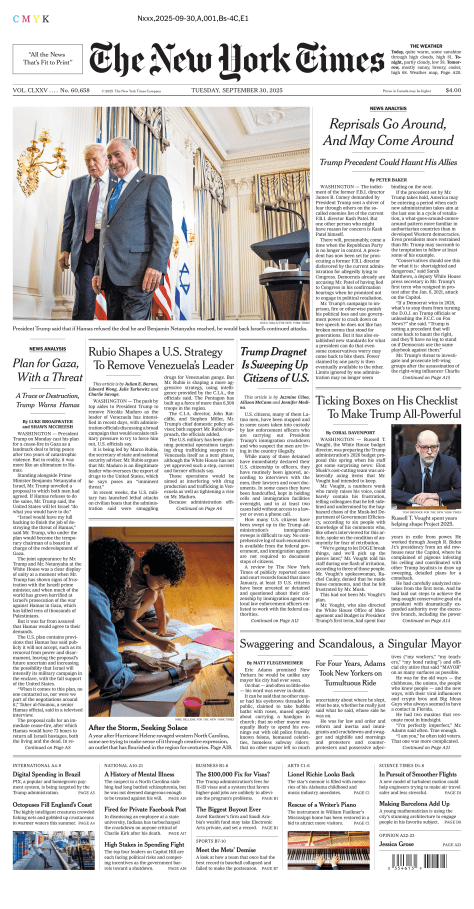
Trump’s New Trade Threats Set Off Global Scramble to Avoid Tariffs

Many countries thought they were negotiating in good faith. President Trump renewed his tariff plan anyway, giving them until Aug. 1 to make offers.

Rescuers Scour Flood Debris in Texas as Hope Fades for Survivors

The chances of finding anyone alive five days after the deluge tore through Central Texas are remote. The death toll climbed to more than 100 people.

See When Federal and Local Officials Issued Warnings About the Texas Floods

Trump and Netanyahu Trade Praise as Gaza Cease-Fire Talks Unfold

President Trump and Prime Minister Benjamin Netanyahu of Israel confronted an array of high-stakes Middle East issues. But first they took a victory lap.

“Why Socialism”: Albert Einstein’s Resplendent Impertinence of Genius

The following essay was written by ChatGPT, and edited by Intellicurean, through the creative filter of Oscar Wilde’s barbed wit and George Bernard Shaw’s moral seriousness, of a review of John Bellamy Foster’s “Albert Einstein’s ‘Why Socialism?’: The Enduring Legacy of His Classic Essay” as it would appear in an esteemed magazine or journal.

In an era where celebrity chatter often drowns out meaningful discourse—ephemeral as the pixels that transmit it—it is both refreshing and necessary to recall that Albert Einstein was not merely a demigod of science, floating above the affairs of humankind. He was a thinker with moral conviction and intellectual courage. John Bellamy Foster’s timely volume, Albert Einstein’s “Why Socialism?”: The Enduring Legacy of His Classic Essay (Monthly Review, July 2025), excavates an overlooked manifesto whose radical clarity remains provocatively undiminished by time.


Unpacking Einstein’s Socialist Vision

More than seventy-five years have passed since Einstein contributed his essay Why Socialism? to the inaugural issue of Monthly Review in May 1949—right in the throes of America’s Red Scare. In that climate of ideological hysteria, even reason itself was suspect. Yet Einstein, with characteristic directness, named capitalism as the source of modern spiritual and economic malaise. “The economic anarchy of capitalist society,” he wrote, “is, in my opinion, the real source of the evil.”

This was no armchair abstraction. It was an act of moral and intellectual defiance in an era of conformity. Rather than tempering his critique to placate the political climate, Einstein diagnosed capitalism as a system that cripples the individual, erodes social cohesion, and mistakes profit for purpose. His socialism, then, was not bureaucratic dogma, but a humane vision: a call for solidarity, responsibility, and human dignity.

Foster’s introduction accomplishes three critical feats. First, it confirms Einstein’s consistent—if unfashionable—commitment to socialist ideals. Second, it situates Why Socialism? within a contemporary moment of deepening ecological and geopolitical crisis, not unlike the postwar anxieties Einstein addressed. Third, and most compellingly, Foster refuses to treat Einstein’s words as nostalgic artifacts. Instead, he reads them as instruments of moral interrogation for the present.


Einstein’s Moral Urgency in a Cynical Age

A powerful moment recounted in Foster’s commentary draws from a recently unearthed interview transcript titled, YES, ALBERT EINSTEIN WAS A SOCIALIST. In it, Einstein recounts a chilling conversation: a friend, contemplating nuclear annihilation, casually asks why Einstein is so concerned about humanity’s extinction. The question is as nihilistic as it is sincere—eerily prefiguring today’s fatalism disguised as realism.

Einstein’s response was telling. He saw this resignation not as philosophical sophistication, but as a symptom of capitalism’s emotional deadening. A world driven by profit, he argued, had alienated people not only from one another but from their very capacity to find joy. “The naive, simple and unsophisticated enjoyment of life,” he mourned, had become a casualty. The resulting solitude, he observed, was not noble introspection but a prison built of egotism and insecurity.

In Why Socialism?, Einstein extends this observation: “Man is, at one and the same time, a solitary being and a social being… As a social being, he seeks to gain the recognition and affection of his fellow human beings… and to improve their conditions of life.” The essay thus offers not just an economic critique, but a portrait of the spiritual crisis induced by capitalism.


A Socialism of Decency, Not Dogma

Einstein did not envision socialism as the rigid apparatus of state control feared by his critics. Instead, he imagined a cultural and moral transformation—one that would replace competition with cooperation, and empty success with meaningful contribution. “In addition to promoting his own innate abilities,” he wrote, “education would attempt to develop in [the individual] a sense of responsibility for his fellow man in place of the glorification of power and success in our present society.”

This human-centered socialism bears more resemblance to George Bernard Shaw’s ethical idealism than to any centralized Leninist command structure. It’s a socialism that asks not only how society is organized, but what kind of people it produces.


Economic Insecurity and the Specter of Waste

Foster’s commentary reaches its most powerful moments when it highlights the relevance of Einstein’s critique in light of today’s contradictions. Technological progress has not delivered leisure or security—it has exacerbated anxiety. “The worker is constantly in fear of losing his job,” Einstein observed. “Technological progress frequently results in more unemployment rather than an easing of the burden of work for all.”

The implications are strikingly modern. The rise of AI, automation, and gig economies has done little to stabilize human life. Meanwhile, the grotesque spectacle of billionaires launching vanity rockets while basic needs go unmet seems to fulfill Einstein’s warning: “Private capital tends to become concentrated in few hands… at the expense of smaller ones.”

Einstein’s insights cut deeper than economics. He warned that unbridled competition produces “a huge waste of labor and… crippling of the social consciousness of individuals.” Foster echoes this, showing how the very mechanisms that promise efficiency often produce alienation and redundancy. In a world where millions remain hungry while supply chains overflow, the diagnosis of “planned chaos” is tragically apt.


The Courage to Imagine a Better World

To Foster’s credit, the book does not shy away from the difficulties of implementing socialism. It acknowledges Einstein’s own candor: that centralized systems can create new forms of domination. “How can the rights of the individual be protected,” he asked, “and therewith a democratic counterweight to the power of bureaucracy be assured?”

Foster does not offer easy answers, nor does he romanticize Einstein’s views. But what he recovers is the philosopher’s refusal to retreat into cynicism. Einstein, like Shaw, understood that history does not advance through comfort or caution. It advances through the courage to propose—and live by—dangerous ideals.

This moral clarity is what makes Why Socialism? enduring. In an era when capitalism insists that no alternatives exist, Einstein reminds us that alternatives are always possible—so long as we preserve the moral imagination to conceive them.


No Middle Ground—And That’s the Point

If one criticism can be leveled at Foster’s approach, it is that he leaves little room for ambiguity. This is no quiet meditation on gradual reform. It is a call to judgment. In a time when readers often seek the past as comfort, Foster compels us to read it as confrontation. The result is not a nostalgic ode to Einstein’s politics but a provocation: What kind of civilization do we want?

Einstein wrote, “I am convinced there is only one way to eliminate these grave evils, namely through the establishment of a socialist economy, accompanied by an educational system which would be oriented towards social goals.” The boldness of that sentence still stings in a society that treats cooperation as utopian and hoarding as genius.

Foster’s restraint is notable throughout—he avoids both hagiography and polemic. He invites the reader to wrestle with Einstein’s ideas, not worship them. The book’s greatest achievement is that it makes us take Einstein seriously—not just as a physicist, but as a moral thinker who challenged the logic of his time and, perhaps, still ours.


Conclusion: A Dangerous Hope

To read Why Socialism? in 2025 is to hear a still-resonant signal from a thinker who refused to let go of the future. Einstein’s socialism was never about bureaucracies—it was about the possibility of decency, of cooperation, of lives lived without fear. And if that vision sounds naive today, then perhaps the problem lies not in the vision, but in the world that has taught us to dismiss it.

As Foster’s book makes clear, the choice remains what it was in 1949: between solidarity and atomization, between a society built on care or one cannibalized by competition. It is, at bottom, a choice between life and extinction.

One imagines Einstein, ever the pragmatist with a poet’s soul, would have approved.

THE NEW YORK TIMES – MONDAY, JULY 7, 2025

Image

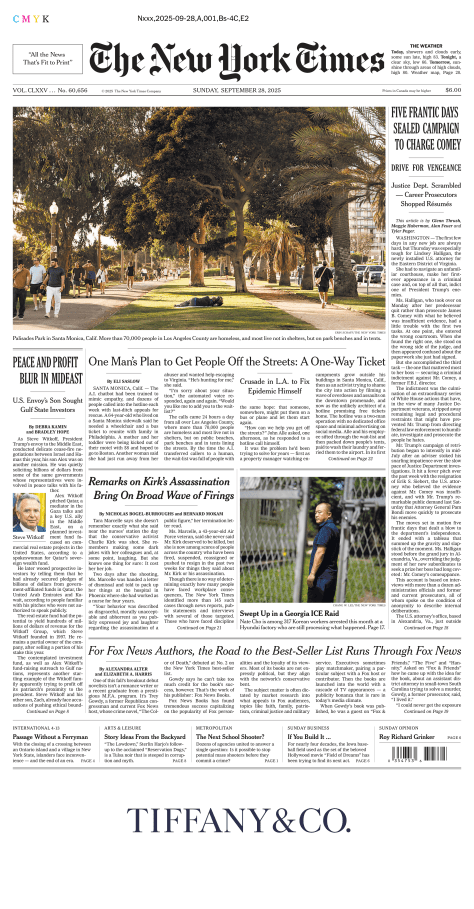
Summer Camp Says 27 Girls and Staff Killed in Texas Floods

Camp Mystic, an all-girls Christian summer camp, confirmed that at least 27 campers and counselors had died, calling it an “unimaginable tragedy.”

What’s at Stake as Benjamin Netanyahu and Trump Meet in Washington

President Trump is considering whether to pursue a new nuclear agreement with Tehran. He is also urging a new cease-fire deal to end the fighting in Gaza.

Israel’s Deadly Assault on Iran Prison Incites Fury, Even Among Dissidents

U.S. Trading Partners Are on Edge as Tariff Deadline Nears

President Trump is set to once again put economic pressure on other nations, as a deadline for making trade deals elapses this week.