

In 1972, Frank Wilczek and his thesis adviser, David Gross, discovered the basic theory of the strong force — the final pillar of the Standard Model of particle physics. Their work revealed the strange alchemy at work inside the nucleus of an atom. It also turned out to underpin almost all subsequent research into the early universe. Wilczek and Gross went on to share the 2004 Nobel Prize in Physics for the work. At the time it was done, Wilczek was just 21 years old. His influence in the decades since has been profound. He predicted the existence of a hypothetical particle called the axion, which today is a leading candidate for dark matter. He published groundbreaking papers on the nature of the early universe. And just last year, his prediction of the “anyon” — a strange type of particle that only shows up in two-dimensional systems — was experimentally confirmed.
Tag Archives: Physicists
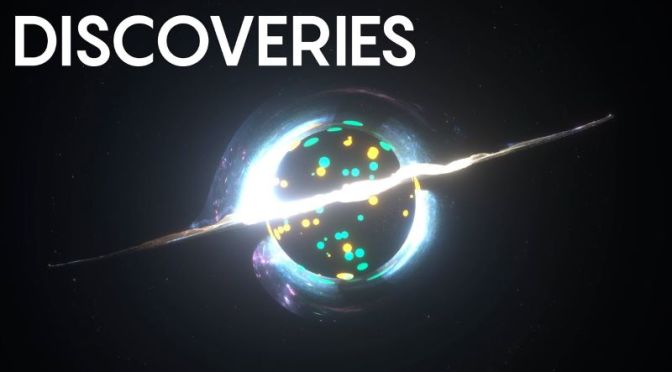
Science: ‘The Biggest Breakthroughs In Physics In 2020’ (Quanta Video)
This year, two teams of physicists made profound progress on ideas that could bring about the next revolution in physics. Another still has identified the source of a long-standing cosmic mystery.
- 1. Here’s an extremely brief version of the black hole information paradox: Stuff falls into a black hole. Over time — a long, long time — the black hole “evaporates.” What happened to the stuff? According to the rules of gravity, it’s gone, its information lost forever. But according to the rules of quantum mechanics, information can never be lost. Therefore, paradox. This year, a series of tour de force calculations has shown that information must somehow escape — even if how it does so remains a mystery.
- 2. Levitating trains, lossless power transmission, perfect energy storage: The promise of room-temperature superconductivity has fed many a utopian dream. A team based at the University of Rochester in New York reported that they had created a material based on a lattice of hydrogen atoms that showed evidence of superconductivity at up to about 15 degrees Celsius (59 degrees Fahrenheit) — about the temperature of a chilly room. The only catch: Superconductivity at this temperature only works if the material is crushed inside a diamond anvil to pressures approaching those of Earth’s core. Utopia will have to wait.
- 3. A dazzling cosmic strobe has ended an enduring astronomical mystery. Fast radio bursts — blips of distant radio waves that last for mere milliseconds — have eluded explanation since they were first discovered in 2007. Or rather, astronomers had come up with far too many theories to explain what are, for the brief time they’re alight, the most powerful radio sources in the universe. But on a quiet morning in April, a burst “lit up our telescope like a Christmas tree,” said one astronomer. This allowed researchers to trace its source back to a part of the sky where an object had been shooting out X-rays. Astronomers concluded that a highly magnetized neutron star called a magnetar was behind the phenomenon.

Interviews: 71-Year Old Nobel Prize Physicist Steven Chu Q&A On Sustainability (Video)
Watch a Q&A with Steven Chu, who’s devoted a large part of his scientific career to searching for solutions to our climate challenges.
- 0.06 – What does sustainability mean to you?
- 0.34 – What are the present challenges in sustainability?
- 1.50 – How can we help every person see the importance of being sustainable?
- 3.24 – What can I do to be more sustainable in my everyday life?
- 5.22 – What’s the most sustainable form of energy in your opinion?
- 6.44 – How do you try to do research in the lab in a sustainable way?
- 8.34 – Where do you see our world’s climate status in 50 years?
- 10.19 – Do you feel hope in humanity when it comes to tackling climate change?
Steven Chu born February 28, 1948) is an American physicist and a former government official. He is known for his research at the University of California at Berkeley and his research at Bell Labs and Stanford University regarding the cooling and trapping of atoms with laser light, for which he won the Nobel Prize in Physics in 1997, along with his scientific colleagues Claude Cohen-Tannoudji and William Daniel Phillips.
Chu served as the 12th United States Secretary of Energy from 2009 to 2013. At the time of his appointment as Energy Secretary, Chu was a professor of physics and molecular and cellular biology at the University of California, Berkeley, and the director of the Lawrence Berkeley National Laboratory, where his research was concerned primarily with the study of biological systems at the single molecule level. Chu resigned as energy secretary on April 22, 2013. He returned to Stanford as Professor of Physics and Professor of Molecular & Cellular Physiology.
Chu is a vocal advocate for more research into renewable energy and nuclear power, arguing that a shift away from fossil fuels is essential to combating climate change. He has conceived of a global “glucose economy”, a form of a low-carbon economy, in which glucose from tropical plants is shipped around like oil is today. On February 22, 2019, Chu began a one-year term as president of the American Association for the Advancement of Science.
Bio from Wikipedia
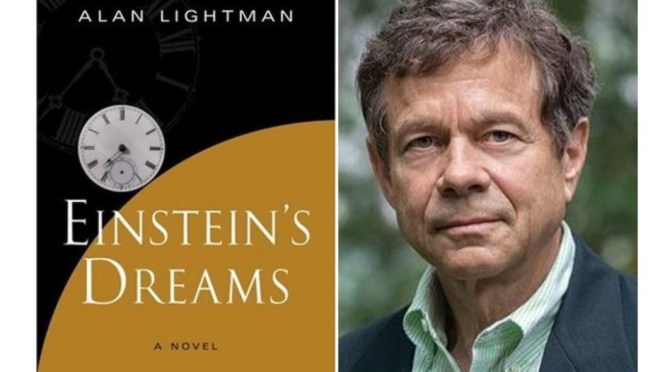
Profiles: 71-Year Old Physicist And Author Alan Lightman’s “Creative Life”
From a New York Times online article (February 13, 2020):
“I love physics, but what was even more important to me was leading a creative life,” Dr. Lightman said. “And I knew that writers could continue doing their best work later in life.”
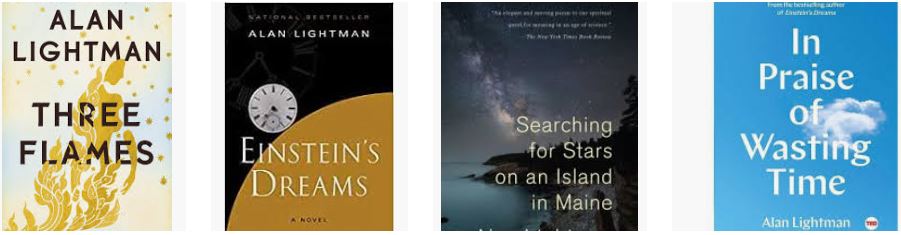
Lightman is best known in literary circles for his 1992 novel, “Einstein’s Dreams,” which is all about the vicissitudes – romantic, physical and otherwise – of time. It recounts the nightly visions of a young patent clerk in Bern, Switzerland, as he struggles to finish his theory of relativity.
But before that, Dr. Lightman was an astrophysicist, a card-carrying wizard of space and time, with a Ph.D. from the California Institute of Technology and subsequent posts at Cornell and Harvard In 1989, at the peak of his prowess as a physicist, he began to walk away from the world of black holes to enter the world of black ink and the uncertain, lonely life of the writer.
Recently he was in New York for the opening of “Einstein’s Dreams,” an off-Broadway play based on his book. There have been dozens of such stage adaptations over the last 30 years.

Video Profiles: 66-Year Old Author & Director Jan Eliasberg (“Hannah’s War”)
 A “mesmerizing” re-imagination of the final months of World War II (Kate Quinn, author of The Alice Network), Hannah’s War is an unforgettable love story about an exceptional woman and the dangerous power of her greatest discovery.
.
Berlin, 1938. Groundbreaking physicist Dr. Hannah Weiss is on the verge of the greatest discovery of the 20th century: splitting the atom. She understands that the energy released by her discovery can power entire cities or destroy them. Hannah believes the weapon’s creation will secure an end to future wars, but as a Jewish woman living under the harsh rule of the Third Reich, her research is belittled, overlooked, and eventually stolen by her German colleagues. Faced with an impossible choice, Hannah must decide what she is willing to sacrifice in pursuit of science’s greatest achievement.
New Mexico, 1945. Returning wounded and battered from the liberation of Paris, Major Jack Delaney arrives in the New Mexican desert with a mission: to catch a spy. Someone in the top-secret nuclear lab at Los Alamos has been leaking encoded equations to Hitler’s scientists. Chief among Jack’s suspects is the brilliant and mysterious Hannah Weiss, an exiled physicist lending her talent to J. Robert Oppenheimer’s mission. All signs point to Hannah as the traitor, but over three days of interrogation that separate her lies from the truth, Jack will realize they have more in common than either one bargained for.
Hannah’s War is a thrilling wartime story of loyalty, truth, and the unforeseeable fallout of a single choice.
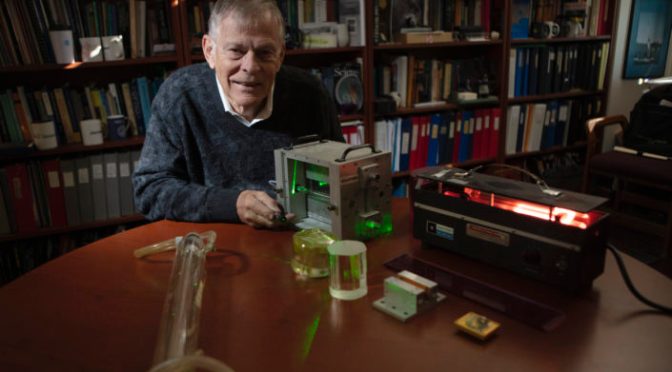
Profiles: Stanford Physicist Robert Byer, 77, Helped Develop “Most Stable Laser In The World”
From a Stanford University News article:
 Byer also helped develop the quietest, most stable laser in the world, called the diode-pumped YAG laser. YAG lasers are today found in everything from communications satellites to green handheld laser pointers, which Byer co-developed with two of his graduate students and cites as one of his favorite inventions (he had joined Stanford in 1969). YAG lasers also form the main beams of the gravitational wave-detecting instrument, LIGO, which in 2015 achieved the most precise measurement ever made by humans when its antenna detected the tenuous spacetime fluctuations generated by two colliding black holes 1.3 billion light-years away.
Robert Byer was 22 years old when he first saw the light that changed his life.
 One summer morning in 1964, Byer drove the hour from Berkeley down to Mountain View for a job interview at a California company called Spectra Physics. He walked in to find an empty lobby but could hear clapping and cheering in the back of the building. After politely waiting for several minutes, he followed the commotion to a darkened room filled with men whose jubilant faces were illuminated by a rod of red-orange light that seemed to float above an instrument-strewn table
To read more: https://news.stanford.edu/2019/11/19/life-changing-first-glimpse-laser/
 Boomers Daily