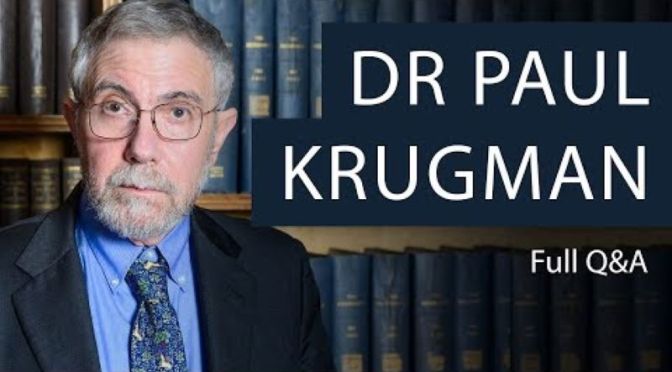
Dr. Paul Krugman is a Nobel Prize-Winning economist, and a regular commentator for the New York Times. Though academically recognised for his contributions to international trade theory, he writes about a wide range of economic issues, and is well known for making economic theory accessible to non-academics through his columns and numerous popular books. A liberal, Dr. Krugman is a fierce opponent of the modern Republican party, though he previously served as an economic advisor in Reagan’s White House.
ABOUT THE OXFORD UNION SOCIETY: The Oxford Union is the world’s most prestigious debating society, with an unparalleled reputation for bringing international guests and speakers to Oxford. Since 1823, the Union has been promoting debate and discussion not just in Oxford University, but across the globe.
Bloomberg Opinion columnist Barry Ritholtz interviews economist, bestselling author and New York Times columnist Paul Krugman, whose most recent book is “Arguing With Zombies: Economics, Politics, and the Fight for a Better Future.”
Paul Robin Krugman (born February 28, 1953) is an American economist who is the Distinguished Professor of Economics at the Graduate Center of the City University of New York, and a columnist for The New York Times. In 2008, Krugman was awarded the Nobel Memorial Prize in Economic Sciences for his contributions to New Trade Theory and New Economic Geography. The Prize Committee cited Krugman’s work explaining the patterns of international trade and the geographic distribution of economic activity, by examining the effects of economies of scale and of consumer preferences for diverse goods and services.
Krugman was previously a professor of economics at MIT, and later at Princeton University. He retired from Princeton in June 2015, and holds the title of professor emeritus there. He also holds the title of Centenary Professor at the London School of Economics. Krugman was President of the Eastern Economic Association in 2010, and is among the most influential economists in the world. He is known in academia for his work on international economics (including trade theory and international finance),economic geography, liquidity traps, and currency crises.
Krugman is the author or editor of 27 books, including scholarly works, textbooks, and books for a more general audience, and has published over 200 scholarly articles in professional journals and edited volumes. He has also written several hundred columns on economic and political issues for The New York Times, Fortune and Slate. A 2011 survey of economics professors named him their favorite living economist under the age of 60.[13] As a commentator, Krugman has written on a wide range of economic issues including income distribution, taxation, macroeconomics, and international economics. Krugman considers himself a modern liberal, referring to his books, his blog on The New York Times, and his 2007 book The Conscience of a Liberal. His popular commentary has attracted widespread attention and comments, both positive and negative. According to the Open Syllabus Project, Krugman is the second most frequently cited author on college syllabi for economics courses.

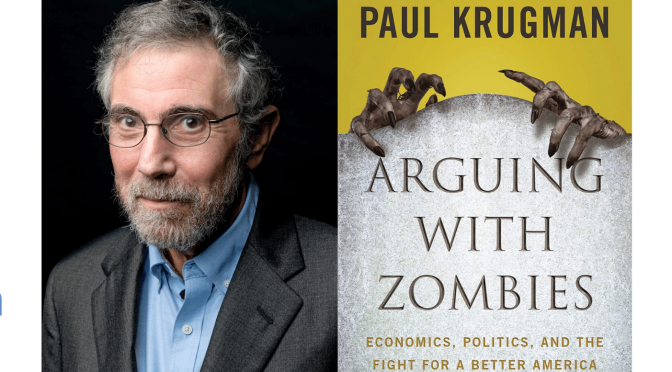
 Bloomberg Opinion columnist Barry Ritholtz interviews economist, bestselling author and New York Times columnist Paul Krugman, whose most recent book is “Arguing With Zombies: Economics, Politics, and the Fight for a Better Future.”
  Paul Robin Krugman (born February 28, 1953) is an American economist who is the Distinguished Professor of Economics at the Graduate Center of the City University of New York, and a columnist for The New York Times. In 2008, Krugman was awarded the Nobel Memorial Prize in Economic Sciences for his contributions to New Trade Theory and New Economic Geography. The Prize Committee cited Krugman’s work explaining the patterns of international trade and the geographic distribution of economic activity, by examining the effects of economies of scale and of consumer preferences for diverse goods and services.
 Boomers Daily