
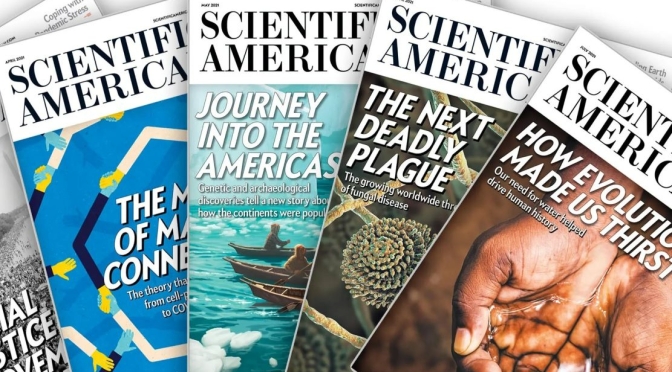
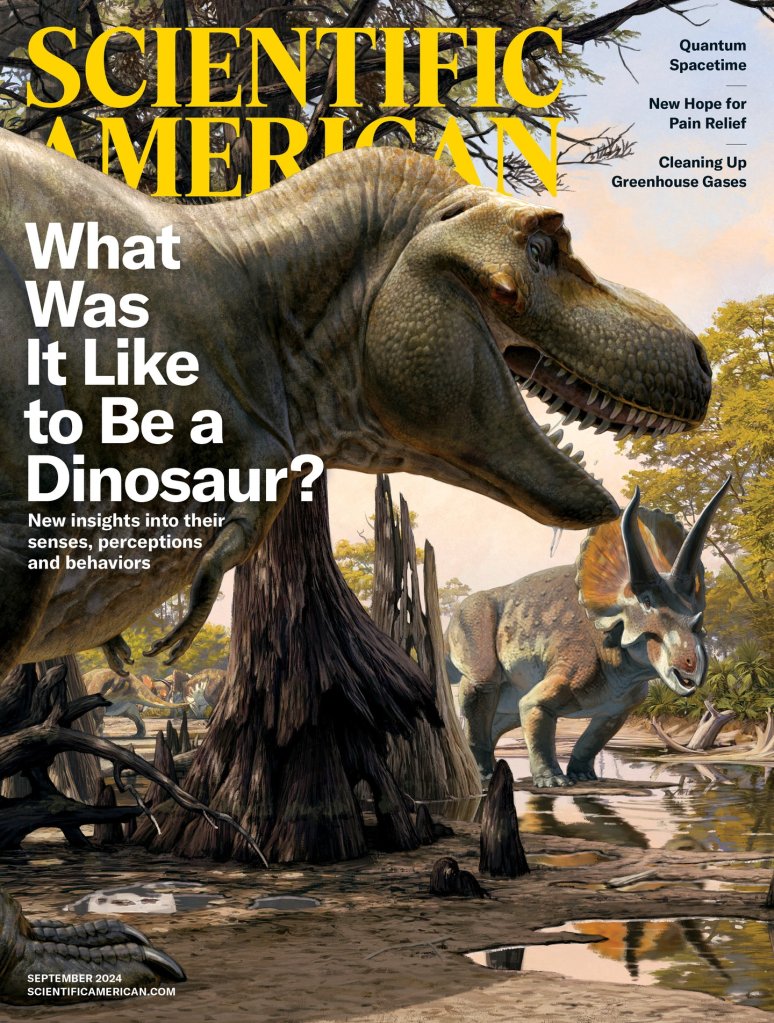

Scientific American (August 21, 2024): The September 2024 issue features ‘What Was It Like To Be A Dinosaur? – New insights into their senses, perceptions and behaviors…
What Was It Like to Be a Dinosaur?
New fossils and analytical tools provide unprecedented insights into dinosaur sensory perception by Amy M. Balanoff, Daniel T. Ksepka
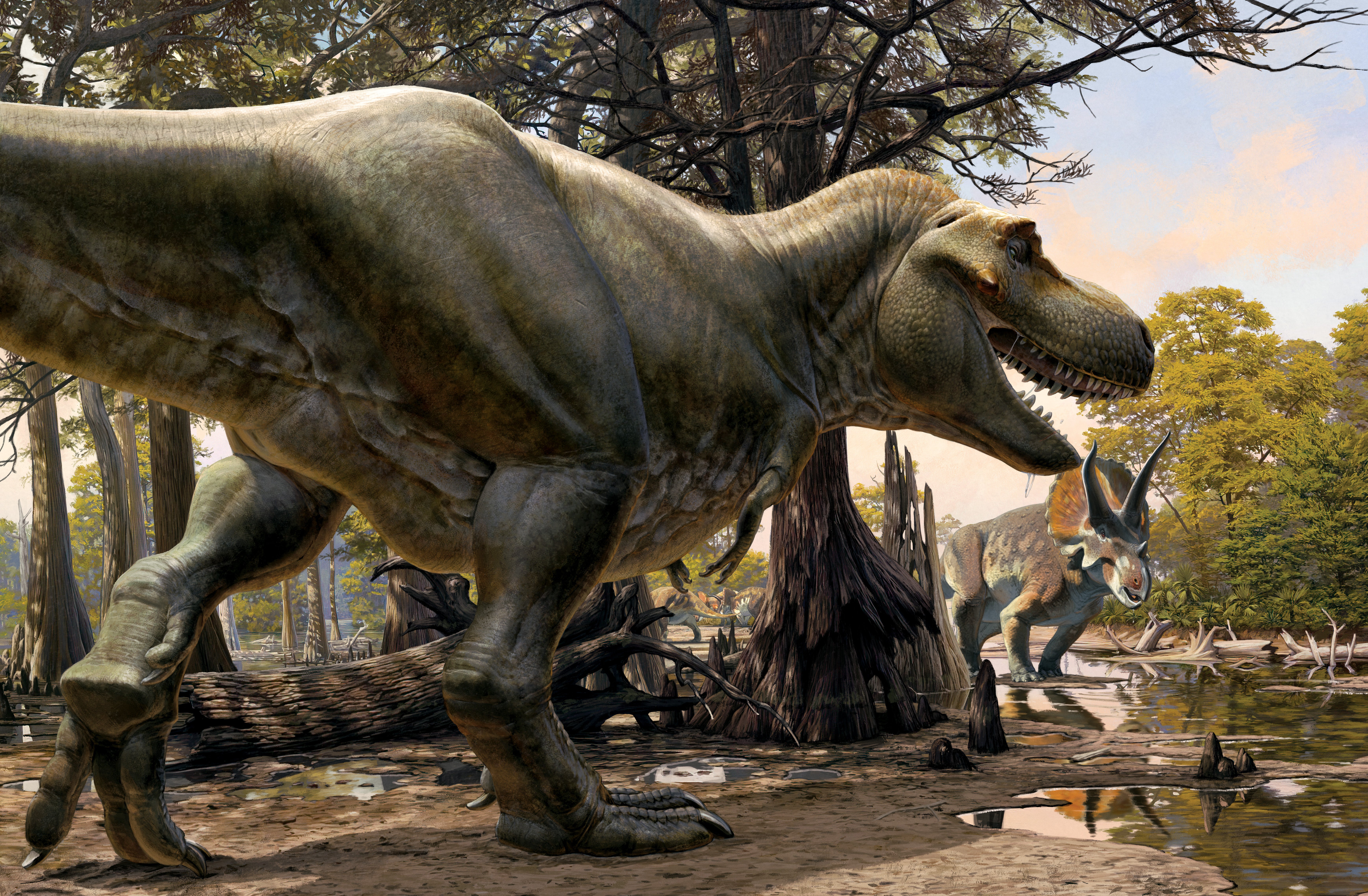
Alone Tyrannosaurus rexsniffs the humid Cretaceous air, scenting a herd of Triceratops grazing beyond the tree line. As the predator scans the floodplain, its vision suddenly snaps into focus. A single Triceratops has broken off from the herd and wandered within striking distance. Standing motionless, the T. rex formulates a plan of attack, anticipating the precise angle at which it must intersect its target before the Triceratops can regain the safety of the herd. The afternoon silence is shattered as the predator crashes though the low branches at the edge of the forest in hot pursuit.
T. rex has hunted Triceratops in so many books, games and movies that the encounter has become a cliché. But did a scene like this one ever unfold in real life? Would T. rex identify its prey by vision or by smell? Would the Triceratops be warned by a loudly cracking branch or remain oblivious because it was unable to locate the source of the sound? Could T. rex plan its attack like a cat, or would it lash out indiscriminately like a shark?
What If We Never Find Dark Matter?

Dark matter has turned out to be more elusive than physicists had hoped by Tracy R. Slatyer, Tim M. P. Tait
Can Pulling Carbon from Thin Air Slow Climate Change?
The End of the Lab Rat?
New Painkiller Could Bring Relief to Millions—Without Addiction Risk
Can Space and Time Exist as Two Shapes at Once? Mind-Bending Experiments Aim to Find Out
Nick Huggett, Carlo Rovelli

 replicating a
  Boomers Daily