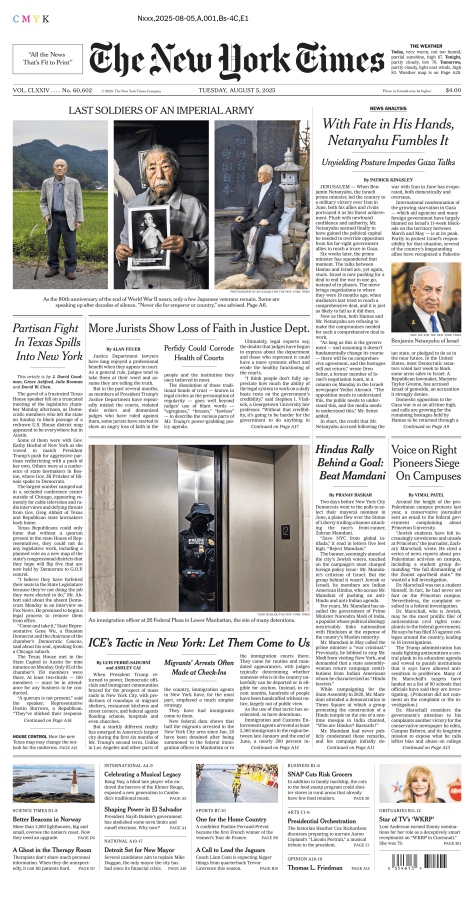
Kerr County repeatedly failed to secure a warning system, even as local officials remained aware of the risks and as funds were available for similar projects.
Blunt letters dictating terms posted to social media and changes late in negotiations have left trading partners wondering what President Trump will do next.
An analysis of Camp Mystic shows that several buildings were in known hazard zones. A $5 million expansion in 2019 did nothing to alleviate the problem.
Flash floods hit during the night, but many local officials appeared unaware of the unfolding catastrophe, initially leaving people near the river on their own.
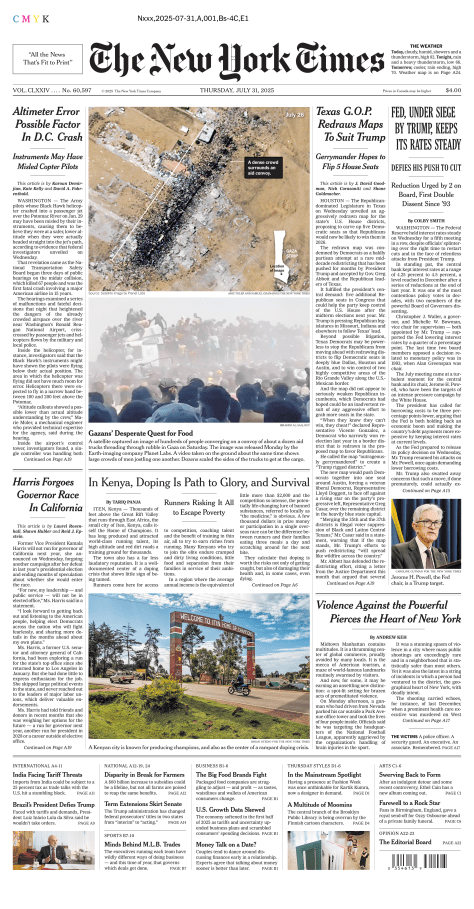
China Surveys Seabeds Where Naval Rivals May One Day Clash
Research ships are studying the seas for science and resources, but the data they gather could also be useful in a conflict with Taiwan or the U.S.
U.K. and France Agree to First-Ever Nuclear Weapons Pact to Fend Off Threat to Europe
Prime Minister Keir Starmer of Britain and President Emmanuel Macron of France are set to confirm a strengthened defense relationship at a summit today.
Officials said the search for remains would continue until all victims were accounted for. In the hardest-hit county, no survivors have been found since Friday.
A court-ordered pause in May had covered nearly two dozen federal agencies at different stages of executing President Trump’s directive for mass layoffs.
President Trump and Prime Minister Benjamin Netanyahu of Israel confronted an array of high-stakes Middle East issues. But first they took a victory lap.
President Trump is considering whether to pursue a new nuclear agreement with Tehran. He is also urging a new cease-fire deal to end the fighting in Gaza.
THE FOLLOWING IS AN “AI REVIEW” OF THE JULY 3 EPISODE OF “BLOOMBERG LAW WITH JUNE GRASSO” PODCAST TRANSCRIPT:
In the dimly lit chambers of American justice, two parallel stories unfolded this term—one involving the cultural phenomenon of Sean “Diddy” Combs, the other the ideological recalibration of the United States Supreme Court. Each, in its own way, exposed the tensions inherent in a legal system grappling with the competing imperatives of moral condemnation, procedural fairness, and the inexorable gravitational pull of politics.
In federal court, Combs emerged, if not unscathed, then improbably triumphant. After six weeks of graphic testimony and the steady drip of lurid detail, jurors acquitted him of the most sensational accusations: racketeering conspiracy and sex trafficking, crimes that, had they stuck, would almost certainly have resulted in a life sentence. Instead, he was convicted only on two counts of transporting sex workers across state lines to participate in what prosecutors termed “freak-off parties.” In the pantheon of celebrity trials, this outcome was remarkable not merely for the verdict itself but for the rhetorical overreach that defined the government’s case.
Robert Mintz, a former federal prosecutor turned defense attorney, spoke to the case’s cautionary lesson about prosecutorial ambition. RICO—the Racketeer Influenced and Corrupt Organizations Act—was never an intuitive fit for Combs, a music mogul whose business dealings, however flamboyant, bore little resemblance to the mafia syndicates the statute was designed to dismantle. In the final analysis, jurors appeared unconvinced that the machinery of Combs’s empire—record labels, promotional companies, an entourage that blurred the line between personal and professional—was itself the instrument of a criminal conspiracy. They were similarly unconvinced that the two women at the heart of the government’s sex trafficking charges had been coerced rather than entangled in a toxic, if mutually complicit, set of relationships.
Perhaps more striking still was the defense’s strategy: they called no witnesses. Rather than counter the government’s narrative with competing testimony, Combs’s lawyers focused their energy on cross-examination, unspooling the contradictions and ambivalences embedded in the prosecution’s evidence. Here, too, lay a broader truth about modern criminal justice. The power to define the contours of the case—the charges themselves—can be as determinative as the evidence marshaled to prove them. When the government chooses to depict a defendant as the capo di tutti capi of an illicit empire, it must persuade a jury not only of wrongdoing but of a sweeping criminality that often strains credulity. When that narrative collapses, as it did here, the defense is left with the simpler task of pointing out the seams.
But Combs’s legal jeopardy is not yet at an end. Though acquitted of the most serious charges, he faces up to twenty years in prison on the counts that remain, even if the federal sentencing guidelines suggest a considerably lower range. The presiding judge, troubled by videotaped evidence of Combs assaulting one of the alleged victims, declined to release him pending sentencing—a reminder that in federal court, the most powerful voice is not the jury’s but the judge’s. It is not inconceivable that the final chapter of this saga will be harsher than the defense’s celebration suggested.
If Combs’s courtroom drama offered a microcosm of prosecutorial overreach, the Supreme Court’s term showcased a more profound shift: a conservative supermajority willing to reconfigure the balance of power between the judiciary and the executive—and, by extension, between individuals and the state. In conversation with constitutional law scholar Michael Dorf, host June Grasso illuminated the breadth of these changes. Over the past year, the Court issued a series of rulings that, taken together, represent a quiet revolution in the way the federal courts interact with presidential authority.
At the heart of this transformation was the Court’s decision to curtail nationwide injunctions—sweeping orders issued by district judges to block federal policies across the entire country. For decades, these injunctions served as a vital mechanism by which civil rights plaintiffs, immigrant communities, and other marginalized groups could halt executive overreach before it inflicted irreparable harm. Their disappearance is no mere procedural adjustment; it recasts the balance between the judiciary’s protective function and the executive’s prerogative to govern unencumbered.
This doctrinal shift accrued almost exclusively to the benefit of President Trump, whose administration had faced a phalanx of legal challenges. Whether the issue was the forced deportation of migrants, the exclusion of transgender Americans from military service, or the elimination of birthright citizenship, the Supreme Court’s majority showed an evident willingness to side with the executive branch on an emergency basis—often with scant explanation. Dorf described this posture as striking not merely for its partisanship but for its inconsistency: lower courts that blocked Trump policies were overruled with alacrity, even as those same justices castigated nationwide injunctions as judicial overreach.
At the same time, the term’s most divisive rulings revealed a Court emboldened to advance a culturally conservative agenda. In a 6-3 decision, the justices upheld Tennessee’s ban on gender-affirming care for minors, dismissing the equal protection claims of transgender plaintiffs and casting doubt on whether such discrimination should trigger heightened constitutional scrutiny. In another ruling, religious parents were granted the right to withdraw their children from public school curricula that included LGBTQ-themed storybooks—a decision that critics warn will invite broader challenges to any teaching that conflicts with sectarian belief. In the aggregate, these rulings did more than roll back hard-won protections for LGBTQ Americans. They signaled a willingness to prioritize religious objections over the rights of vulnerable communities, an alignment that recurred throughout the term.
For Dorf, the most unsettling dimension was not the conservative tilt per se but the Court’s apparent comfort with what he called a “soft authoritarian” style of governance. The Roberts Court had already repealed the constitutional right to abortion and limited the federal government’s capacity to regulate firearms. What distinguished this term was its readiness to facilitate the Trump administration’s disregard for judicial orders—an erosion not of precedent but of the rule of law itself.
Whether these developments portend a lasting reorientation of American jurisprudence remains to be seen. What is clear, however, is that the ideological polarization of the Supreme Court is reshaping the lives of countless citizens in ways that transcend conventional partisanship. In this respect, the travails of Sean Combs and the ambitions of the Roberts Court are, improbably, two facets of the same American story: one in which the legal system’s power to punish and to protect is increasingly mediated by political will—and by the narratives that prevail when the evidence, the law, and the culture clash in the crucible of the courtroom.
Segment 1: The Verdict in Sean “Diddy” Combs’ Case
Guests:
Robert Mintz, former federal prosecutor, partner at McCarter & English
Topics:
Combs’ acquittal on the most serious charges (racketeering, conspiracy, sex trafficking)
Conviction on two lesser felonies (transportation to engage in prostitution)
Defense’s strategy to challenge overcharging
Impact of the 2016 video showing domestic violence
Potential sentencing: between ~2–5 years under guidelines, but judge has broad discretion
Judge’s refusal to release Combs pending sentencing due to danger concerns
Broader implications of prosecutorial overreach and the difficulties of proving coercion in complex, long-term relationships
Segment 2: The Supreme Court Term Review
Guest:
Michael Dorf, constitutional law professor, Cornell Law School
Topics:
The Supreme Court siding repeatedly with the Trump administration
Disbanding nationwide injunctions (limiting checks on executive power)
Facilitating major policy shifts (transgender military ban, deportations, birthright citizenship challenges)
LGBTQ rights decisions:
Upholding Tennessee’s ban on gender-affirming care for minors
Requiring schools to exempt religious families from LGBTQ-inclusive curricula
Concerns about the erosion of protections under equal protection doctrine
Forthcoming cases on transgender sports participation and conversion therapy bans
Second Amendment developments:
Court upholding ghost gun regulations
Declining to broadly immunize gun manufacturers
Signaling possible caution but not reversal of the pro-gun rights direction
Emergency docket criticism:
Pattern of granting Trump administration emergency relief with limited justification
Disregard for procedural norms
Overarching movement:
From traditional conservatism into enabling a more authoritarian style of governance
Summary
This episode of Bloomberg Law, hosted by June Grasso, offered an in-depth analysis of two major legal stories:
1. The Sean “Diddy” Combs Case After a six-week federal trial with emotionally charged testimony, Combs was acquitted of racketeering and sex trafficking but convicted of transporting sex workers across state lines—a felony under the Mann Act. Prosecutors’ strategy to use RICO laws typically reserved for mob cases ultimately backfired, allowing the defense to argue overreach. While the jury found Combs’ conduct disturbing, they did not believe it rose to organized criminal enterprise. Despite securing partial convictions, the prosecution faces criticism for overcharging, which opened avenues for defense cross-examination and ultimately undermined their case. Combs remains in custody as he awaits sentencing, which could be significantly harsher than defense estimates due to the judge’s concerns about continued danger.
2. The Supreme Court’s Term Professor Michael Dorf described a term marked by sweeping decisions that advanced a conservative agenda, often benefiting the Trump administration. The Court stripped lower courts of their ability to issue nationwide injunctions, effectively removing a key check on executive overreach. In LGBTQ cases, the Court upheld bans on gender-affirming care for minors, sided with religious parents seeking exemptions from inclusive curricula, and signaled openness to further limits on trans rights in upcoming cases. While the Court maintained some gun regulations, its overall jurisprudence continues a rightward trajectory, blending traditional conservative principles with deference to Trump’s more aggressive policies. Emergency docket decisions frequently favored the administration without full briefing, raising concerns about procedural fairness and erosion of judicial norms. Ultimately, the Court’s direction was characterized as not just conservative, but increasingly aligned with authoritarian tendencies.
THIS POSTING WAS WRITTEN BY AI AND EDITED BY INTELLICUREAN
The nation is more secure from threats than ever. But the war in Gaza, and attacks on Iran and Lebanon, have undercut its standing among the world’s democracies.
It was not immediately clear whether the group was demanding any significant changes to the plan for a 60-day truce and talks on a permanent end to the war.
President Trump spent days cajoling Republicans to support his bill. Now he will have to convince a skeptical public as Democrats focus on how it helps the wealthy.
In The New Yorker essay “Donald Trump, Zohran Mamdani, and Posting as Politics,” Kyle Chayka explores how social media has become not merely a communication tool for political figures but the primary arena in which politics itself now unfolds. The piece contrasts the digital personas of Donald Trump and Zohran Mamdani to illustrate how posting has evolved into a core exercise of power and a new form of political identity.
Chayka begins by chronicling former President Trump’s frenetic use of Truth Social, the platform he created after leaving Twitter. Trump does not merely announce decisions online; he appears to make them there. For instance, in June 2025, Trump unilaterally declared and publicized a ceasefire between Israel and Iran on Truth Social after having ordered strikes on Iranian nuclear facilities only days earlier. He issued warnings and taunts in the same all-caps style he once used to brag about the size of his nuclear arsenal compared to Kim Jong Un’s. The essay argues that this real-time posting has compressed world-shaking events into casual, ephemeral updates, trivializing violence and policy into the equivalent of viral content.
Yet Trump is not alone in harnessing the power of constant broadcasting. Chayka turns to Zohran Mamdani, a 33-year-old New York State assembly member and Democratic nominee for New York City mayor, who embodies a different approach to digital politics. Where Trump’s style is bombastic and combative, Mamdani’s presence on TikTok and Instagram is more polished and warm. His short-form videos—some produced by the creative agency Melted Solids—blend documentary realism with the aesthetics of viral influencer content. Clips of Mamdani walking through Manhattan or spontaneously greeting his filmmaker mother, Mira Nair, have garnered millions of views. His collaborations with high-profile digital creators like the Kid Mero and Emily Ratajkowski reflect an understanding that modern campaigns are not only about policy but about generating a steady stream of engaging material.
Chayka underscores that both politicians are symptoms of the same phenomenon: social media has swallowed the traditional infrastructure of political communication. No longer is there a clear boundary between a politician’s private musings and official pronouncements. The medium has become the message—and often the entire substance. Even memes have turned into flash points of political conflict. The article recounts how U.S. border officials detained a Norwegian tourist, Mads Mikkelsen, who carried a satirical meme of Vice President J.D. Vance on his phone, suggesting that political images have acquired the power to implicate their holders in ideological battles.
This transformation, Chayka argues, has significant consequences. Trump’s unfiltered posts, once viewed as a sideshow, have become a primary instrument of governance, with the potential to inflame conflicts or disrupt alliances. Meanwhile, Mamdani’s refined authenticity—crafted through video diaries and collaborations—illustrates how even progressive candidates must adopt the same always-online posture to cultivate a political following. While Mamdani’s style is less aggressive than Trump’s, it similarly depends on projecting a version of authenticity that is inseparable from performance.
The essay closes by reflecting on the future of American politics in this environment. The Democratic Party has struggled to counter Trump’s cultural dominance, as shown by tone-deaf spectacles like a Pride concert at the Kennedy Center with anti-Trump parodies of Les Misérables. In contrast, Mamdani’s campaign has generated genuine enthusiasm. Yet Chayka raises an open question: can the idealistic energy of this new digital-first politics survive the compromises of actual governance? If online performance has become the main credential for leadership, it is unclear whether any politician—no matter their ideology—can avoid the pressures of perpetual self-promotion.
In the end, Chayka’s essay offers a clear warning: social media has transformed politics into a theater of the immediate, where every post carries the weight of policy and every meme can become an instrument of power. Whether this dynamic can be reconciled with the demands of responsible government remains the central challenge of the digital age.
Strengths of the Essay
Compelling Illustrations of Digital-First Governance
The article effectively juxtaposes Trump’s all-caps proclamations with Mamdani’s handheld videos.
Vivid examples: Trump’s posts about Iranian bombings feel almost satirical in their triviality—like “food grams”—yet they are deadly serious.
The Vance meme incident (Norwegian tourist Mikkelsen denied entry partly over a meme) underscores how digital artifacts can become politically consequential.
Clear Argument
Chayka convincingly demonstrates that posting is no longer merely a marketing tactic—it is a form of exercising power.
The phrase “influencer-in-chief” encapsulates this new paradigm succinctly.
Timeliness and Relevance
The piece captures the unsettling normalcy of this phenomenon—how we now expect statecraft to be conducted via apps.
It connects to broader anxieties about the erosion of institutional boundaries between governance and entertainment.
Balanced Comparison
The contrast between Trump’s aggression and Mamdani’s optimism avoids simple equivalence.
The essay suggests that while style differs, both are beholden to the same dynamics: immediacy, spectacle, and performative authenticity.
Areas For Further Exploration
A Critique of Consequences
While Chayka notes the trivialization of serious decisions (e.g., bombings posted like selfies), he stops short of examining the systemic dangers—the erosion of deliberative processes, the collapse of public trust, and the incentivizing of extremism.
A deeper dive into why social media rewards such maximalist performances—and how this affects democracy—would have been valuable.
An Exploration of Audience Complicity
The essay portrays politicians as the main actors, but it could interrogate how audiences co-produce this environment: what are the incentives to consume, share, and reward this content?
Do voters really want “authenticity,” or simply entertainment masquerading as politics?
Further developed Historical Context
While the piece references Trump’s first term, it could have drawn richer parallels with earlier media transformations:
Roosevelt’s radio “Fireside Chats”
Kennedy’s TV charisma
Obama’s early social media campaigns
This would help readers situate today’s moment within a longer trajectory.
Broader Implications
The essay ultimately raises unsettling questions:
If the performance of authenticity is now the primary qualification for political power, how do policy substance and institutional competence survive?
Is there any way for governance to reassert seriousness, or will the logic of virality always prevail?
What happens when online theater collides with offline consequences—wars, economies, civic life?
These questions feel especially urgent given that the piece suggests this dynamic is not limited to Trump’s right-wing populism but has also infiltrated progressive candidates.
*THIS ESSAY WAS WRITTEN BY CHAT GPT AND EDITED BY INTELLICUREAN.
News, Views and Reviews For The Intellectually Curious