Tag Archives: Marine Wildlife

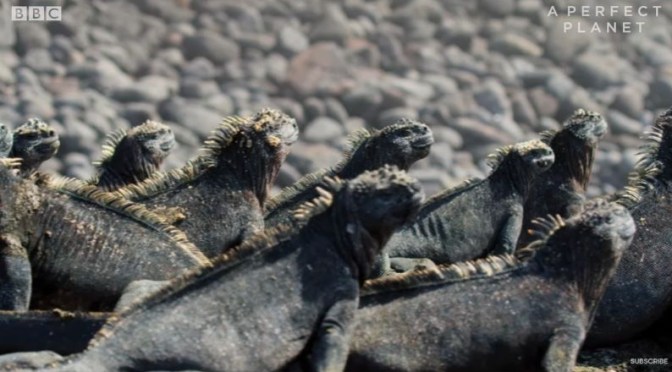
Ocean Wildlife: ‘Marine Iquanas’ Of The Galápagos Islands (BBC Earth Video)

This sea-diving lizard only has 30 minutes to search for food before his muscles seize up.

The marine iguana, also known as the sea iguana, saltwater iguana, or Galápagos marine iguana, is a species of iguana found only on the Galápagos Islands. Unique among modern lizards, it is a marine reptile that has the ability to forage in the sea for algae, which makes up almost all of its diet. 

The Galápagos Islands is a volcanic archipelago in the Pacific Ocean. It’s considered one of the world’s foremost destinations for wildlife-viewing. A province of Ecuador, it lies about 1,000km off its coast. Its isolated terrain shelters a diversity of plant and animal species, many found nowhere else. Charles Darwin visited in 1835, and his observation of Galápagos’ species later inspired his theory of evolution.
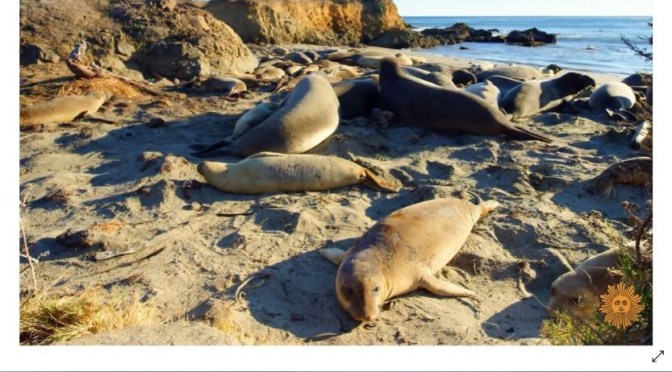
Marine Wildlife: ‘Elephant Seals’ On Beaches In San Simeon, California (Video)

“Sunday Morning” takes us to the beach at San Simeon, Calif., a home for elephant seals. Videographer: Lance Milbrand.

The northern elephant seal (Mirounga angustirostris) is one of two species of elephant seal (the other is the southern elephant seal). It is a member of the family Phocidae (true seals). Elephant seals derive their name from their great size and from the male’s large proboscis, which is used in making extraordinarily loud roaring noises, especially during the mating competition. Sexual dimorphism in size is great. Correspondingly, the mating system is highly polygynous; a successful male is able to impregnate up to 50 females in one season.

San Simeon is a town and census-designated place on the Pacific coast of San Luis Obispo County, California, United States. Its position along State Route 1 is about halfway between Los Angeles and San Francisco, each of those cities being roughly 230 miles away.

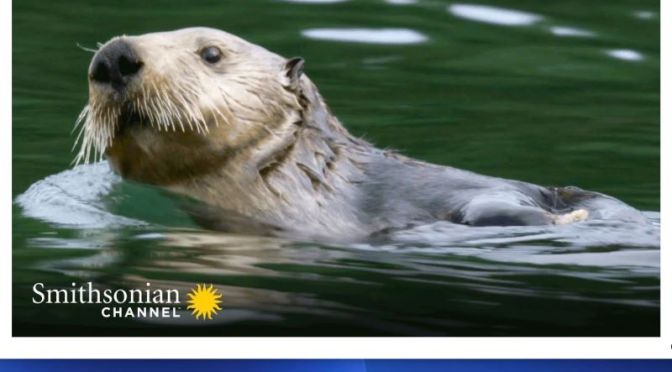
Marine Wildlife: ‘Sea Otter Moms’ Doing Everything For Their Pups (Video)

Northern sea otter pups are raised exclusively by their moms–the fathers play no part. As a result, it falls on mothers to do it all: hunting, feeding, keeping the pups warm and protecting them from predators.

The northern sea otter subspecies (E. lutris kenyoni), is found in the Aleutian Islands, Southern Alaska, British Columbia, and Washington. Within Alaska, there are 3 stocks. The Southeast stock can be found in the coastal waters of Southeast Alaska.  The South central population spans from west of Glacier Bay to the eastern edge of Cook Inlet. The Southwest population stretches from the western edge of Cook Inlet out the Aleutian Islands.