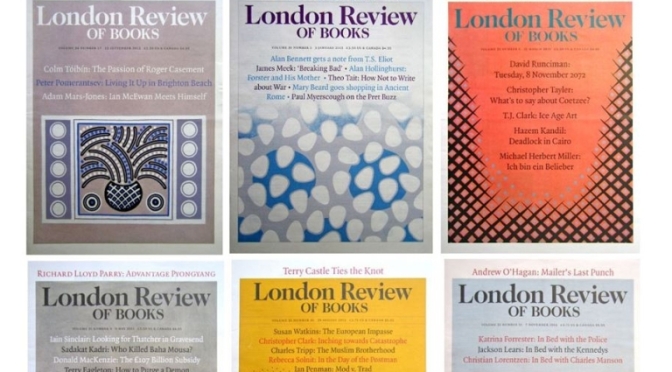
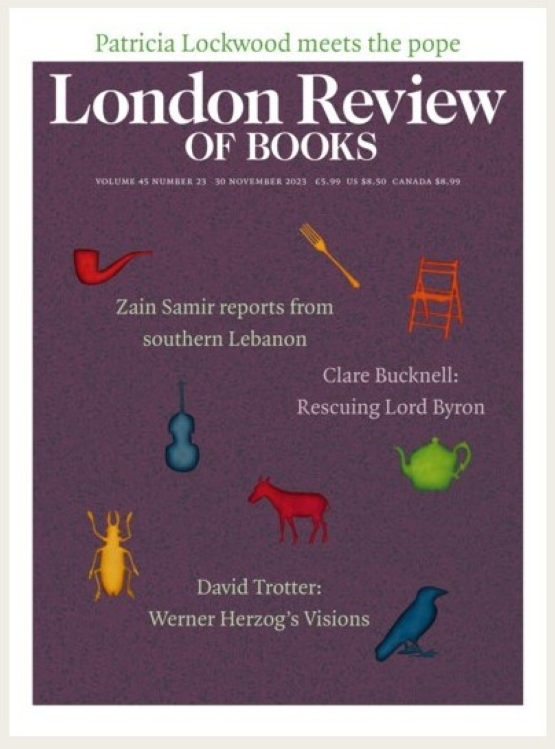
London Review of Books (LRB) – November 30, 2023: The latest issue features Jaqueline Rose on violence and its origins; Zain Samir reporting from Southern Lebanon; Clare Bucknell – Rescuing Lord Byron; David Trotter – Werner Herzog’s Visions, and more….
In response to the destruction of Gaza, it seems to be becoming almost impossible to lament more than one people at a time. When I signed Artists for Palestine’s statement last month, I looked for mention of the atrocities committed by Hamas against Israeli Jews on 7 October, and then decided to settle for the unambiguous condemnation of ‘every act of violence against civilians and every infringement of international law whoever perpetrates them’.
‘Little Boy’ exploded over Hiroshima at 8.15 a.m. on 6 August 1945, wiping most of the city off the face of the earth and killing eighty thousand people instantly. But the ‘shock’ to the leadership in Tokyo envisaged by the former US secretary of war Henry Stimson failed to materialise.
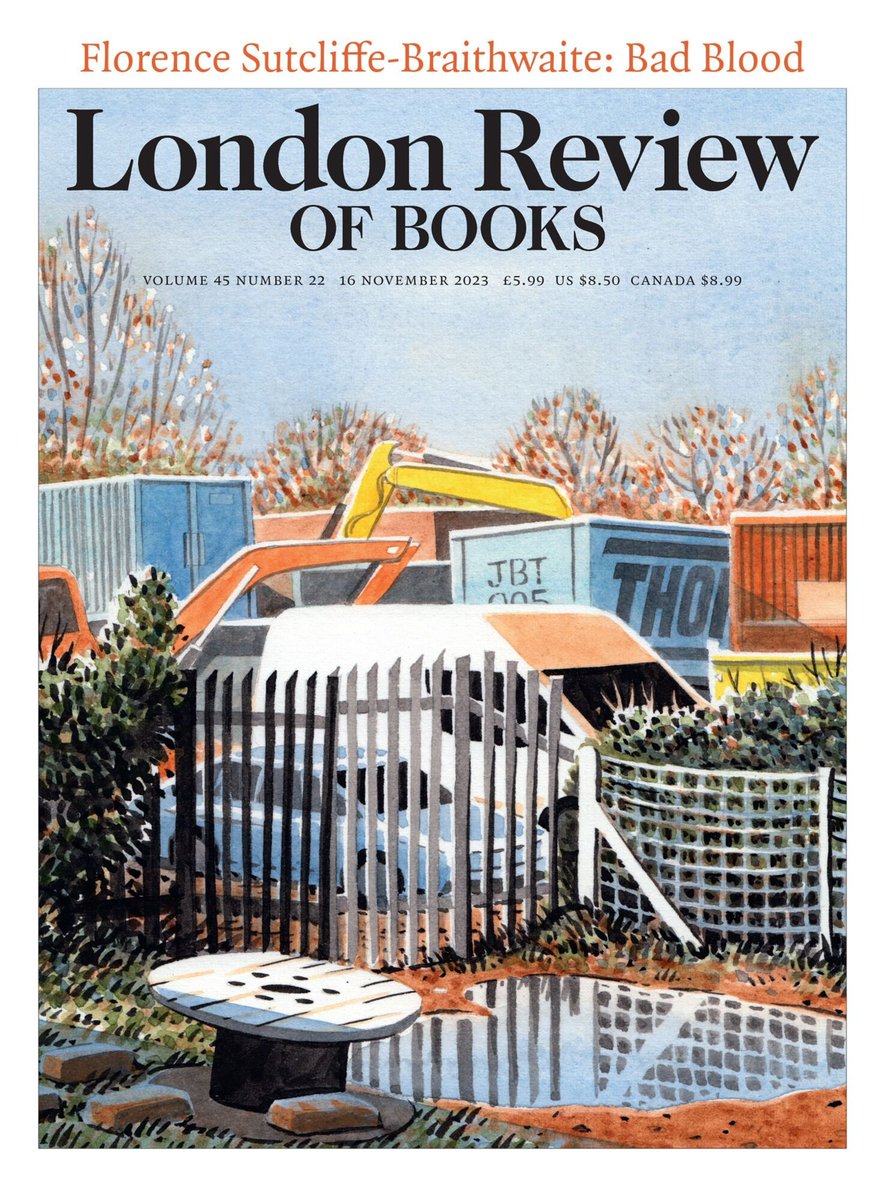
London Review of Books (LRB) – November 16, 2023: The latest issue feature The Inside Story of the NHS Infected Blood Scandal; Elizabeth Taylor’s Magic; The UK government has become increasingly hostile to Freedom of Information requests on arms, and more…
‘In the UK between 1970 and 1991, about 1250 people with bleeding disorders were infected with HIV (and many of them with Hepatitis C, too); by the time the Infected Blood Inquiry began, about three-quarters had died, the majority of them from HIV-related causes.
‘Nearly eighty years after she first starred in a film, Taylor is famous for two things: her intense screen beauty and her many marriages (eight of them, two to Richard Burton). But at least as central to her life were her close and enduring friendships with men.’
London Review of Books (LRB) – November 2, 2023: The new issue features After the Flood – Amjad Iraqi on the ‘regime change planned for Gaza and the carnage it entails; SBF in the dock and Emily Witt on Teju Cole….
The Israeli government is taking a leaf out of Ariel Sharon’s playbook to try to undo what it regards as Sharon’s biggest mistake. This essay is on the ‘regime change’ planned for Gaza, and the carnage it entails.
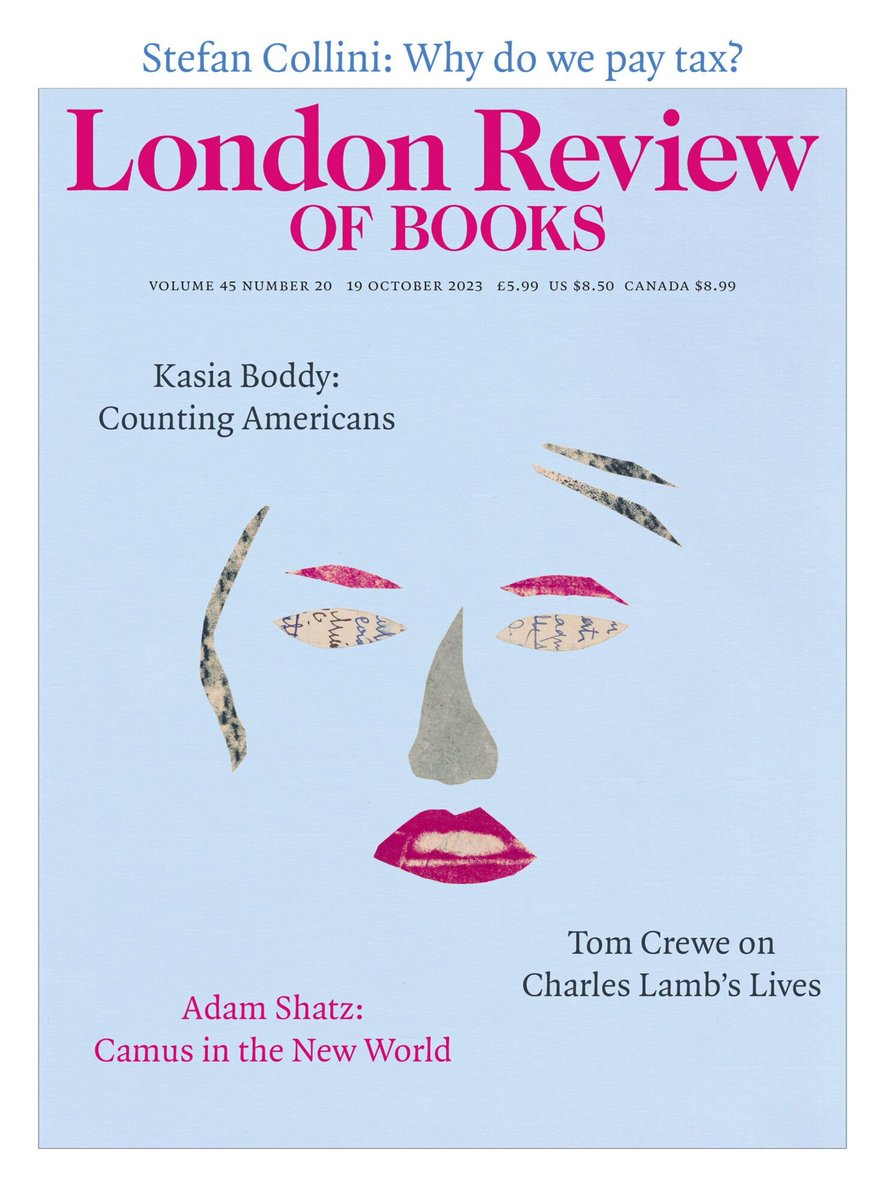
London Review of Books (LRB) – October 19, 2023: The new issue features Camus in the New World; Charles Lamb’s Lives; The Dictionary People: The Unsung Heroes who Created the Oxford English Dictionary and At the Met: On Cecily Brown….
Travels in the Americas: Notes and Impressions of a New World by Albert Camus, edited by Alice Kaplan, translated by Ryan Bloom
Bruno Schulz: An Artist, a Murder and the Hijacking of History by Benjamin Balint
On Nagorno-Karabakh
Democracy’s Data: The Hidden Stories in the US Census by Dan Bouk
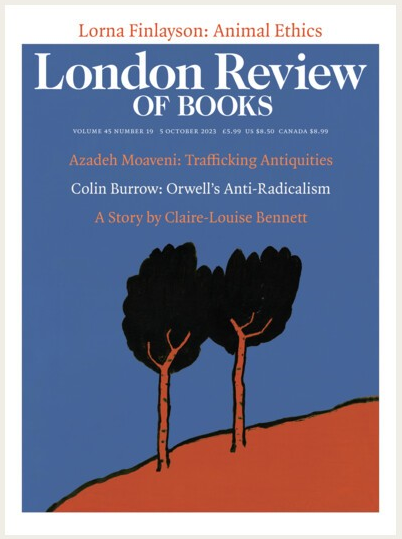
London Review of Books (LRB) – October 5, 2023: The new issue features Animal Ethics; Orca Life – We may understand less about orcas than they do about us, and Why Weber? – Weber insists that everything remain in its rightful place. Politicians should stick to politics, and scientists to science.
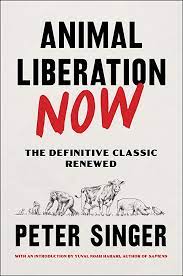
We may be tempted to throw up our hands and say: fuck it, I’m having a burger. Peter Singer would think this illogical: we should endeavour to do the least harm we can. But we might wonder whether something is wrong with the ethical approach that has led us to this point.
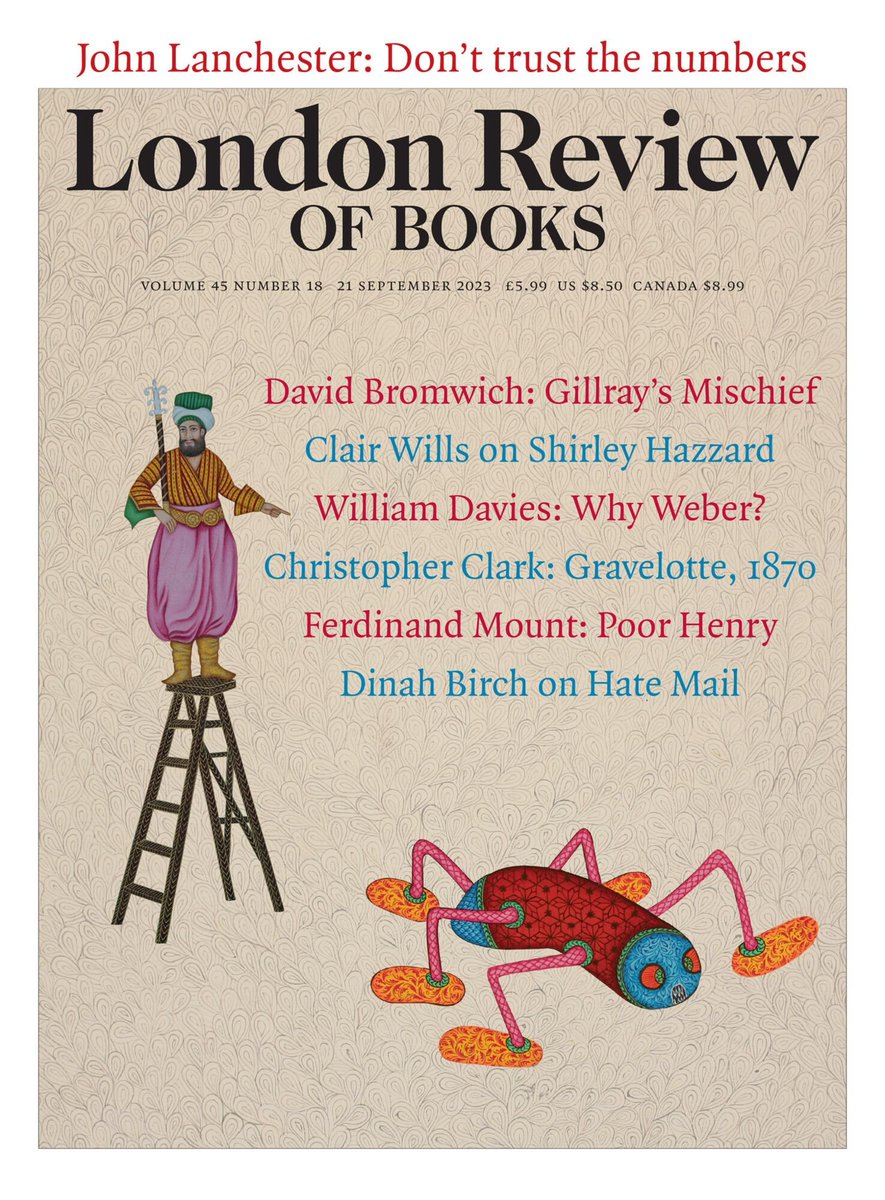
London Review of Books (LRB) – September 21, 2023: The new issue features John Lanchester on statistics, William Davies on Weber, nihilism and universities @dlbirch1 on hate mail, Ferdinand Mount on Henry III Clair Wills on Shirley Hazzard and a cover by Alexander Gorlizki.
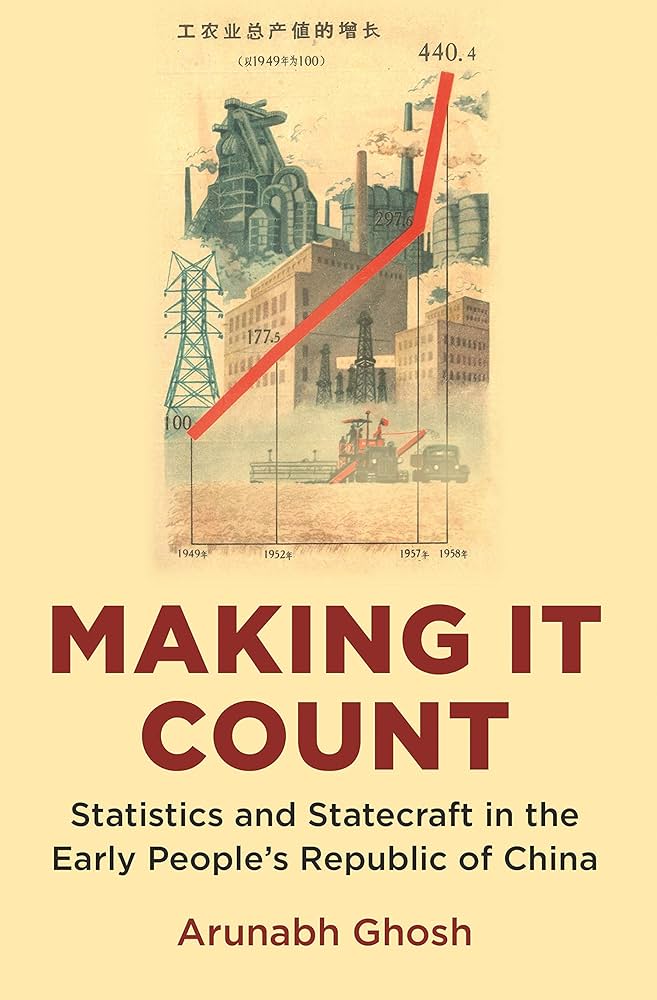
Making It Count: Statistics and Statecraft in the Early People’s Republic of China (Histories of Economic Life, 10) by Arunabh Ghosh
At a dinner with the American ambassador in 2007, Li Keqiang, future premier of China, said that when he wanted to know what was happening to the country’s economy, he looked at the numbers for electricity use, rail cargo and bank lending. There was no point using the official GDP statistics, Li said, because they are ‘man-made’. That remark, which we know about thanks to WikiLeaks, is fascinating for two reasons. First, because it shows a sly, subtle, worldly humour – a rare glimpse of the sort of thing Chinese Communist Party leaders say in private. Second, because it’s true. A whole strand in contemporary thinking about the production of knowledge is summed up there: data and statistics, all of them, are man-made.
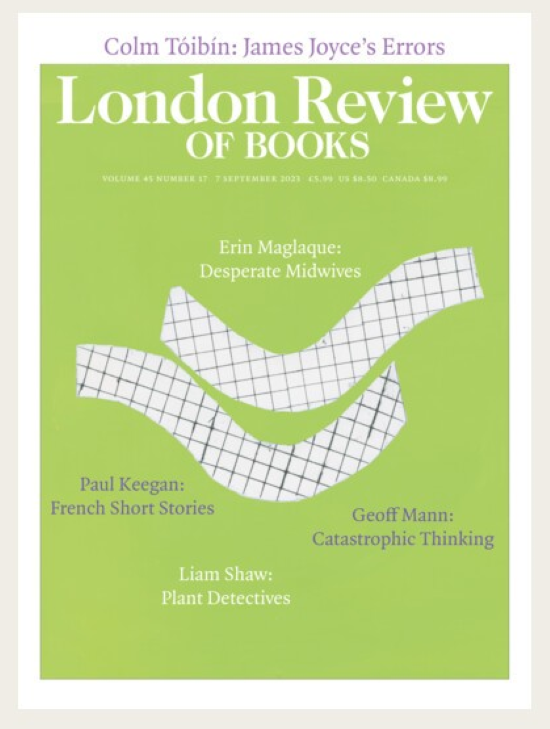
London Review of Books (LRB) – September 7, 2023: The new issue features Colm Tóibín review of ‘Annotations to James Joyce’s ‘Ulysses’; Desperate Midwives; French Short Stories; Catastrophic Thinking and Plant Detectives…
Ulysses is haunted by the story of its own composition. As Joyce famously put it, ‘I’ve put in so many enigmas and puzzles that it will keep the professors busy for centuries arguing over what I meant, and that’s the only way of ensuring one’s immortality.’ The annotators point out, however, that it is ‘very likely that Joyce never said this’.
‘A novelist is condemned to produce a succession of novelties, new names for characters, new incidents for his plots, new scenery,’ reflects the beleaguered hero of The Ordeal of Gilbert Pinfold, Evelyn Waugh’s portrait of the artist as a middle-aged car crash.
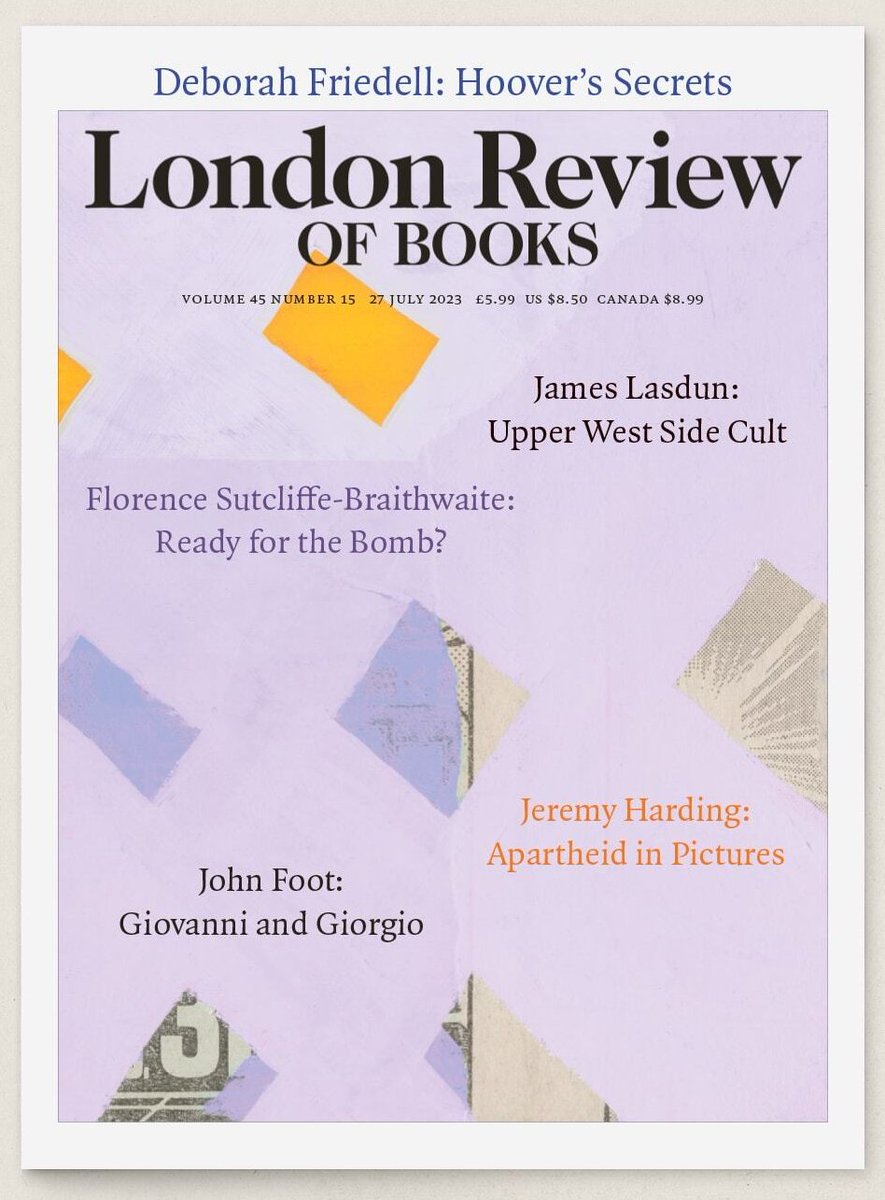
London Review of Books (LRB – August 5, 2023) – But really, as Pinfold goes on to say, ‘most men harbour the germs of one or two books only; all else is professional trickery of which the most daemonic of the masters – Dickens and Balzac even – were flagrantly guilty.’ Pinfold is by admission a self-portrait, so Waugh must have expected readers to speculate on how this observation applied to his own career, and whether he was a one or a two-book man himself.
In 1958, a Cambridge don called Frederick J. Stopp produced a study of Waugh – uniquely, Waugh himself gave ‘generous assistance’ – which warmly endorsed the idea that he had basically ‘two books in his armoury’, the first featuring the ‘contrast between sanity and insanity’ and the second ‘sanity venturing out into the surrounding sphere of insanity, and defeating it at its own game’.
Whether this particular dualism had Waugh’s approval is unclear, but either way it doesn’t seem entirely satisfactory since the two alternatives look like variants of the same thing. Less well-disposed readers have thought that Waugh’s books divided on much more rudimentary lines: the good ones, which are funny, and the bad ones, which are pious.
There is the string of brilliant, brittle social comedies in the 1930s, and then there is whatever started happening with the publication in 1945 of Brideshead Revisited. Stopp reported, presumably with his master’s sanction, that ‘Mr Waugh’s reputation among the critics has hardly yet recovered from the blow.’ Brigid Brophy had the best joke: ‘In literary calendars, 1945 is marked as the year Waugh ended.’
Working on Capital in the British Museum, plagued by creditors and carbuncles, Karl Marx complained not only that nobody had ever written so much about money and had so little of it, but that ‘this economic crap’ was keeping him from writing his big book on Balzac. His work is studded with allusions to Homer, Sophocles, Rabelais, Shakespeare, Cervantes, Goethe and scores of other authors, though he was less enthralled by ‘Elizabeth’s arse-kissing poet’ Edmund Spenser, an advocate of state terror in Ireland.
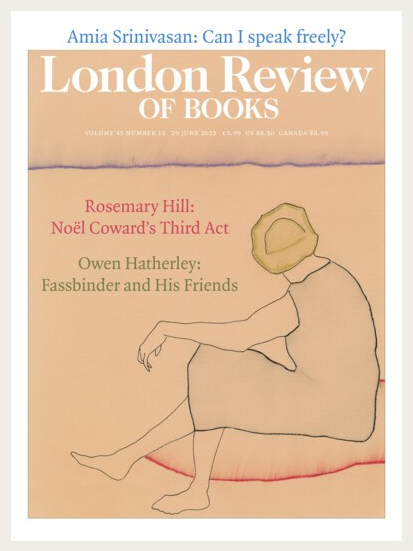
Most of us would find it horrible to be told that we aren’t worth engaging with, that our views are socially unacceptable or merely a function of demography. But that it is painful to be on the receiving end of such remarks doesn’t mean that one’s own rights to ‘free speech’ are thereby imperilled; it might simply be a reminder that speech can wound.
News, Views and Reviews For The Intellectually Curious








 Boomers Daily