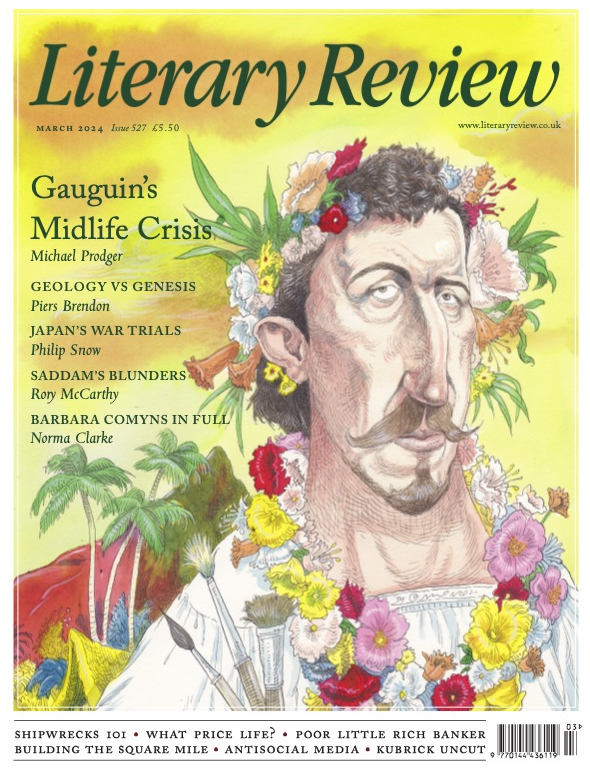
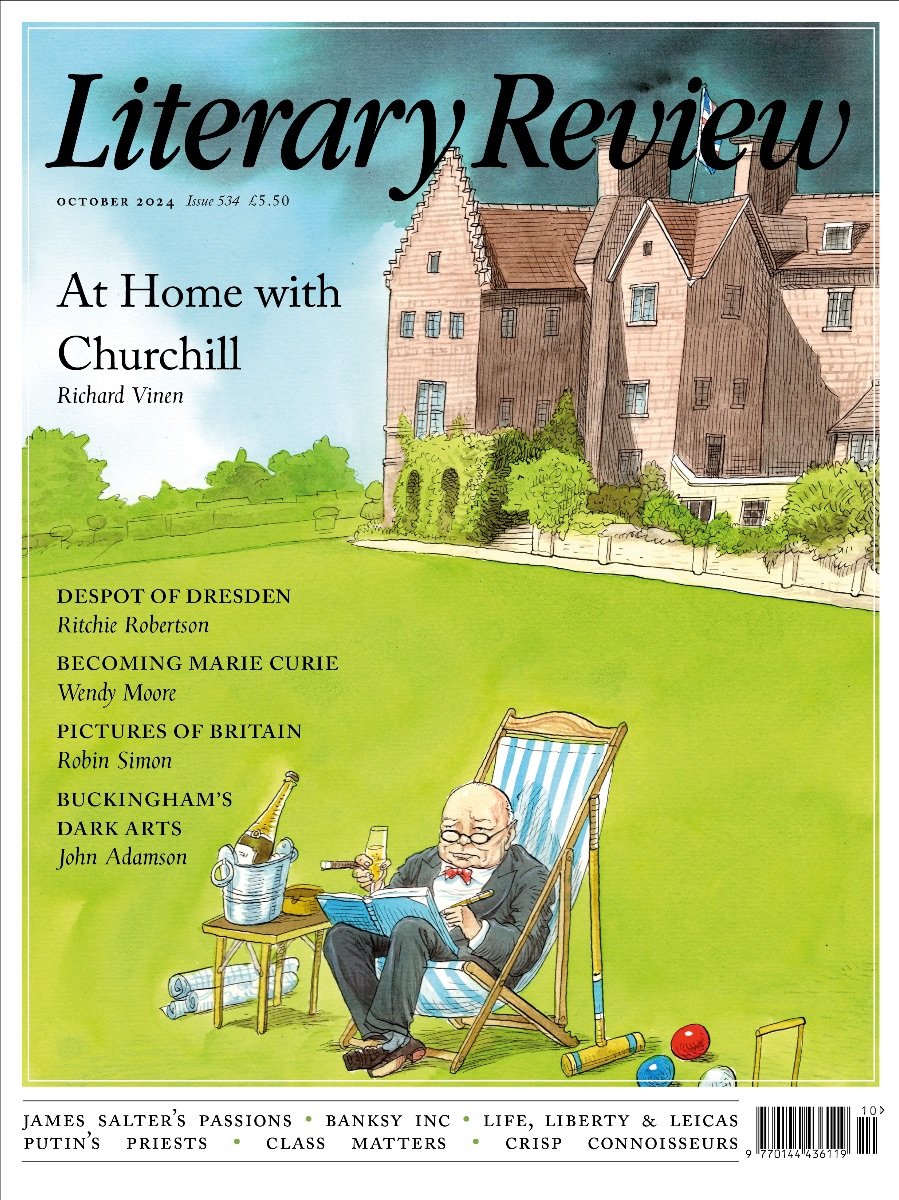

Literary Review – April 2, 2024: The latest issue features ‘From Bebop to Britpop’; Legends of Orkney; A Garden of One’s Own and Writing Doomsday…
Storm’s Edge: Life, Death and Magic in the Islands of Orkney By Peter Marshall
By JOHN KEAY

Literary Review – April 2, 2024: The latest issue features ‘From Bebop to Britpop’; Legends of Orkney; A Garden of One’s Own and Writing Doomsday…
By JOHN KEAY

Literary Review – March 1, 2024: The latest issue features ‘Gaughin’s Midlife Crisis’; Geology vs Genesis; Japan’s War Trials; Saddam’s Blunderers and Barbara Comyns in Full…
“The Showman: The Inside Story of the Invasion That Shook the World and Made a Leader of Volodymyr Zelensky” By Simon Shuster
As someone who has to consume quite a lot of Russian media, I can tell you that if there is one common denominator, it’s that whether we’re talking about a shouty TV news programme (less Newsnight, more a kind of geopolitical Jeremy Kyle Show), a stodgy government newspaper of record or a racy tabloid, no one has a good word for Volodymyr Zelensky.
Kubrick: An Odyssey By Robert P Kolker
There are, I have long suspected, two types of cinephiles: those who think Stanley Kubrick’s 2001: A Space Odyssey (1968) is a masterpiece and those who think it’s a relentless bore. Early in their new biography of the film director, Kubrick: An Odyssey, Robert P Kolker and Nathan Abrams make clear which camp they belong to, describing the scene in which the astronaut Frank Poole jogs around (and around and around and around) the spaceship Discovery as ‘one of the most lyrical passages in film history’.

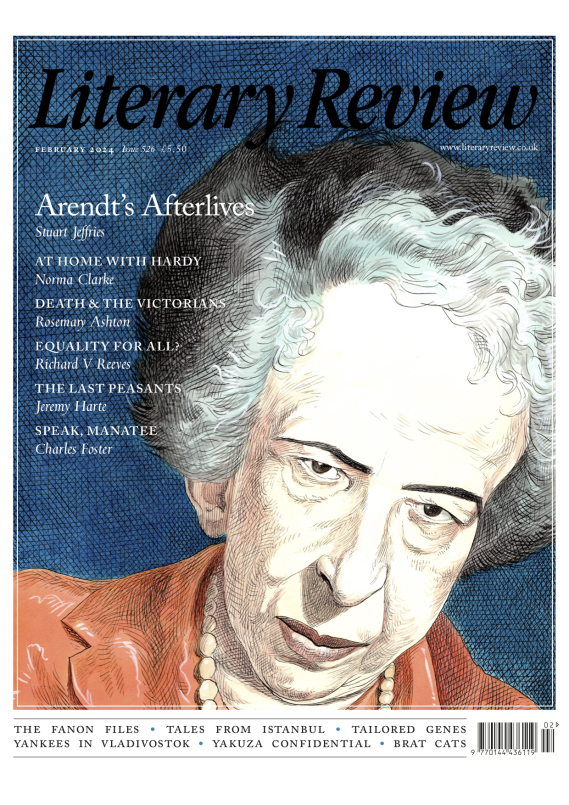
Literary Review – February 2, 2024: The latest issue features ‘We Are Free to Change the World: Hannah Arendt’s Lessons in Love and Disobedience’;
By STUART JEFFRIES
We Are Free to Change the World: Hannah Arendt’s Lessons in Love and Disobedience By Lyndsey Stonebridge
When Hannah Arendt looked at the man wearing an ill-fitting suit in the bulletproof dock inside a Jerusalem courtroom in 1961, she saw something different from everybody else. The prosecution, writes Lyndsey Stonebridge, ‘saw an ancient crime in modern garb, and portrayed Eichmann as the latest monster in the long history of anti-Semitism who had simply used novel methods to take hatred for Jews to a new level’. Arendt thought otherwise.
By Norma Clarke
Hardy Women: Mother, Sisters, Wives, Muses By Paula Byrne
The title of Paula Byrne’s Hardy Women is a pun on Thomas Hardy’s name and a gesture to the enthusiasm that greeted Hardy’s fictional women. Bathsheba Everdene in Far from the Madding Crowd, Tess Durbeyfield in Tess of the d’Urbervilles and Sue Bridehead in Jude the Obscure were new kinds of women, and Hardy’s fame, which was immense and began with the publication of Far from the Madding Crowd, rested to a large extent on the heroines he created. One young reader wrote to him of Tess, ‘I wonder at your complete understanding of a woman’s soul.’ Hardy’s discontented wife Emma wondered at it too. She observed, ‘He understands only the women he invents – the others not at all.’

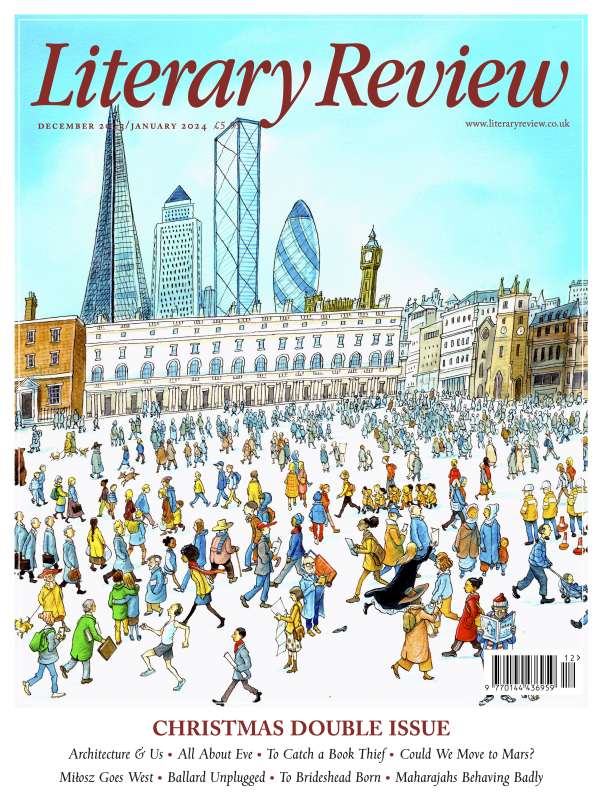
Literary Review – December 6, 2023: The latest issue, December 2023/January 2024, features the Christmas Double Issue; Architecture & Us; To Catch a Book Thief; Could We Move to Mars?; Milosz goes West; Ballard unplugged; To Brideshead Born and Maharajahs behaving badly…

By John Zubrzycki
‘Unruly schoolboys,’ Lord Curzon called them, but then again, he had a penchant for understatement. John Zubrzycki’s new book on India’s last princely rulers is, in fact, Lord of the Flies meets The 120 Days of Sodom. Had Zubrzycki repurposed his material for a novel, he would no doubt have had some stern reviewer scribbling ‘too on the nose’ or ‘uninspired orientalist caricature’ in the margins. Yet the rulers of India’s 562 princely states were for real, and the Raj, resolute on ruling with a light touch, much preferred coexisting with them to conquering them outright.

By Eva Hoffman
In a late poem about a friend’s death, Czesław Miłosz writes of the long passage between youth and age as one of learning ‘how to bear what is borne by others’. It could be a summary of his own poetic witness. Eva Hoffman’s moving and eloquent essay traces the ways in which that simultaneously guilty, compassionate and fastidious response characterises Miłosz’s work from its earliest days. Bearing what is borne by others is, for Miłosz, close to the heart of the poetic task, but it is also fraught with risk.

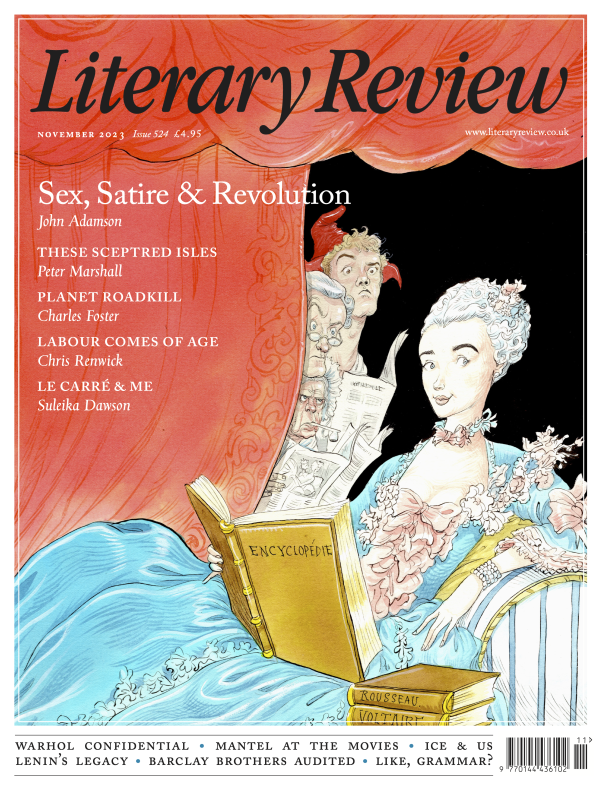
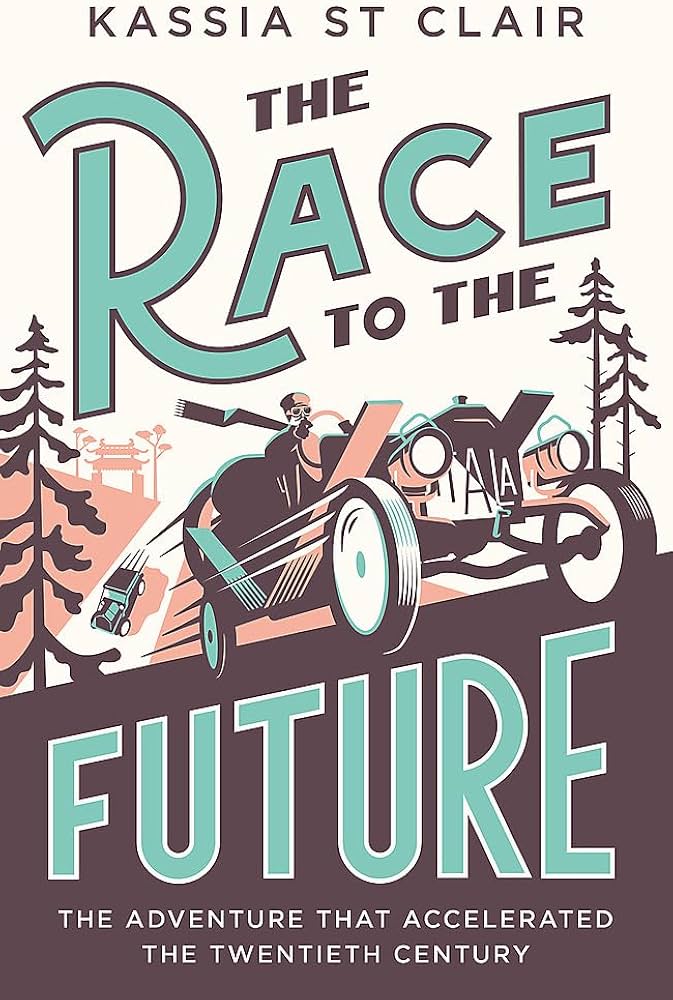
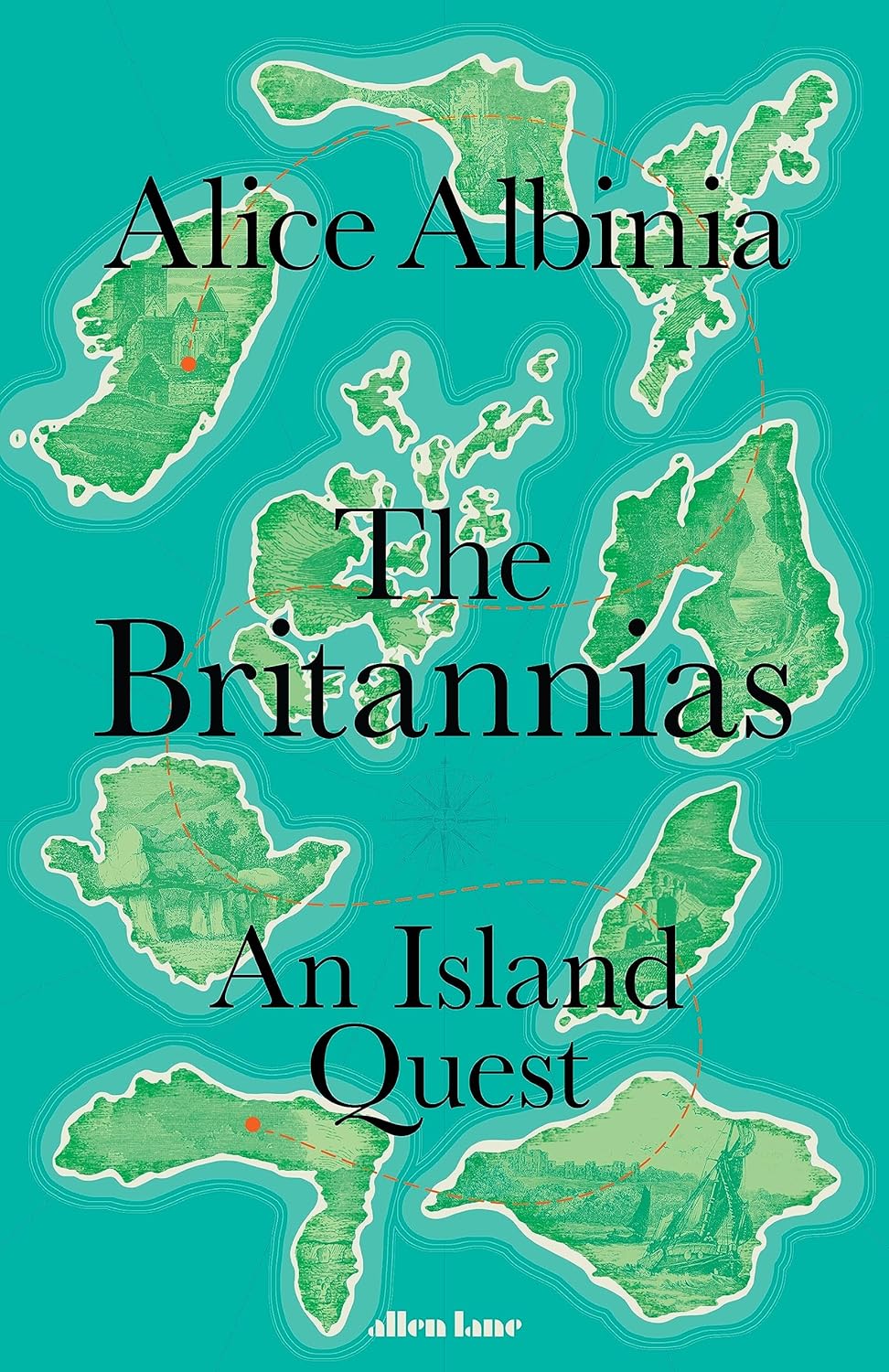
Literary Review – November 2023: The new issue features Sex, Satire & Revolution; The Race to the Future: The Adventure that Accelerated the Twentieth Century; Notes from the Atlantic Archipelago – The Britannias: An Island Quest; and more…

The Race to the Future: The Adventure that Accelerated the Twentieth Century
By Kassia St Clair
Cost, not a lack of courage, ensured that the entry field for the 1907 Peking to Paris car race was small. A massive two-thousand-franc deposit (equivalent to a professor’s annual salary) kept all but five of the aspiring contestants out of the race. That exclusion, as Kassia St Clair demonstrates in her captivating history of one of the most challenging endurance trials in the history of motoring, was precisely what the organisers intended.

The Britannias: An Island Quest
By Alice Albinia
In July 2023 Orkney Islands Council voted to explore alternative governmental arrangements for the archipelago. One option proposed by the council leader was for it to become a self-governing territory of Norway, the kingdom which lost control of Orkney to Scotland in 1468. The episode – in reality, a smart political stunt in a row over the Scottish government’s transport policy – attracted extraordinary international attention. In the UK press, it was treated with an uneven mixture of constitutional soul-searching and patronising amusement at the Passport to Pimlico-styleantics of the Orcadians.

Literary Review – October 2023: The new issue features How Bond Was Born; Impressions of Monet; Inequality through the Ages; Adam Smith the Socialist, and more…

Becoming James Bond By Nicholas Shakespeare
Anthony Powell, two and a half years older than Ian Fleming, remembered him as ‘one of the few persons I have met to announce that he was going to make a lot of money out of writing novels, and actually contrive to do so’.

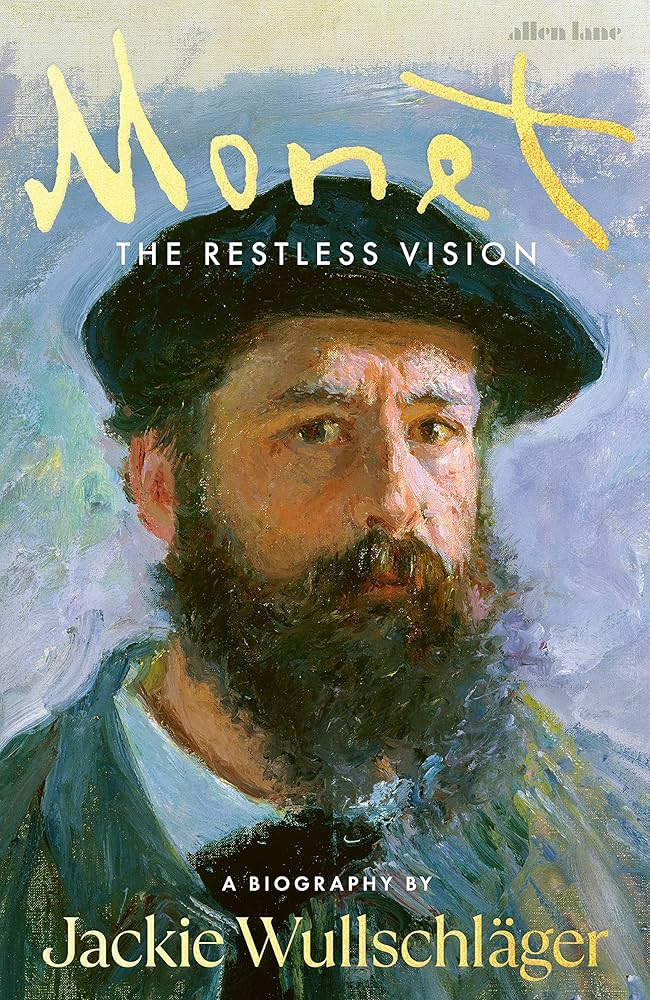
Monet: The Restless Vision By Jackie Wullschläger
You long for sublime artists to be sublime people. Or, if they’re bad, to be magnificently so. Possessing ‘a vanity born of supreme egoism’, Claude Monet ‘believed his art conferred a right to good living’ and that ‘his welfare must be … the immediate concern of others’, writes Jackie Wullschläger, chief art critic of the Financial Times. With great honesty, Wullschläger records her subject’s wearisome scrounging letters and his propensity for petty and often pointless mendacity.

Literary Review – September 2023: The new issue features Yoga Goes To Hollywood by Dominic Green; How England Lost France; Who’s Afraid of AI?; Don’t Mention Tiananmen; Anne Boleyn’s Ascent and Tastes of China….

RICHARD VINEN
Turning Points: Crisis and Change in Modern Britain, from 1945 to Truss By Steve Richards
In the good old days, dates were for foreigners. France, to take the obvious example, had repeatedly been turned upside down by war, revolution and changes of regime. But the English tourist in Paris rarely bothered to find out which of these distasteful events might be commemorated by, say, the rue du Quatre Septembre. The history of England (this was less true of Scotland and not at all true of Ireland) was a smooth and mostly benign progression. Educated people could tell you what the Glorious Revolution was but might be hazy about when exactly it had happened.

BLAKE SMITH
The Handover: How We Gave Control of Our Lives to Corporations, States and AIs By David Runciman
Artificial intelligence, it is commonly acknowledged, will pose one of the gravest challenges to humanity in the coming years. In the minds of some, it is already the most urgent problem we face. While there are a number of possible dangers that might bring about the extinction of our species, AI confronts us with a particularly dire situation, because it may well be that we have only a brief amount of time – perhaps a generation – in which to set up norms and constraints on the development of autonomous, non-human intelligences that may otherwise escape our control.
Literary Review – August 2023 Issue: How Sugar Became King; Oil, Resin, Vinegar & Paint – “Albrecht Dürer: Art and Autobiography” By David Ekserdjian; Shopping & Plucking – “How to Be a Renaissance Woman: The Untold History of Beauty and Female Creativity” By Jill Burke and more…

Albrecht Dürer: Art and Autobiography By David Ekserdjian
Dürer’s Lost Masterpiece: Art and Society at the Dawn of a Global World By Ulinka Rublack
The German Renaissance artist Albrecht Dürer (1471–1528) was fortunate in his initials. The stylised ‘AD’ that he routinely inserted into his paintings and engravings, and even the preparatory drawings, seemed to imbue his productions with an almost divine stamp of approval. Most German painters of the era did not sign their work, but Dürer was eager to assert creative ownership of his productions, obtaining legal protection of his sole right to the trademark monogram.

The World of Sugar: How the Sweet Stuff Transformed Our Politics, Health, and Environment over 2,000 Years By Ulbe Bosma
There was a time when commodity histories were everywhere. They tended to focus on consumption and trade over very long distances. Ulbe Bosma’s The World of Sugar is much more than this sort of book. It is one of the most accomplished longue durée case studies in the history of capitalism that we have, concerned not just with trade and consumption but with production also. At every turn it subverts both critiques and celebrations of capitalism, and our understanding of much else besides. It is an extraordinary achievement.

Literary Review – July 2023 Issue: Brushes with the Dutch Golden Age; @LauraCummingArt’s ‘Thunderclap’ – a remarkable experiment in form as well as a richly satisfying extended meditation on art, life and death’; Bismarck’s Great Gamble; Eden by Thames – The Infinite City: Utopian Dreams on the Streets of London…

The Other Pandemic: How QAnon Contaminated the World By James Ball
Back in the mists of time, great idealism surrounded social media. There was a sense that global interconnection would shift us into a more egalitarian and democratic age. How time makes fools of us all.
Thunderclap: A Memoir of Art & Life & Sudden Death By Laura Cumming
As a teenager with an interest in art, growing up on London’s Old Kent Road with a father whose mantra was ‘God gave you legs to walk’ (he didn’t believe in God but he did believe in walking), I often found myself on Sunday afternoons walking to the National Gallery in Trafalgar Square. I remember distinctly the day I discovered the Dutch painters. It wasn’t Rembrandt or Vermeer who caught my eye, but Hendrick Avercamp and, especially, Pieter de Hooch.

Literary Review – June 2023 issue: The issue features a
Crime Round-up. Also, Pétain In The Dock, Twilight of the Elite, Dementia’s Casualties, Man Versus Plague, and more.
By S A Cosby

S A Cosby’s troubled hero, Titus Crown, the sheriff of Charon County, Virginia, has to fight on many different fronts. Local racism makes his job difficult at the best of times, but now he is also faced with a school shooting and atrocious crimes against black children. His personal life has its own challenges and he is loaded down with guilt. Cosby’s talent makes all this misery work in a novel of great warmth, and he has a lovely turn of phrase. Titus’s loathing of hypocrisy, injustice and cruelty makes him enormously attractive.
By Mark Edwards

Mark Edwards’s great skill is to involve readers in his characters’ lives, showing step by mistaken step how they get themselves into trouble. In this case, the characters are Matthew and Helena, who had a relationship at university and meet again at a twenty-year reunion, soon after her husband has died. Rekindling their friendship, they travel to Iceland together, where an ill-judged selfie almost leads to her death. In the aftermath of this drama, she reveals a terrible secret to Matthew and their plunge into emotional and practical trauma begins. The writing is straightforward and without flourishes, but it gives the increasingly dramatic story an air of surprising normality. Edwards carries readers with him all the way and then leaves them with a wicked cliffhanger.
By Gilly Macmillan
Gilly Macmillan’s latest psychological thriller is a study in greed and vengeance, and it suggests that there is almost no human being who cannot be persuaded to commit a crime when motivated by one or the other. Nicole and Tom have won £10 million in the lottery and built a spectacular glass barn on the beautiful Lancaut Peninsula on the River Wye. Their nearest neighbours are an at first apparently benevolent but then increasingly sinister couple, Olly and Sasha, who seemingly live without means in a ravishing medieval manor house, cared for by their housekeeper, Kitty. Of course nothing is quite as it appears and when a body is found floating in a swimming pool, the police arrive and everyone’s story begins to unravel. Twisty and colourful, this is a novel to entertain all who have experienced schadenfreude.