
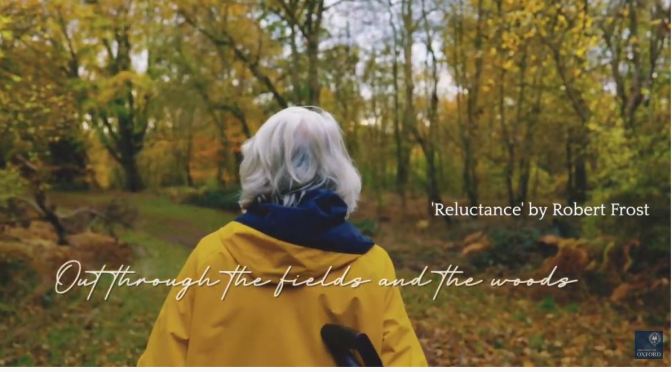
Sarah Watkinson is Wytham Woods’ first poet in residence. She leads us through a delicate maze of woodland and words, weaving together nature, research and poetry. In their work, scientists are objective: they don’t express opinions, they don’t talk about themselves. Poetry would seem science’s diametrical opposite: it’s traditionally inward-looking and self-reflective. Sarah’s writing combines her scientific background and her love for form and words in the most delicate and unexpected way: observing the world, for her, is a form of poetry.




 The real California, though, the California of immigrant dreams that break and get reborn, of lives as they turn out not as they are planned, is the California of the eucalyptus.
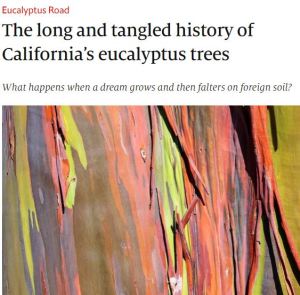 Like his friend John Muir, Lukens believed that California desperately needed more forests. Since the mid-19th century forests, and their loss, had been the principal focus of conservationist thought in America. According to Jared Farmer, who traces the history of the eucalyptus in California in “Trees in Paradise” (2013), Lukens and Muir were particularly keen on growing forests as a way to provide water—always a key to power in the state. Trees brought rain and captured fog and moisture; without forests, the men feared the state’s great cities would dry up.
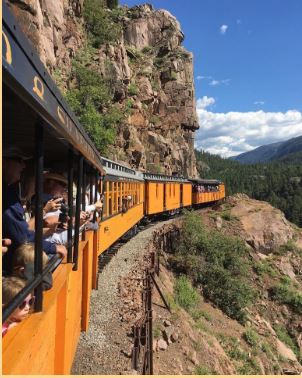 As it leaves Durango, the train’s multiple-chime steam whistle can be heard reverberating throughout the town and along the Animas Valley. As it proceeds north, the train winds alongside the Animas River as it traverses the verdant green pastures of the Animas Valley and then crosses through the spectacular and breathtaking San Juan National Forest. The remote and treacherous route through the mountains includes a dramatic and stomach-churning stretch along the edge of a narrow shelf carved into the sheer granite cliffs 400 feet above the river.
  Boomers Daily