Tag Archives: Economics

THE ECONOMIST MAGAZINE – MARCH 14, 2026 PREVIEW

THE ECONOMIST MAGAZINE: The latest issue features An attack on the world economy‘….

An attack on the world economy

Whatever happens in the Strait of Hormuz, energy markets have been changed for ever

China’s hereditary elite is taking shape

The Communist Party is afraid to tax inherited wealth

There are no good options for Iran’s nuclear programme

If America cannot eliminate the threat, what should it do?

How to teach Donald Trump a Latin lesson

By alienating Hispanics, he has given Democrats an open goal

Haiti needs order first, then elections

Voters must be able to turn out without risking death

THE ECONOMIST MAGAZINE – MARCH 7, 2026 PREVIEW

THE ECONOMIST MAGAZINE: The latest issue features A war without a strategy‘….

Donald Trump must stop soon

His ill-considered conflict risks descending into chaos

AI danger gets real

The squabble between America’s government and Anthropic makes an AI disaster more likely

China needs a more ambitious growth target

Otherwise a fourth year of deflation awaits

It’s time to unleash Europe’s pensions

One reform offers both security in old age and dynamism now

Nigel Farage and Zack Polanski: best of frenemies

Britain’s twin populists have a symbiotic relationship

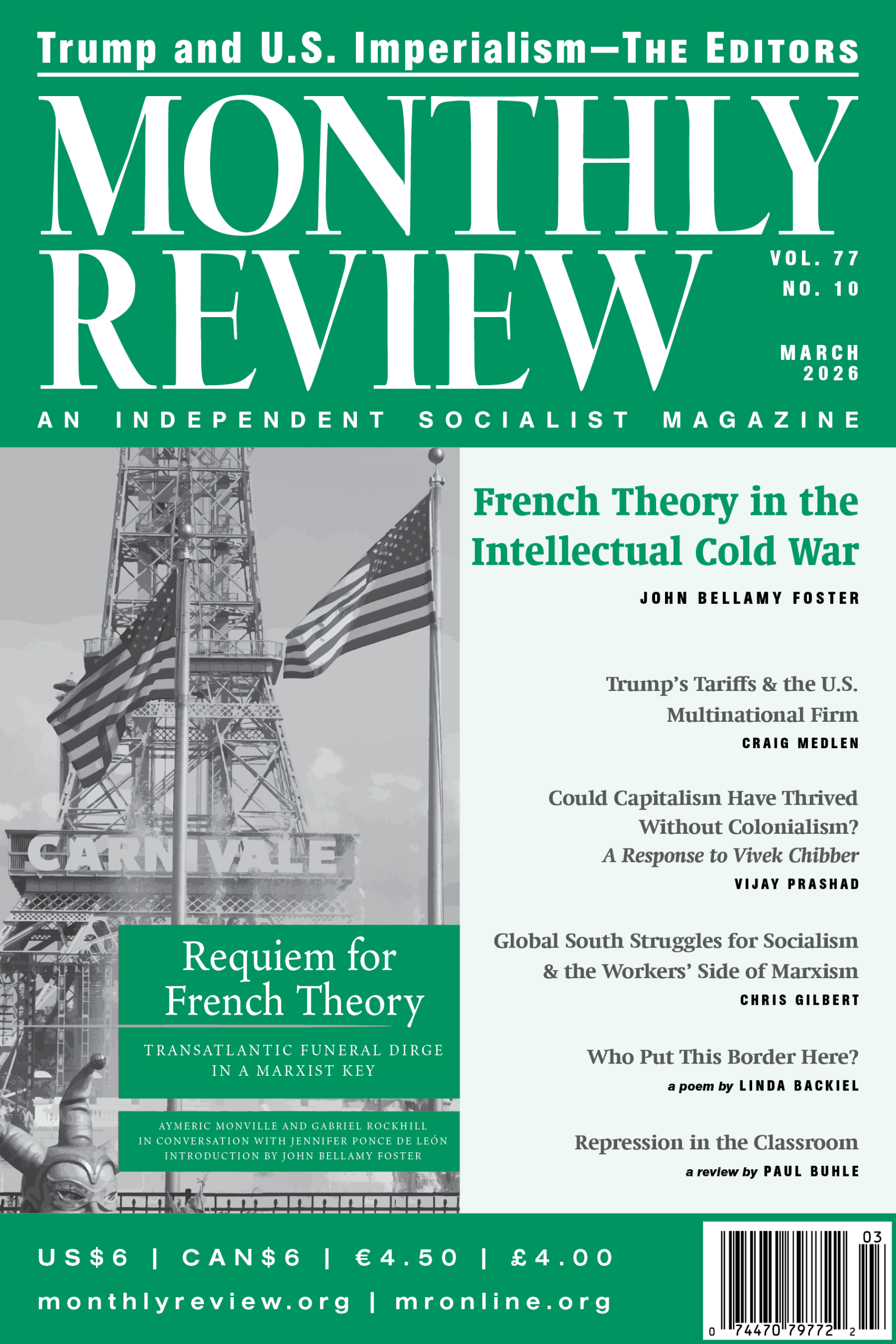
MONTHLY REVIEW MAGAZINE – MARCH 2026 PREVIEW

March 2026 (Volume 77, Number 10) - Monthly Review

MONTHLY REVIEW MAGAZINE: The latest issue feature ‘French Theory in the Intellectual Cold War’….

With the Trump administration’s backing down on its tariffs on China, its military abduction of Venezuelan President Nicolás Maduro, its insistence on seizing Greenland one way or another, its bombings in Nigeria, and its declaration that the official U.S. military budget will be increased by 50 percent in 2027—the last four events occurring in a two-week span in late December and early January—establishment commentators are all over the map.

Could Capitalism Have Thrived Without Colonialism? A Commentary on Vivek Chibber’s Jacobin Radio Interview

by Vijay Prashad

Vijay Prashad critiques the argument that colonialism was, at most, ancillary to the transition between capitalism and feudalism in Western Europe. Instead, Prashad argues, “capitalism as it historically emerged—industrial, global, racialized, and imperial—was inseparable from colonial expropriation.” This reality must fuel a Marxist conception of the global struggle for reparations for those who have been oppressed and exploited at the hands of empires past and present.

Repression in the Classroom

by Paul Buhle

In this dual review, Paul Buhle lends contemporary context to the histories of McCarthyism found in the recently published A Blacklist Education, by Jane S. Smith, and Operation Mind, by Natalie Zemon Davis and Elizabeth Donovan. In these two books, Buhle writes, readers can find parallels with the was that is today being waged against university professors and students for political activities—a stark reminder that political witch-hunts did not end with Joe McCarthy.

Trump’s Tariffs and the U.S. Multinational Firm

by Craig Medlen

Craig Medlen dissects the logic behind the Trump administration’s efforts to impose tariffs as a way to counteract “unfair” U.S. trade deficits. Situating these deficits in the longer history of U.S. trade hegemony and its crumbling position in the global economy, Medlen uses incontrovertible data to illustrate how mainstream economic orthodoxy fails to acknowledge the effects of foreign inputs that integral to the workings of U.S. monopoly capital.


THE ECONOMIST MAGAZINE – FEBRUARY 28, 2026 PREVIEW

THE ECONOMIST MAGAZINE: The latest issue features ‘Digging for victory’…

America’s dangerous pursuit of critical-mineral dominance

With a more focused approach, it could break China’s chokehold

Donald Trump is at risk of launching a war without purpose

A conflict with Iran without a clear objective would be recklessly dangerous

The right response to private-market dangers

Was a Blue Owl fund mismanaged, or did it reveal fundamental problems about the industry?

America’s states should beware of copying Europe too much

Welfare is rightly becoming more generous. But regulatory fragmentation is a problem

Heathrow’s third runway is turning into another infrastructure fiasco

The government must step in

THE ECONOMIST MAGAZINE – FEBRUARY 21, 2026 PREVIEW

THE ECONOMIST MAGAZINE: The latest issue features The Robin Hood state

Don’t go after the rich to fix broken budgets

It will not work, and is wrong in principle

Vladimir Putin is caught in a vice of his own making

Russia’s president cannot win the war, but fears peace

Saudi Arabia and the Emirates must resolve their own differences

America’s neglect is allowing an unwelcome tension to fester between two of its allies

Why insider trading isn’t always bad

At least on prediction markets

How to improve American legislators’ lot

Doing so would be good for members of Congress, and for democracy

THE ECONOMIST MAGAZINE – FEBRUARY 14, 2026 PREVIEW

THE ECONOMIST MAGAZINE: The latest issue features Why social media bans won’t work

Don’t ban teenagers from social media

Restrictions would do more harm than good

The world’s most powerful woman

Japan’s prime minister has earned a once-in-a-generation chance to remake her country. Will she seize it?

The Epstein files tell a story of justice denied

Prosecutors have moved far too slowly

The rich world should beware Brazilification

When governments are indebted, high interest rates wreak havoc

Britain’s predicament will get worse before it gets better

With Sir Keir Starmer weakened, the government 

Harvard Business Review – MARCH/APRIL 2026

March–April 2026

HARVARD BUSINESS REVIEW: Why Great Innovations Fail to Scale: Breakthrough ideas need a special kind of leader to help them flourish.

Gen AI Won’t Make Your Employees Experts

But it can help novices perform better and faster.

The HBR Interview with Outgoing Walmart CEO Doug McMillon

His advice to fellow executives: “Listen to your gut.”

Why Gen AI Feels So Threatening to Workers

And what leaders can do to ease the anxiety.

THE ECONOMIST MAGAZINE – FEBRUARY 7, 2026 PREVIEW

THE ECONOMIST MAGAZINE: The latest issue features The dangerous dollar‘…

The age of a treacherous, falling dollar

Those holding American assets will have to get used to it

As global press freedom dwindles, corrupt politicians rejoice

Less scrutiny, more booty

How to think about new risks of nuclear proliferation

In a might-makes-right world, many countries may conclude that only nukes can keep them safe

The new Bangladesh is only half built

Whoever wins the coming election has a lot to do

THE ECONOMIST MAGAZINE – JANUARY 31, 2026 PREVIEW

THE ECONOMIST MAGAZINE: The latest issue features The ICE test

ICE’s impunity is a formula for more violence

Is America’s president building his own paramilitary militia?

Xi Jinping’s purge should worry the world

Installing his yes-men to lead the army could be dangerous for Taiwan

The weak yen and the weakening dollar are signs of financial fragility

But neither Japan nor America should meddle with exchange rates

Haters on the right and left are wrong about London

It’s a hub, not a hellhole. Labour should give it more love

Africa’s two biggest economies may be turning the corner

As Nigeria and South Africa revive, the continent’s growth may outpace Asia’s in 2026

Stop panicking about AI. Start preparing

There is time to adapt. Use it wisely

THE ECONOMIST MAGAZINE – JANUARY 24, 2026 PREVIEW

THE ECONOMIST MAGAZINE: The latest issue features The true danger posed by Donald Trump

The true danger posed by Donald Trump

Despite a tactical retreat, great risks remain

The odd thing about Modi’s mojo

Constraints make India’s prime minister govern better

Trump’s Board of Peace is a distraction from the real work in Gaza

America’s president has unusual power to impose peace; he must continue to use it

Chinese AI is a risk for Europe. So is shunning it

Especially now that America is becoming a less reliable partner

Britain’s good idea for custom genetic medicines

A way to tackle the tricky economics of drugs designed for one person