

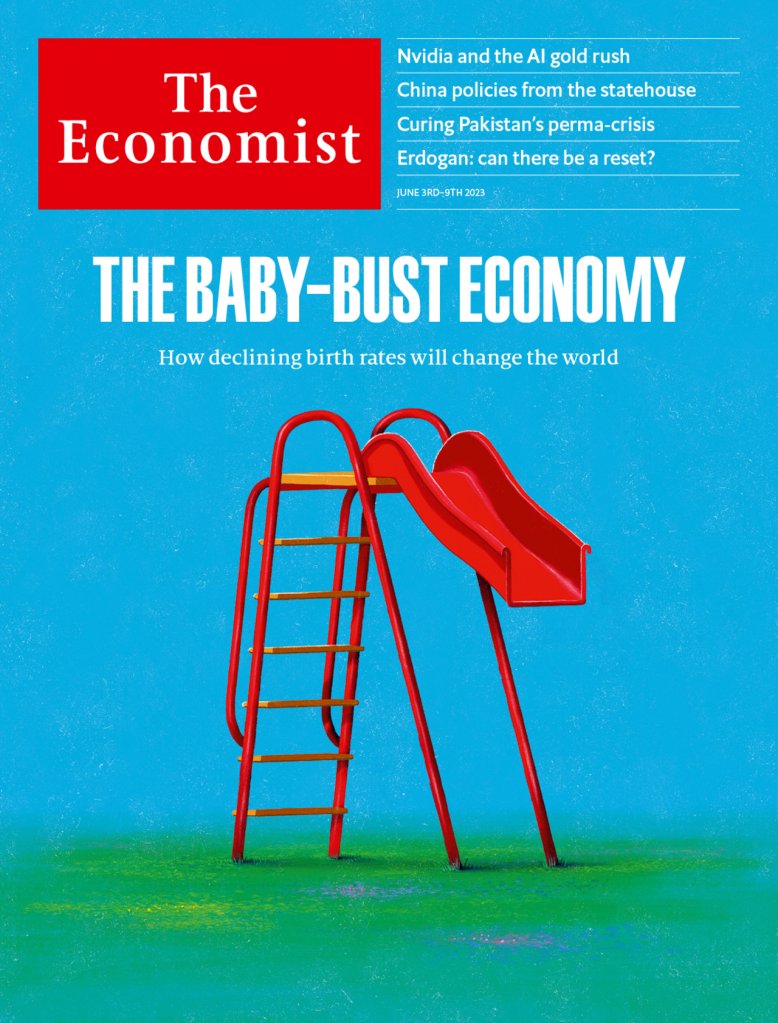

Global fertility has collapsed, with profound economic consequences

What might change the world’s dire demographic trajectory?
In the roughly 250 years since the Industrial Revolution the world’s population, like its wealth, has exploded. Before the end of this century, however, the number of people on the planet could shrink for the first time since the Black Death. The root cause is not a surge in deaths, but a slump in births. Across much of the world the fertility rate, the average number of births per woman, is collapsing. Although the trend may be familiar, its extent and its consequences are not. Even as artificial intelligence (ai) leads to surging optimism in some quarters, the baby bust hangs over the future of the world economy.
How to make the re-election of Recep Tayyip Erdogan less bad news

There is a chance for a partial reset
It certainly wasn’t fair. Nor was it entirely free. But, like it or not, the victory on May 28th of Recep Tayyip Erdogan in Turkey’s presidential election is a fact. For the next five years Turkey, Europe and the wider world will have to deal with a prickly and authoritarian populist. That is bad news on many fronts: economically, democratically and regionally. And yet pragmatists have a duty to search for chinks of light in the gloom.
It’s not just a fiscal fiasco: greying economies also innovate less
That compounds the problems of shrinking workforces and rising bills for health care and pensions

“Adam is a special child,” says the voice-over, as the camera pans across abandoned classrooms and deserted maternity wards. “He’s the last child born in Italy.” The short film made for Plasmon, an Italian brand of baby food owned by Kraft-Heinz, a giant American firm, is set in 2050. It imagines an Italy where babies are a thing of the past. It is exaggerating for effect, of course, but not by as much as you might imagine. The number of births in Italy peaked at 1m in 1964; by 2050, the un projects, it will have shrunk by almost two-thirds, to 346,000.
 This week our correspondent joined Emmanuel Macron on his visit to China. The French president is stretching his diplomatic wings, and has some striking views about Europe’s place in the world. The state of Texas has been reliably Republican for decades, but its demographics are changing; could it at last turn blue? And how Japan is dealing with its epidemic of public-transport groping.
 There’s a sense among a majority of Americans that parents are doing too much for their young adult children these days – 55% of all adults say this, while only 10% say parents are doing too little for their young adult children. About a third (34%) say parents are doing about the right amount.
 Among adults ages 18 to 29, 45% say they received a lot of (24%) or some (21%) financial help from their parents in the past 12 months. About one-in-five (21%) say they received only a little financial help, and 34% say they received none.
 Boomers Daily