Tag Archives: Book Review

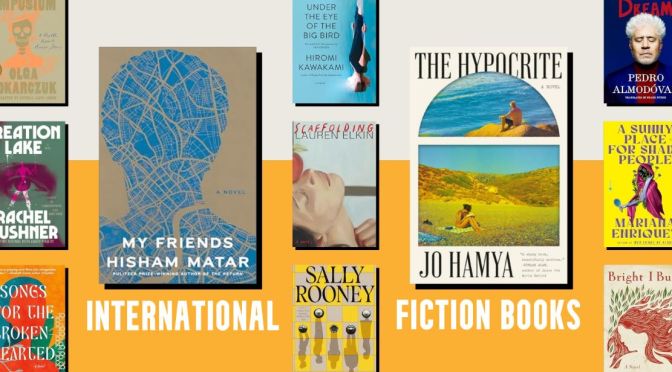
Book Reviews: Best Of International Fiction

Foreign Policy (September 20, 2024): The Mediterranean was the backdrop for much of FP’s summer reading. For the first installment of our new column about international fiction, we travel to two very different settings along this vast sea: Muammar al-Qaddafi’s Libya and modern Sicily. Plus, we highlight the buzziest releases in international fiction this month.


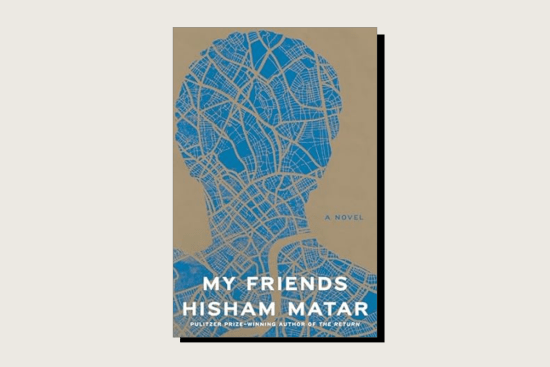
My Friends: A Novel

Hisham Matar (Random House, 416 pp., $28.99, January 2024)

Hisham Matar’s latest novel, recently longlisted for the 2024 Booker Prize, is about friendship and exile. Matar, a Libyan American writer based in London, was raised in a family of anti-Qaddafi dissidents and has made the tyrant’s maniacal rule the subject of most of his work.

In My Friends, Matar follows protagonist and narrator Khaled from his school days in Benghazi to the period following Qaddafi’s overthrow in 2011. After attending a 1984 anti-Qaddafi demonstration in London and landing on the dictator’s hit list, Khaled is forced to upend his quiet life as a university student in Edinburgh and start over in the British capital. (The real-life protest, where officials at the Libyan Embassy shot several protesters and killed a police officer, led Libya and Britain to sever ties.)

Khaled develops strong friendships with two fellow Libyans in London, Hosam and Mustafa. Unlike Khaled, both are unwavering in their political convictions. Although Khaled is opposed to Qaddafi’s regime, he is also aware of the costs—and futility—of speaking out. That Khaled’s criticism of Qaddafi’s Libya never leaves the private, rhetorical sphere is a point of contention between him and his friends. Ultimately, Hosam and Mustafa return to Libya in 2011 to join the militias fighting Qaddafi; Khaled remains in Britain, deeply insecure about his inaction.

Khaled’s decision to attend the 1984 protest was one he made hesitantly, so it is all the more shocking that his first brush with activism fundamentally altered the course of his life. Khaled’s father, an academic who resigned himself to a mid-level career under Qaddafi to avoid repression, had taught his son that it is “almost always best to leave things be.”

At its core, My Friends is a debate over whether, in the face of repression, such silence is a form of self-preservation or cowardice. This tension exists between the book’s main characters—the friends—as well as within Khaled’s own head. While Khaled’s exile led him to make great friends, his time in London is equally a painful experience of solitude. With Libyan phone lines tapped and mail pilfered by the regime, he has had to uphold a decades-long lie to his family about why he can no longer return home—all because he attended a single protest.

An author with an agenda might have sought to portray Hosam and Mustafa as valiant fighters whose sacrifices are rewarded, opposite Khaled, who prefers comfort to confrontation. But Libyan history does not follow a morally righteous narrative arc. At the end of the book, Libya becomes enveloped in a new crisis, and each friend seeks to find his place within it.—Allison Meakem


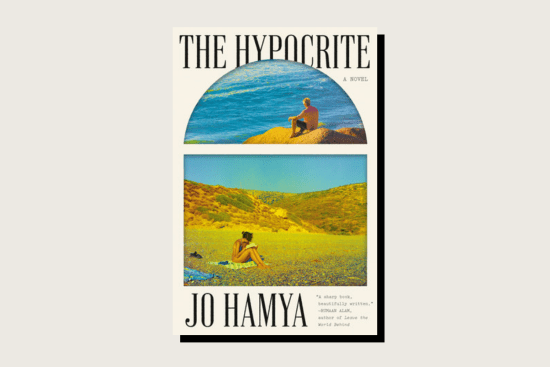
The Hypocrite: A Novel

Jo Hamya (Pantheon, 240 pp., $26, August 2024)

The Mediterranean is a time-honored stage for the psychosocial dramas of the elite. From British novelist John Fowles’s 1965 masterpiece, The Magus, to the entire Mamma Mia! franchise, fictional foreigners have long flocked to Greek and Italian isles to escape from—and, more often, confront—their heartbreaks and pathologies and familial squabbles. Often left out of these tales are the locals.

The Hypocrite by British author Jo Hamya at first seems like more of the same. It takes place over the course of one staging of a play about a summer that Sophia, the young playwright, once spent in Sicily’s Aeolian Islands with her father, a famous novelist whose work has aged poorly. It’s a smooth and often witty portrait of the upper-middle-class London art scene, written in the streamlined Rachel Cusk-esque register that defines much contemporary literary fiction.

Yet The Hypocrite also attempts to do something more. Although Sophia’s family dramas make up the bulk of the narrative, Hamya eventually shifts her focus to the family’s housekeeper in Sicily. She recalls that Sophia “was demanding in the worst way an English tourist could be.” Sophia didn’t try to learn even a little Italian. She and her father, the housekeeper thinks, were “lazy, messy people” who never bothered “to make her job easier with the simplest of acts.”

Hamya’s novel is part of the recent trend of examining who, historically, has been omitted in traditional narratives, especially ones set in locales that are under-resourced, exoticized, and deeply reliant on tourism. (Sicilians are European, yes, but they also live in one of Italy’s poorest regions.) In this regard, the novel is closer in spirit to HBO’s The White Lotus, the much-lauded send-up of the rich at a luxury resort chain (first in Hawaii, then in Sicily, and soon in Thailand), than many of its other predecessors.

Hamya does not dwell, however, on this upstairs-downstairs dynamic. Rather than skewering the careless interlopers, she aims for a bit more nuance, attending—if only fleetingly—to both the narrower interests of her protagonists and the invisible hands that helped set the stage for them that summer.—Chloe Hadavas

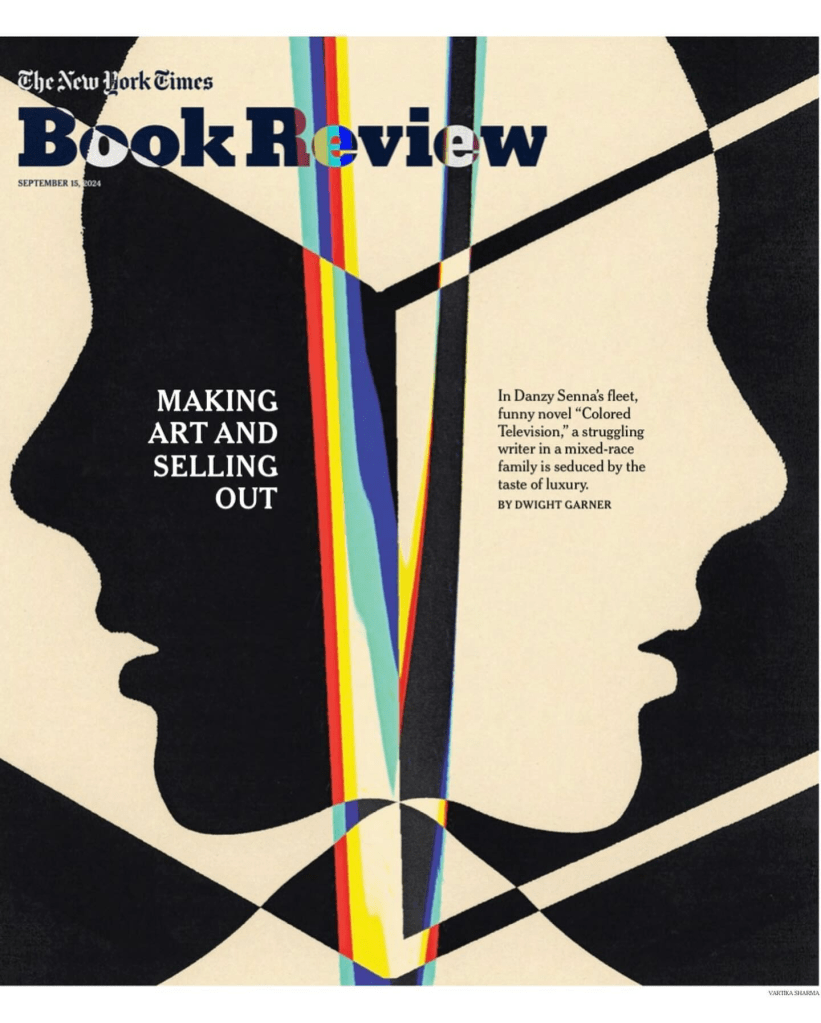
The New York Times Book Review – Sept. 15, 2024

THE NEW YORK TIMES BOOK REVIEW (September 15, 2024): The latest issue features ‘Making Art and Selling Out’ = In Danny Senna’s fleet, funny novel “Colored Television”, a struggling writer in a mixed-race family is seduced by the taste of luxury….

Debt Was Supposed to Cure Poverty and Help Pay for College. What Went Wrong?

Three new books examine debt’s fraught politics and history.

Ketanji Brown Jackson Looks Forward to Reading Fiction Again

The Supreme Court justice has been drawn to American history and books about the “challenges and triumphs” of raising a neurodiverse child. She shares that and more in a memoir, “Lovely One.”

The New York Times Book Review – April 21, 2024

Image

THE NEW YORK TIMES BOOK REVIEW (April 20, 2024): The latest issue features….

Coddling Plus Devices? Unequivocal Disaster for Our Kids.

In “The Anxious Generation,” Jonathan Haidt says we’re failing children — and takes a firm stand against tech.

In this photo-illustration, a child sits on a seesaw set in a field of emerald green grass. On the other side of the seesaw is a giant smartphone.

By Tracy Dennis-Tiwary

THE ANXIOUS GENERATION: How the Great Rewiring of Childhood Is Causing an Epidemic of Mental Illness, by Jonathan Haidt

Quick! Someone Get This Book a Doctor.

Inside the book conservation lab at the Metropolitan Museum of Art.

By Molly Young

Not every workplace features a guillotine. At a book conservation lab tucked beneath the first floor of the Metropolitan Museum of Art, the office guillotine might as well be a water cooler or a file cabinet for all that it fazes the staff. “We have a lot of violent equipment,” said Mindell Dubansky, who heads the Sherman Fairchild Center for Book Conservation.

How the Rich and Poor Once Saw War

In “Muse of Fire,” Michael Korda depicts the lives and passions of the soldier poets whose verse provided a view into the carnage of World War I.

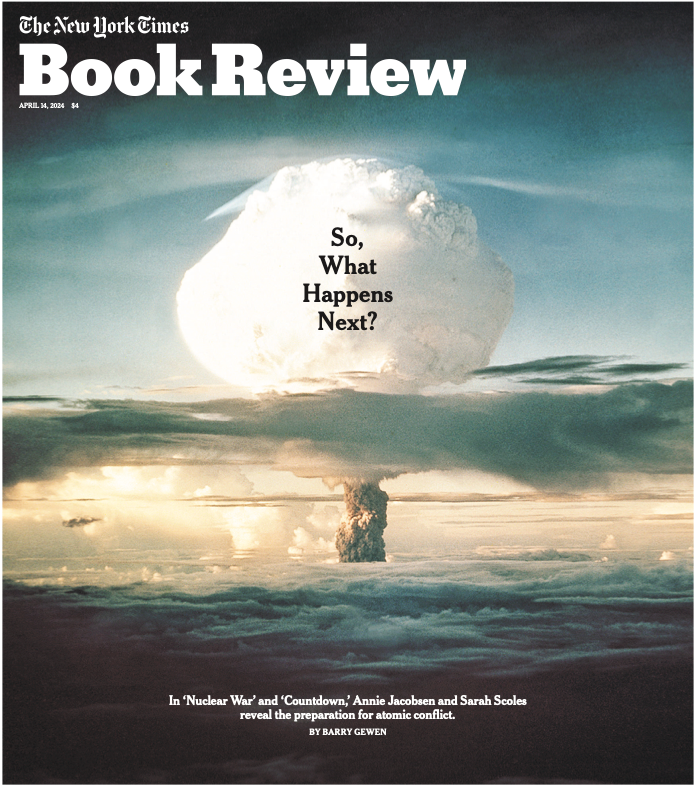
The New York Times Book Review – April 14, 2024

Image

THE NEW YORK TIMES BOOK REVIEW (April 12, 2024): The latest issue features  the cold-sweat-inducing premise of the two books on our cover this week, Annie Jacobsen’s “Nuclear War” and Sarah Scoles’s “Countdown.” 

Let’s Say Someone Did Drop the Bomb. Then What?

In “Nuclear War” and “Countdown,” Annie Jacobsen and Sarah Scoles talk to the people whose job it is to prepare for atomic conflict.

The Culture Warriors Are Coming for You Smart People

In Lionel Shriver’s new novel, judging intelligence and competence is a form of bigotry.

Doris Kearns Goodwin Wasn’t Competing With Her Husband

Richard Goodwin, an adviser to presidents, “was more interested in shaping history,” she says, “and I in figuring out how history was shaped.” Their bond is at the heart of her new book, “An Unfinished Love Story: A Personal History of the 1960s.”

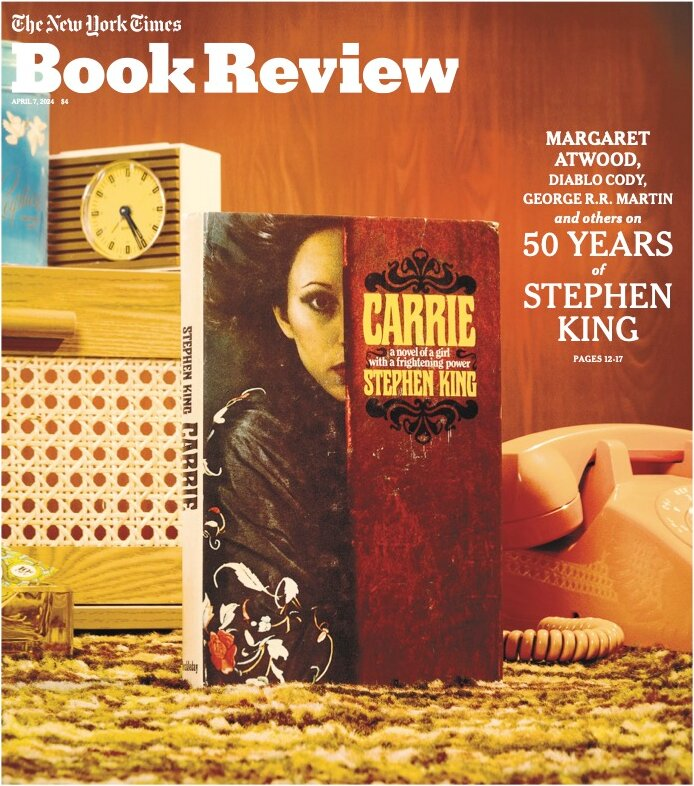
The New York Times Book Review – April 7, 2024

Image

THE NEW YORK TIMES BOOK REVIEW (April 5, 2024): The latest issue features Stephen King’s first novel, “Carrie,” published 50 years ago. The Book Review editors weren’t sure what to do with it, so they handed it to their mystery columnist, Newgate Callendar. He called it “brilliant” but conceded, “Maybe, strictly speaking, it is not a mystery.” Still, he added, “That this is a first novel is amazing. King writes with the kind of surety normally associated only with veteran writers.”

Stephen King’s First Book Is 50 Years Old, and Still Horrifyingly Relevant

This photo still life shows a hardcover edition of “Carrie” on a brown shag carpet, next to an orange rotary-dial telephone and a section of chair caning with an analog clock balanced on top. The wall behind them is paneled wood.

“Carrie” was published in 1974. Margaret Atwood explains its enduring appeal.

By Margaret Atwood

Stephen King’s “Carrie” burst upon an astonished world in 1974. It made King’s career. It has sold millions, made millions, inspired four films and passed from generation to generation. It was, and continues to be, a phenomenon.

“Carrie” was King’s first published novel. He started it as a men’s magazine piece, which was peculiar in itself: What made him think that a bunch of guys intent (as King puts it) on looking at pictures of cheerleaders who had somehow forgotten to put their underpants on would be riveted by an opening scene featuring gobs of menstrual blood? This is, to put it mildly, not the world’s sexiest topic, and especially not for young men. Failing to convince himself, King scrunched up the few pages he’d written and tossed them into the garbage.

How Stephen King Got Under Their Skin

As “Carrie” turns 50, George R.R. Martin, Sissy Spacek, Tom Hanks, the Archbishop of Canterbury and others recall the powerful impact the writer’s work has had on their lives.

This is a photo-illustration with a movie still of blood-covered Carrie, from the Stephen King novel, at its center.

In the late ’70s the image of Carrie covered in blood at the high school dance was already part of the national narrative — in a fun way. Struggling to afford the rent and the diapers while navigating those first years of a creative journey in the big city, I had not seen the movie nor read the book. Then a copy of “The Stand” was being gobbled up by our gang — read in a fever pitch on every subway ride and first thing in the morning. Once done, the copy was passed along to the next pair of eyes and promptly devoured.

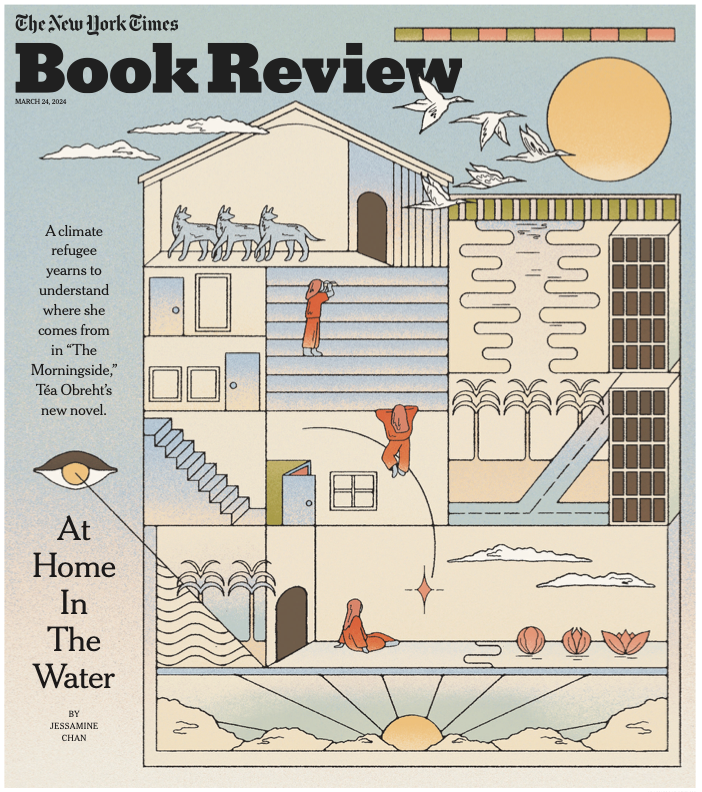
The New York Times Book Review – March 24, 2024

Image

THE NEW YORK TIMES BOOK REVIEW (March 23, 2024): 

In Téa Obreht’s Latest, a Refugee Seeks Home in a Ruined World

An illustrated cross section of a house, showing rooms full of animals, trees, water plants and people.

“The Morningside” reckons with climate change and its fallout while finding hope in the stories we preserve.

By Jessamine Chan

THE MORNINGSIDE, by Téa Obreht


The elegant, effortless world-building in Téa Obreht’s haunting new novel, “The Morningside,” begins with a map. Island City resembles Manhattan, but alarmingly smaller, the borders of the city redrawn by the rising water. There’s the River to the east, the Bay to the west. Here, hurricanes and tides have made building collapse a constant danger, the freeway is visible only on low-tide days, food is government rations, the wealthy have fled “upriver to scattered little freshwater townships,” and gigantic birds called rook cranes are everywhere.

An Exquisite Biography of a Gilded Age Legend

In Natalie Dykstra’s hands, the life of Isabella Stewart Gardner is a tribute to the power of art.

The serpia-toned photograph portrays a woman in a dark taffeta dress wth a bustle. Her hat is adorned with a dark plume.

By Megan O’Grady

CHASING BEAUTY: The Life of Isabella Stewart Gardner, by Natalie Dykstra


Bright, impetuous and obsessed with beautiful things, Isabella Stewart Gardner led a life out of a Gilded Age novel. Born into a wealthy New York family, she married into an even wealthier Boston one when she wed John Lowell Gardner in 1860, only to be ostracized by her adopted city’s more conservative denizens, who found her self-assurance and penchant for “jollification” a bit much.

Luminous Fables in a Land of Loss

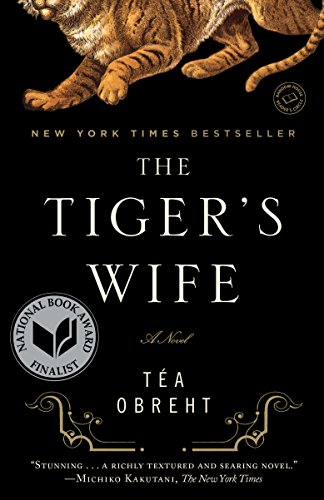
The Tiger's Wife: A Novel See more

By Michiko Kakutani

Téa Obreht’s stunning debut novel, “The Tiger’s Wife,” is a hugely ambitious, audaciously written work that provides an indelible picture of life in an unnamed Balkan country still reeling from the fallout of civil war. At the same time it explores the very essence of storytelling and the role it plays in people’s lives, especially when they are “confounded by the extremes” of war and social upheaval and need to somehow “stitch together unconnected events in order to understand” what is happening around them.

The New York Times Book Review – March 17, 2024

Image

THE NEW YORK TIMES BOOK REVIEW (March 16, 2024): 

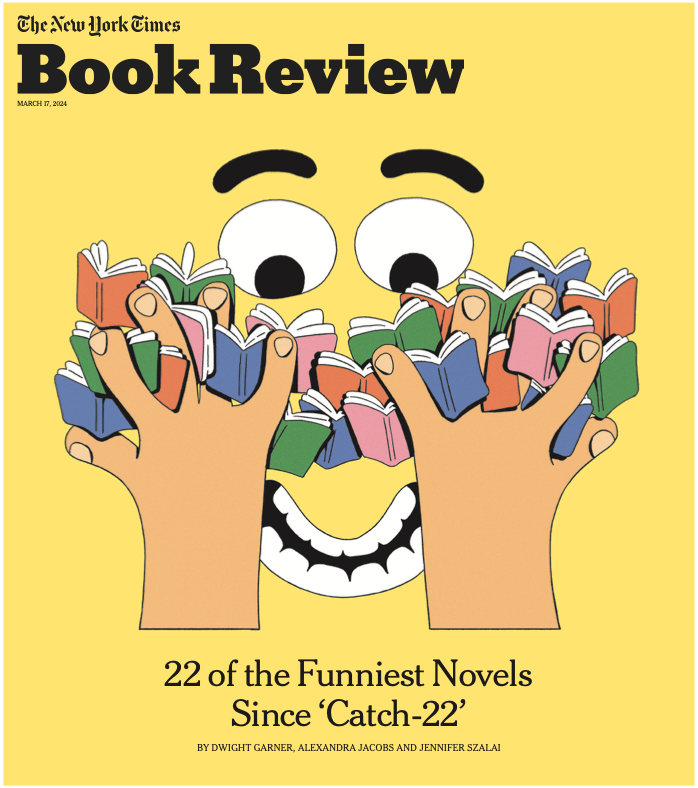
22 of the Funniest Novels Since ‘Catch-22’

Catch-22 eBook by Joseph Heller, Christopher Buckley | Official Publisher  Page | Simon & Schuster

Because we could all use a laugh.

By Dwight GarnerAlexandra Jacobs and Jennifer Szalai

When it comes to fiction, humor is serious business. If tragedy appeals to the emotions, wit appeals to the mind. “You have to know where the funny is,” the writer Sheila Heti says, “and if you know where the funny is, you know everything.” Humor is a bulwark against complacency and conformity, mediocrity and predictability.

With all this in mind, we’ve put together a list of 22 of the funniest novels written in English since Joseph Heller’s “Catch-22” (1961). That book presented a voice that was fresh, liberated, angry and also funny — about something American novels hadn’t been funny about before: war. Set during World War II and featuring Capt. John Yossarian, a B-25 bombardier, the novel presaged, in its black humor, its outraged intelligence, its blend of tragedy and farce, and its awareness of the corrupt values that got us into Vietnam, not just Bob Dylan but the counterculture writ large.

You’re Not Being Gaslit, Says a New Book. (Or Are You?)

“On Gaslighting,” by the philosophy professor Kate Abramson, explores the psychological phenomenon behind the hashtags.

A still from a black-and-white movie portrays a couple in Victorian dress. The man, in a dark suit, looks down disdainfully at a woman in a gown and pompadour as she gazes into the distance.

By Dodai Stewart

ON GASLIGHTING, by Kate Abramson


Don’t be so sensitive.

You’re overreacting.

You’re imagining things.

These are things gaslighters say, writes Kate Abramson.

As she explains in “On Gaslighting,” the term originated in the 1944 film “Gaslight,” and after entering the therapeutic lexicon of the 1980s, steadily made its way into colloquial usage.

As a society we have become adept at classifying actions within interpersonal relationships using therapy-speak. From “attachment style” to “trauma-bonding,” personal judgments have become diagnoses — without the assistance of a licensed professional: Anyone with a social media account or a jokey T-shirt can get in on the action. (In 2021, the flippant phrase “gaslight, gatekeep, girlboss” became a popular, snide social-media shorthand for a certain kind of capitalist feminism.)

The New York Times Book Review – March 10, 2024

Image

THE NEW YORK TIMES BOOK REVIEW (March ,8 2024): The latest issue features Renaissance scholar Ramie Targoff’s new book, “Shakespeare’s Sisters,” which sets out to show modern readers that the Elizabethan era did indeed produce its share of great women writers, and she details four of them across a range of disciplines. 

Some of the Best Bards Were Women

A round portrait is composed from the quadrants of four different medieval women’s faces.

In “Shakespeare’s Sisters,” the Renaissance scholar Ramie Targoff presents an astounding group of Elizabethan women of letters.

By Tina Brown

SHAKESPEARE’S SISTERS: How Women Wrote the Renaissance, by Ramie Targoff


Judith Shakespeare, Virginia Woolf’s imaginary sister of the Bard, was for years the accepted portrait of the nonexistent writer of Renaissance England. In “A Room of One’s Own,” her seminal feminist essay, Woolf concluded that any glimmer of female creativity in Shakespeare’s time would have been expunged by a pinched life as a breeding machine of children who so often died, disallowed opinions of her own. Had any woman survived these conditions, wrote Woolf, “whatever she had written would have been twisted and deformed, issued from a strained and morbid imagination.”

A Bee’s-Eye View of the World

A photo of a flower with stamen and pistils that appear to glow yellow, purple and orange in UV light.

Using clever camera methods, a new photo book illuminates how honeybees see plants and flowers.

By William Atkins

In WHAT THE BEES SEE: The Honeybee and Its Importance to You and Me, Craig P. Burrows’s ultraviolet-lit photographs mimic the fluorescence his botanical subjects emit when exposed to sunlight, revealing colors and textures usually obscured by the dazzle of visible light. Because bees see in the ultraviolet spectrum, Burrows’s method can afford us a glimpse of the world as they perceive it: His portraits of plants are, in part, prompts for interspecies empathy at a time when bees are under attack on multiple fronts, from air pollution to pesticides.

The New York Times Book Review – March 3, 2024

Image

THE NEW YORK TIMES BOOK REVIEW (March 1, 2024): The latest issue features ‘Yakety-Yak’ – In “Language City”, Ross Perlin chronicles some of the precious traditions hanging on in New York, the world’s most linguistically diverse metropolis…

Kate DiCamillo Says ‘Paying Attention Is a Way to Love the World’

Credit…Rebecca Clarke

The feisty title character of her new book, “Ferris,” has a sharp eye for detail, and so, its author hopes, does she. Meanwhile, she is on an Alice McDermott reading jag.

How to Speak New York

In “Language City,” the linguist Ross Perlin chronicles some of the precious traditions hanging on in the world’s most linguistically diverse metropolis.

The New York Times Book Review – February 25, 2024

Image

THE NEW YORK TIMES BOOK REVIEW (February 23, 2024): The latest issue features ‘Dawn of Woman’ – Lucy Sante recounts the trials and joys of her gender transition in a memoir, “I Heard Her Call My Name”…

Lucy Sante Is the Same Writer She Has Always Been

Lucy Sante poses for a portrait in the basement office of her home in Kingston, N.Y. She’s surrounded by shelves packed with books. There’s an open laptop on her desk.

In her memoir “I Heard Her Call My Name,” the author reflects on her life and embarking on a gender transition in her late 60s

The Affair That Split New York High Society

A black-and-white photograph portrays a New York City street scene. Horse-drawn vehicles, men in boaters and derbies, and women in long dresses and hats walk in front of a statue of George Washington.

In “Strong Passions,” the historian Barbara Weisberg tells the story of an explosive, lurid 1860s case that still resonates today.