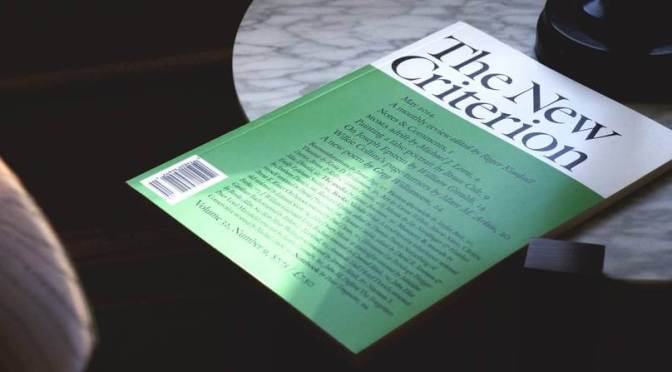
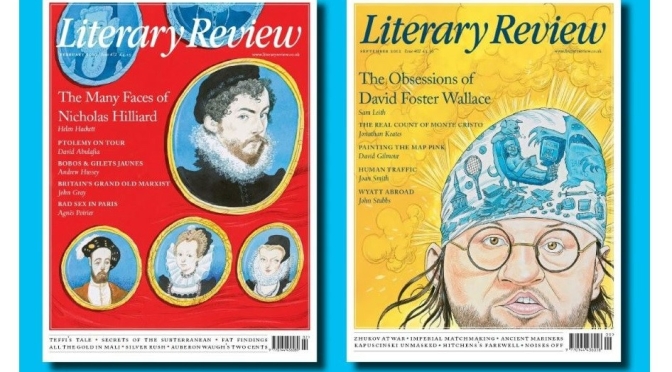
THE NEW CRITERION: The latest issue features…
Will China bury us? by Andrew Roberts
Leukophobia & other obsessions by Victor Davis Hanson
The lost worlds of Lawrence Durrell by Charles Sligh
Great genes by David Dubal

THE NEW CRITERION: The latest issue features…
Great genes by David Dubal

A critic’s power lies in the testing of deeply held beliefs about the nature of art and art’s place in the world against the experience of specific artworks.
Authority by Andrea Long Chu
All Things Are Too Small: Essays in Praise of Excess by Becca Rothfeld
Those Passions: On Art and Politics by T.J. Clark
Criticism and Truth: On Method in Literary Studies by Jonathan Kramnick
No Judgment by Lauren Oyler
The MAGA movement is not fed by conservative ideas but by a nihilistic, apocalyptic determination to stage a counterrevolution against the Sixties, against liberalism, against even democracy itself.
When the Clock Broke: Con Men, Conspiracists, and How America Cracked Up in the Early 1990s by John Ganz
Furious Minds: The Making of the MAGA New Right by Laura K. Field
Early modern female writers, who were denied the sort of authority usually needed to write literary criticism, were also freed from its constraints.
Sex and Style: Literary Criticism and Gender in Early Modern England by Elizabeth Scott-Baumann

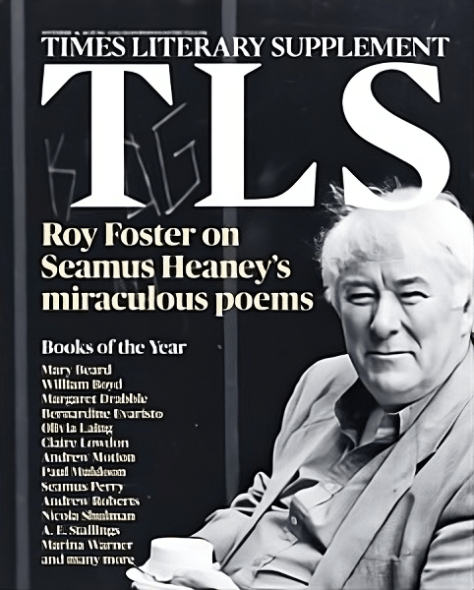
TIMES LITERARY SUPPLEMENT: The latest issue features ‘Artist in the making: Joyce Carol Oates on Sally Mann’s photographic craft’
The British upper classes today By Michael Hall
A how-to book by ‘one of the greatest’ American photographers’ By Joyce Carol Oates
László Krasznahorkai, Nobel laureate in literature By George Szirtes
Religion, immigration, gender politics and severed heads By Mary Beard

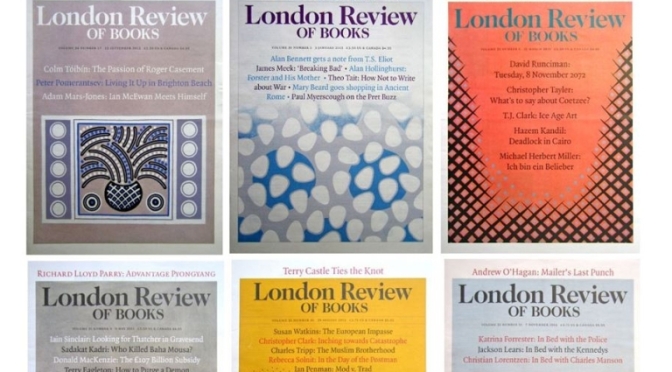
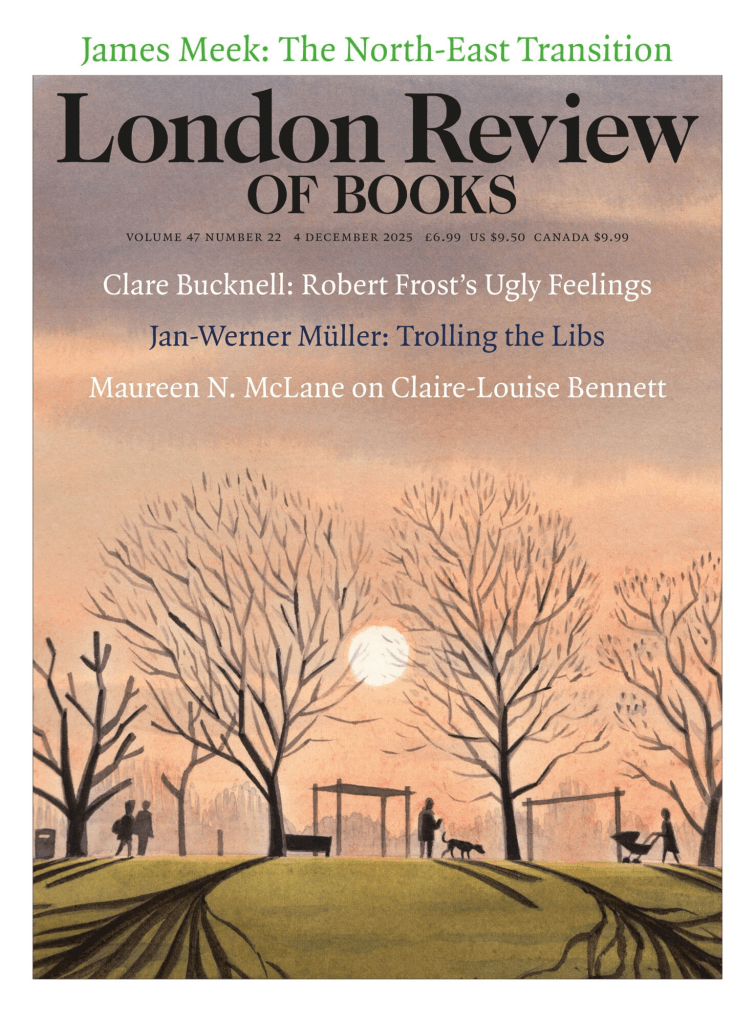
LONDON REVIEW OF BOOKS: The latest issue features ‘Mrs. Dalloway’s Demons
The Inner Life of ‘Mrs Dalloway’
by Edward Mendelson.
Columbia, 137 pp., £20, September, 978 0 231 22171 9
‘Mrs Dalloway’: Biography of a Novel
by Mark Hussey.
Manchester, 222 pp., £18.99, May, 978 1 5261 7681 3
Mrs Dalloway
by Virginia Woolf, edited by Edward Mendelson.
NYRB, 208 pp., £15.99, September, 978 1 68137 998 2
Mrs Dalloway
by Virginia Woolf, edited by Trudi Tate.
Oxford, 224 pp., £7.99, May, 978 0 19 285985 3
Gustave Flaubert et Michel Lévy: Un couple explosif
by Yvan Leclerc and Jean-Yves Mollier.
Le Livre de Poche, 224 pp., €8.40, November 2024, 978 2 253 94112 5
Liquid Empire: Water and Power in the Colonial World
by Corey Ross.
Princeton, 447 pp., £35, September 2024, 978 0 691 21144 2
In Praise of Floods: The Untamed River and the Life It Brings
by James C. Scott.
Yale, 220 pp., £20, February, 978 0 300 27849 1

THE NEW YORKER MAGAZINE: The latest cover features Harry Bliss’s “Cannonball” – The delights of fall.
Congress wrote statutes with the apparent assumption that whoever held the office of the Presidency would use the powers they granted in good faith. By Jeannie Suk Gersen
Smoking a cig takes twenty minutes off your life. But thinking about Rudy Giuliani’s downfall might add some time back. By Greg Clarke
How conservatives learned to stop worrying and love federal power. By Emma Green
The thirty-three-year-old socialist is rewriting the rules of New York politics. Can he transform the city as mayor? By Eric Lach

THE LONDON MAGAZINE (April 2, 2025): The latest issue features….
‘Several broadly millennial acquaintances confess that reading the book made them feel a sort of sickening recognition.’
Yasmina Snyder spoke to writers, poets, musicians and event organisers based in London about the connections between live music and poetry, and the spaces that host them.
‘There’s big trouble in the world of little magazines. In the last two years, an alarming number have vanished into that second-hand bookshop in the sky. Each leaves the world a little quieter, a little poorer.’

THE NEW YORKER MAGAZINE: The latest cover features Brian Stauffer’s “Winds of Change” – A gust of fall.
Peace abroad and war at home? It’s an unusual note to strike in an electoral democracy. By Benjamin Wallace-Wells
President Nixon got the brothers’ variety show cancelled after they wouldn’t let up on Vietnam. In the wake of the new late-night wars, Dick Smothers is having flashbacks. By Bruce Handy
As the thirtysomething leader of Finland, Sanna Marin pursued an ambitious policy agenda. The press focussed on her nights out and how she paid for breakfast. By Jennifer Wilson
The chief prosecutor has obtained warrants against Israeli leaders for war crimes—but faces allegations of sexual misconduct. By David D. Kirkpatrick
How Hypatia of Alexandria’s murder marked the moment reason fell to zeal—and why her lesson still echoes in an age ruled by algorithms.

By Michael Cummins, Editor, October 5, 2025
In the waning light of Alexandria’s golden age, a woman stood at the threshold of the cosmos. Draped in the robes of a philosopher, Hypatia of Alexandria taught mathematics as if it were music, astronomy as if it were prayer, and philosophy as if it were the architecture of the soul. She wrote no manifestos and led no armies. She taught. She reasoned. And for this—for the audacity of clarity in a world turning toward dogma—she was torn from the world. Her death was not merely a murder; it was a cultural wound, a severing of the classical from the medieval, of inquiry from ideology. The light she guarded—the flickering flame of secular, public reason—was extinguished in the very place conceived to protect it.
To speak of Hypatia is to speak of a city that believed knowledge could civilize the human spirit. Alexandria, founded by Alexander and tended by the Ptolemies, was the ancient world’s neural network, an experiment in global curiosity. Within its Library and Museum—the first great research institute—scholars mapped the heavens, dissected geometry, and debated the soul’s immortality under vaulted ceilings that smelled of parchment and sea salt. It was in this monumental, decaying marble world that Hypatia was born, around 370 CE, to Theon, the Library’s last known scholar. Her father taught her what Euclid and Eratosthenes had discovered, but she learned what they had meant: that geometry was not sterile abstraction but a form of devotion, a way of approaching perfection through reason.
She inherited the lineage of the ancients—the serene logic of Euclid, the restless measurement of Eratosthenes, the astronomical audacity of Ptolemy—and fused them into something both rigorous and spiritual. In late antiquity, knowledge still shimmered with moral purpose. Neoplatonism, the philosophy she championed, held that all things emanated from a single divine source, and that the human mind could ascend toward it through contemplation and mathematics. Numbers were not quantities but metaphors of being; to trace a circle was to imitate eternity. For Hypatia, geometry was not an escape from the world but its transfiguration—each theorem a small proof of cosmic coherence. It was not rebellion but refinement, a path to God that required no priest—and therefore could not be permitted.
Her genius lay in making the abstract visible. She wrote commentaries on Diophantus’s Arithmetica, clarified Ptolemy’s Almagest, and edited Apollonius’s Conics, ensuring future astronomers could still plot the curves of planets and light. Yet her intellect was not confined to parchment. She improved the astrolabe, designed hydroscopes to measure fluid density, and demonstrated that science was not the enemy of spirituality but its instrument. In Hypatia’s hands, philosophy became a navigation system—an attempt to chart truth in a universe governed by reason.
Imagine her in the lecture hall: morning light slanting through the colonnade, dust motes rising like miniature stars. A semicircle of students—Greeks, Egyptians, Romans, Jews, Christians—sit cross-legged at her feet. “You see,” she tells one, “a circle is not only a form—it is an argument for eternity.” Another asks, “And where is the soul in all this?” She pauses, chalk in hand. “In the harmony,” she says, smiling. The air hums with the audacity of free exchange. In an age dividing along creeds, her classroom was a sanctuary of synthesis.
At night, when the city’s noise dimmed and the harbor lanterns shimmered against the water, she would walk the colonnade alone. The scrolls in her study carried the scent of dust and oil. She read by lamplight until her fingers grew black with soot. To her students, she was certainty incarnate; alone, she seemed to understand that clarity provokes envy—that serenity itself is a kind of heresy. Even the stars she charted seemed to dim slightly under the weight of her foresight.
Her authority rested not on birth or ordination but on rational mastery—an unsettling legitimacy that bypassed both patriarchs and priests. She was an unmarried woman commanding reverence in a public space. Her followers were loyal not to a doctrine but to the discipline of thought itself. That was her heresy.
By the early fifth century, the harmony she embodied had begun to collapse. Alexandria had become a city of sharpened edges: pagan temples shuttered, Jewish enclaves under siege, imperial statues toppled and replaced by crosses. The Roman Empire was disintegrating; in its vacuum rose new centers of power, most formidable among them the Church. Bishop Cyril, brilliant and autocratic, sought to consolidate both spiritual and civic control. The imperial prefect Orestes—Hypatia’s friend and intellectual peer—defended the older ideal of the secular city. Between them stood the philosopher, calm and unarmed, the last civil defense against clerical supremacy.
The city had become a mirror of the empire’s exhaustion. Pagan artisans carved crosses beside the fading faces of their old gods; traders whispered prices under the sound of sermons. In the streets, theology replaced law. Orestes issued decrees that no one obeyed; Cyril’s sermons moved armies. The parabalani patrolled the harbor, their tunics stained from tending the sick and, at times, from beating the unbeliever. What began as civic unrest curdled into ritual violence—not just a fight for power, but for the right to define what counted as truth.
The conflict between Hypatia and Cyril was more than political. It was metaphysical. She represented individual, discovered truth; he, collective, inherited truth. Her worldview required no mediator between human reason and the divine. His authority depended on the indispensability of mediation. To Cyril, Neoplatonism’s notion that one could approach God through geometry and contemplation was blasphemy—it made the soul its own priest. The Church could not tolerate such independence.
One March afternoon, the mob found her carriage. They dragged her through the streets to a church—irony as architecture. Inside, beneath mosaics of saints, they stripped her, flayed her with oyster shells, and burned what remained. Socrates Scholasticus, a Christian historian, wrote simply: “Such a deed brought great disgrace upon Cyril and the Church of Alexandria.” It was not a killing; it was an exorcism. By tearing her apart, they sought to purge the city of its final pagan ghost—the living remnant of Athens’ rational soul.
Orestes, her ally, could not avenge her. The Empire, hollowed by decay, turned away. Cyril triumphed, later sanctified as a saint. The rule of law yielded to the rule of zeal. And so, with Hypatia’s death, an epoch ended. The library’s embers cooled, the lamps of the Museum darkened, and Europe entered its long medieval night.
For nearly a thousand years she survived only as rumor. Then the Enlightenment rediscovered her. Gibbon saw in her death the moment “barbarism and religion triumphed.” Voltaire invoked her as evidence that superstition kills what it cannot comprehend. Hypatia’s revival became part of a broader reckoning—a rebellion against inherited authority. To Enlightenment thinkers, she was the prototype of their own project: the reclamation of reason from revelation.
To later feminists, she became something more. Her murder revealed a longer pattern—the way intellectual women are punished not for ignorance but for illumination. Mary Wollstonecraft read her story as an ancestral warning; Simone de Beauvoir as a prelude to every modern silencing of the female intellect. To them, Hypatia was not just the first martyr of reason but its first woman martyr—the proof that wisdom in a woman’s voice has always been political.
Even now, her image flickers at the edge of cultural memory: the philosopher as secular saint, the teacher as threat. She has become the emblem of every rational mind undone by hysteria. Yet her deeper legacy lies not only in her martyrdom but in her method—the belief that the world is comprehensible, and that comprehension is a moral act.
And what, sixteen centuries later, does her story demand of us? We, too, live in an Alexandria of our own making, a world of infinite information and vanishing wisdom. Our libraries are digital, our mobs algorithmic. The algorithm has become the modern parabalani, shredding context and nuance for the sake of engagement. Knowledge no longer burns by fire; it corrodes by speed. We scroll instead of study, react instead of reflect. What once was a civic agora has become a coliseum of certitude.
Somewhere in a dim university office, a woman corrects her students’ proofs by the light of her laptop. She teaches them to think slowly in a world that rewards speed, to doubt the easy answer, to hold silence as rigor. Outside, the din of the feed hums like an approaching crowd. She doesn’t know it, but she’s teaching Hypatia’s lesson: that the mind’s true courage lies not in certainty but in patience.
Her challenge endures. The purpose of philosophy is not to win the argument but to chart the truth, even when the world insists on remaining lost. She reminds us that every age must relearn how to think freely, and that freedom of thought, once lost, returns only through vigilance.
To honor Hypatia is not merely to remember her death but to practice her discipline: to teach, to reason, to listen. The world will always be noisy, half-mad with conviction. Somewhere, in the imagined quiet of that vanished library, a woman still draws circles on marble, tracing the harmonies of a cosmos we have not yet earned. If she could look up now, she would find the same constellations unchanged—Orion still hunting, Cassiopeia still boasting, the curve of the moon unbroken. The geometry she once traced on marble persists in the heavens, indifferent to history’s convulsions. That, perhaps, was her final comfort: that reason, like starlight, travels slowly but never dies. It only waits for another mind, somewhere in the future, to lift its face and see.
THIS ESSAY WAS WRITTEN AND EDITED UTILIZING AI
THE WEEK IN ART (October 2, 2025): The latest episode feature a new exhibition at the Fitzwilliam Museum in Cambridge, UK, called Made in Ancient Egypt, reveals untold stories of the people behind a host of remarkable objects, and the technology and techniques they used.
The Art Newspaper’s digital editor, Alexander Morrison visits the museum to take a tour with the curator, Helen Strudwick. One of the great revelations of the past two decades in scholarship about women artists is Michaelina Wautier, the Baroque painter active in what is now Belgium in the middle of the 17th century. The largest ever exhibition of Wautier’s work opened this week at the Kunsthistorisches Museum in Vienna, and travels to the Royal Academy of Arts in London next year.
Ben Luke speaks to the art historian who rediscovered this extraordinary painter, Katlijne Van der Stighelen, who has also co-edited the catalogue of the Vienna show. And this episode’s Work of the Week is Robert Rauschenberg’s Bed (1955), one of the most important works of US art of the post-war period. It features in the exhibition Five Friends: John Cage, Merce Cunningham, Jasper Johns, Robert Rauschenberg, Cy Twombly, which this week arrives at the Museum Ludwig in Cologne.
We speak to Yilmaz Dziewior, the co-curator of the exhibition.
Made in Ancient Egypt, Fitzwilliam Museum, Cambridge, UK, 3 October-2 April 2026
Michaelina Wautier, Painter, Kunsthistorisches Museum, Vienna
30 September-22 February 2026; Royal Academy of Arts, London
27 March – 21 June 2026.
Five Friends: John Cage, Merce Cunningham, Jasper Johns, Robert Rauschenberg, Cy Twombly, Museum Ludwig, Cologne, Germany,
3 October-11 January 2026

Fights about digital filtering tools have turned more and more bitter. That’s because of their extraordinary power to shape both political opinion and mass culture.
Invisible Rulers: The People Who Turn Lies into Reality by Renée DiResta
Character Limit: How Elon Musk Destroyed Twitter by Kate Conger and Ryan Mac
Filterworld: How Algorithms Flattened Culture by Kyle Chayka
The Soviet Union’s ambitious program of gender equality could never be separated from its abuses of power.
Motherland: A Feminist History of Modern Russia, from Revolution to Autocracy by Julia Ioffe
Shadow Ticket is brisker than Thomas Pynchon’s other work, but it’s full of his usual vaudevillian sensibility, and it addresses his favorite theme: how to live freely under powerful systems of control.
Shadow Ticket by Thomas Pynchon