

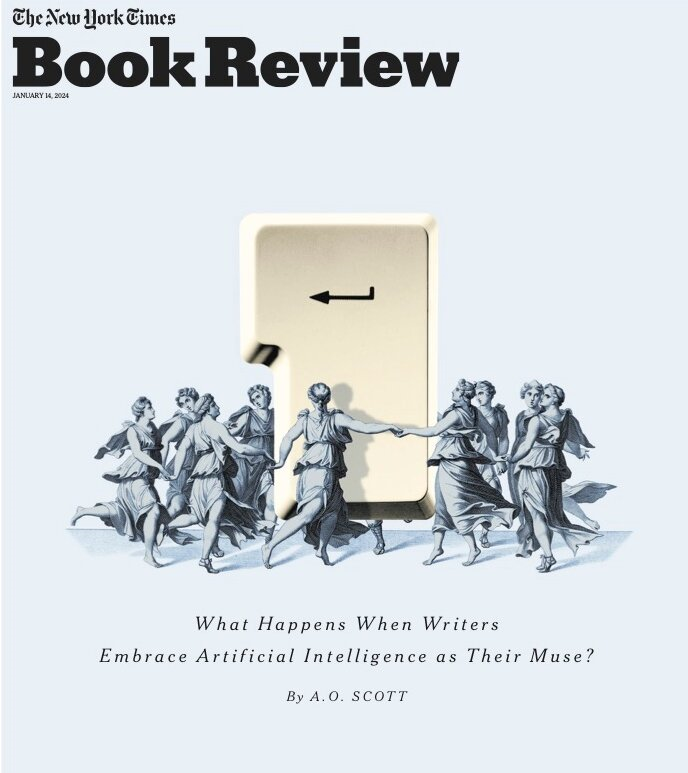

THE NEW YORK TIMES BOOK REVIEW (January 12, 2024): The latest issue features ‘What Happens When Writers Embrace Artificial Intelligence as Their Muse? by A.O. Scott…
Literature Under the Spell of A.I.

What happens when writers embrace artificial intelligence as their muse?
By A.O. Scott
The robots of literature and movies usually present either an existential danger or an erotic frisson. Those who don’t follow in the melancholy footsteps of Frankenstein’s misunderstood monster march in line with the murderous HAL 9000 from “2001: A Space Odyssey,” unless they echo the siren songs of sexualized androids like the ones played by Sean Young in “Blade Runner” and Alicia Vikander in “Ex Machina.”
We fantasize that A.I. programs will seduce us or wipe us out, enslave us or make us feel unsure of our own humanity. Trained by such narratives, whether we find them in “Terminator” movies or in novels by Nobel laureates, we brace ourselves for a future populated by all kinds of smart, possibly sentient machines that will disrupt our most cherished notions of what it means to be human.
A Clash of Civilizations Brought to Life

For Álvaro Enrigue, a novelist fascinated with historical detail, the first meeting of the Aztecs and Spanish conquistadors is the obsession of a lifetime. He brings it to life in “You Dreamed of Empires.”
By Benjamin P. Russell
The Aug. 13, 2021 edition of The New York Times failed to mention the 500th anniversary of the fall of Tenochtitlan, the erstwhile Aztec capital out of which Mexico City was born. Álvaro Enrigue noticed. Of course.
The 54-year-old Enrigue, who grew up in Mexico City, believes that early meeting between Europe and the Americas changed the trajectory of global commerce, urbanism, industry and much else besides. Modernity itself, he argues, was born in the moment the Aztec emperor Moctezuma and Hernan Cortés, the Spanish conquistador, first looked each other in the eye in 1519, a clash of empires that set in motion the city’s capture two years later.



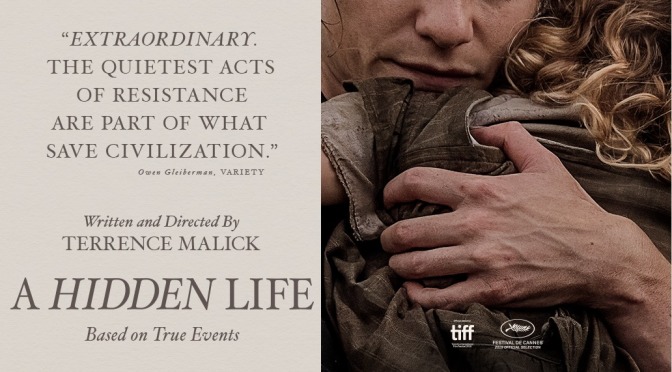
 The arresting visual beauty of “A Hidden Life,” which was shot by Joerg Widmer, is essential to its own argument, and to Franz’s ethical and spiritual rebuttal to the concerns of his persecutors and would-be allies. The topography of the valley is spectacular, but so are the churches and cathedrals. Even the cells and offices are infused with an aesthetic intensity at once sensual and picturesque.
  Boomers Daily