
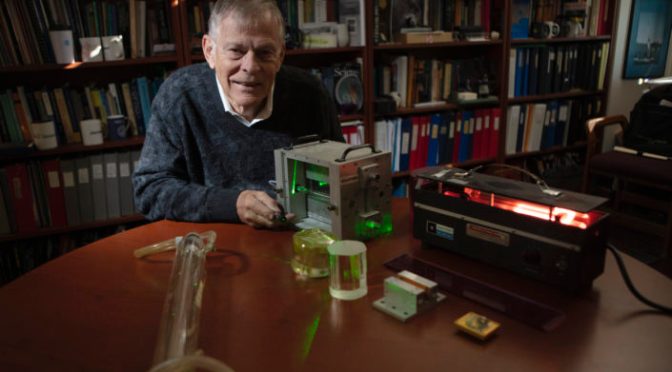
From a Stanford University News article:
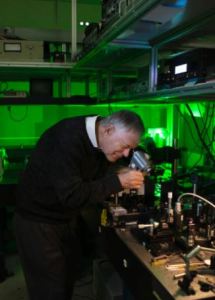 Byer also helped develop the quietest, most stable laser in the world, called the diode-pumped YAG laser. YAG lasers are today found in everything from communications satellites to green handheld laser pointers, which Byer co-developed with two of his graduate students and cites as one of his favorite inventions (he had joined Stanford in 1969). YAG lasers also form the main beams of the gravitational wave-detecting instrument, LIGO, which in 2015 achieved the most precise measurement ever made by humans when its antenna detected the tenuous spacetime fluctuations generated by two colliding black holes 1.3 billion light-years away.
Robert Byer was 22 years old when he first saw the light that changed his life.
 One summer morning in 1964, Byer drove the hour from Berkeley down to Mountain View for a job interview at a California company called Spectra Physics. He walked in to find an empty lobby but could hear clapping and cheering in the back of the building. After politely waiting for several minutes, he followed the commotion to a darkened room filled with men whose jubilant faces were illuminated by a rod of red-orange light that seemed to float above an instrument-strewn table
To read more: https://news.stanford.edu/2019/11/19/life-changing-first-glimpse-laser/
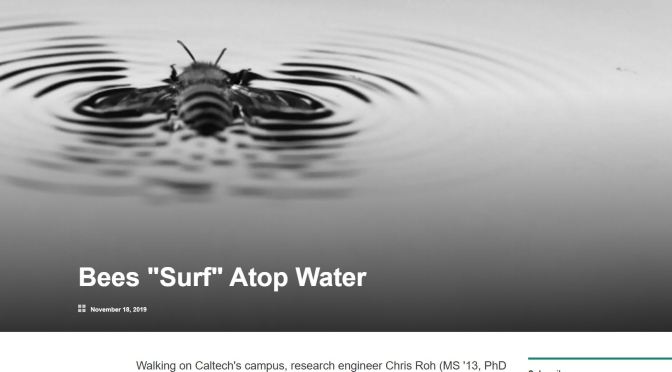
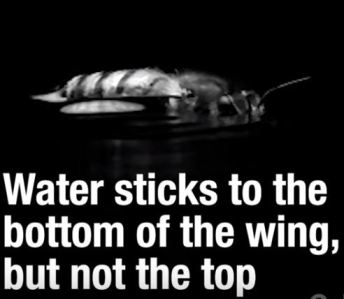 When a bee lands on water, the water sticks to its wings, robbing it of the ability to fly. However, that stickiness allows the bee to drag water, creating waves that propel it forward. In the lab, Roh and Gharib noted that the generated wave pattern is symmetrical from left to right. A strong, large-amplitude wave with an interference pattern is generated in the water at the rear of the bee, while the surface in front of the bee lacks the large wave and interference. This asymmetry propels the bees forward with the slightest of force—about 20 millionths of a Newton.
 The Grand Challenge Prize is looking for bold, audacious innovations, ideas that can really change aging. We’re looking in science, in technology and engineering, in policy, social sciences, behavioral sciences, economic policy, in traditional medical science and health care, and in work focused on specific diseases. It’s really very broad. We’re looking for innovative thinking that can have global impact. The prizes are going to roll out on three levels. There will be 450 Catalyst Prizes awarded over a three-year period. The first of the three yearly calls will be in January 2020. Once it’s announced, there will be six weeks to submit your idea — just the idea, it doesn’t require any pilot work — and a two-page application. They’ll be reviewed within four months and prizes announced by July. The Catalyst Award is intended as seed funding to get the idea into its earliest stages of development. They’re relatively small in dollar amount, about $50,000 each, but they will give access to an annual meeting bringing together world experts in these fields.


 Benjamin Thompson brings you the latest science news. This week, an antibiotic that targets difficult to treat bacteria, and a roundup of the latest science news.
 Most historical accounts of slavery were written by colonists and planters. Researchers are now using the tools of archaeology to learn more about the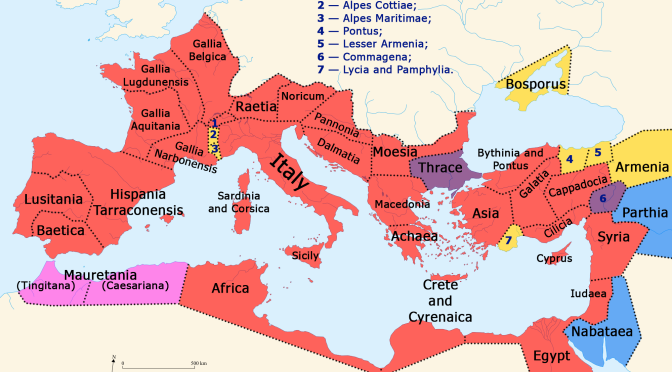
 There was a massive shift in Roman residents’ ancestry, the researchers found, but that ancestry came primarily from the Eastern Mediterranean and Near East, possibly because of denser populations there relative to the Roman Empire’s western reaches in Europe and Africa.
 Listen to the latest science updates, with Benjamin Thompson and Shamini Bundell. This week, insights into the evolution of walking upright, how science needs to change in the next 150 years, and the remaining hurdles for vaccination.
 Boomers Daily