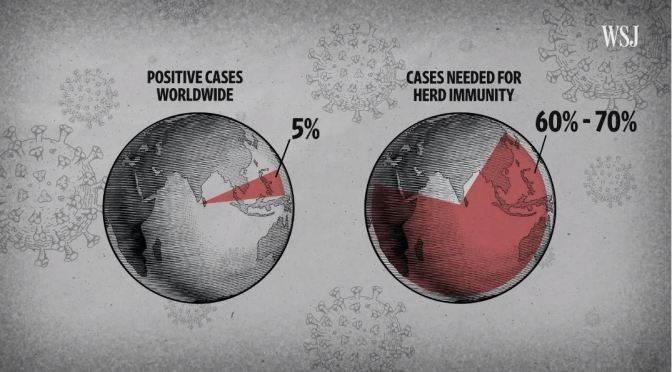
Scientists are working at breakneck speed to develop an effective vaccine for the coronavirus. Their ultimate goal: to immunize enough of the world’s population to reach herd immunity. WSJ explains.
Illustration: Jacob Reynolds

Scientists are working at breakneck speed to develop an effective vaccine for the coronavirus. Their ultimate goal: to immunize enough of the world’s population to reach herd immunity. WSJ explains.
Illustration: Jacob Reynolds
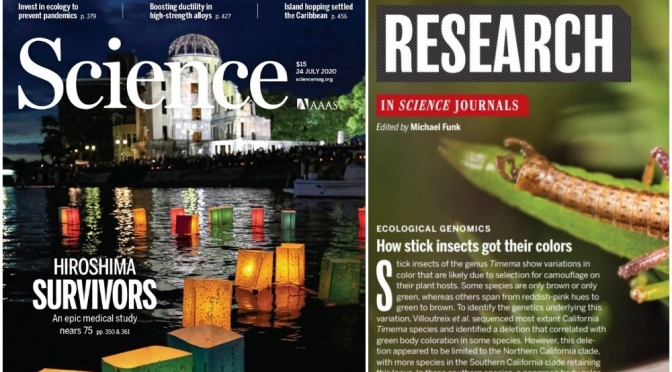
 Contributing Correspondent Dennis Normile talks about a long-term study involving the survivors of the Hiroshima and Nagasaki bombings. Seventy-five years after the United States dropped nuclear bombs on the two cities in Japan, survivors are still helping scientists learn about the effects of radiation exposure.
Also this week, Sarah talks with Winnie Lau, senior manager for preventing ocean plastics at Pew Charitable Trusts about her group’s paper about what it would take to seriously fight the flow of plastics into the environment. This week’s episode was produced with help from Podigy.
 When did people arrive in the Americas? New evidence stokes debate. New evidence may push back the date on human arrival to the Americas, and an examination of science’s flaws.
In this episode:
00:59 Ancient Americans
Two papers suggest that humans were present in the Americas thousands of years before many people have thought. We examine the evidence. Research Article: Ardelean et al.; Research Article: Becerra-Valdivia and Higham; News and Views: Evidence grows that peopling of the Americas began more than 20,000 years ago
10:44 Coronapod
We discuss the latest results from vaccine trials around the world, and controversy in the US as COVID-19 data collection moves out of the CDC. News: Coronavirus vaccines leap through safety trials — but which will work is anybody’s guess
24:38 Research Highlights
How being green makes things easy for some frogs, and how waves will be affected by climate change. Research Highlight: How frogs became green — again, and again, and again; Research Highlight: Extreme Arctic waves set to hit new heights
27:11 How can science improve?
A new book highlights some of the flaws of how science is done. We caught up with the author to find out his thoughts on how science can be cleaned up. Books and Arts: Fraud, bias, negligence and hype in the lab — a rogues’ gallery
35:54 Briefing Chat
We take a look at some highlights from the Nature Briefing. This time we discuss a puzzling new insight into the expansion of the Universe, and an update to Plan S that will allow open-access research to be published in any journal. Nature News: Mystery over Universe’s expansion deepens with fresh data; Nature News: Open-access Plan S to allow publishing in any journal

Contributing Correspondent Gretchen Vogel talks about what can be learned from schools around the world that have reopened during the coronavirus pandemic. Unfortunately, few systematic studies have been done, but observations of outbreaks in schools in places such as France or Israel do offer a few lessons for countries looking to send children back to school soon.
The United Kingdom and Germany have started studies of how the virus spreads in children and at school, but results are months away. In the meantime, Gretchen’s reporting suggests small class sizes, masks, and social distancing among adults at schools are particularly important measures.
Also this week, Sarah talks with Kiristie Thompson, a Ph.D. student in the Georgia Institute of Technology’s Department of Chemistry and Biochemistry, about increasing the efficiency of petroleum processing. If all—or even some—petroleum processing goes heat free, it would mean big energy savings. Around the world, about 1% of all energy use goes to heating up petroleum in order to get useful things such as gas for cars or polymers for plastics. These days, this separation is done through distillation, heating, and separating by boiling point. Kirstie describes a heat-free way of getting this separation—by using a special membrane instead. Read a related Insight.
Probing the superconducting properties of graphene and a bacteria that can use manganese to grow. If you sandwich two sheets of graphene together and twist one in just the right way, it can gain some superconducting properties. Now, physicists have added another material to this sandwich which stabilises that superconductivity, a result that may complicate physicists’ understanding of magic angles.
08:22 Coronapod
With evidence mounting that SARS-CoV2 can spread in tiny aerosolized droplets, researchers have called on the WHO to change their guidance for disease prevention. News: Mounting evidence suggests coronavirus is airborne — but health advice has not caught up; Research article: Morwaska et al.; WHO: Transmission of SARS-CoV-2: implications for infection prevention precautions
19:27 Research Highlights
Repairing human lungs by hooking them up to pigs, and a new form of carbon. Research Highlight: How to use a live pig to revitalize a human lung; Research Highlight: This material is almost as hard as diamond — but as light as graphite
21:46 Manganese munchers
For decades it’s been thought that microbes that use manganese as an energy source must exist. Now, for the first time, researchers have found evidence that they do. Research Article: Yu and Leadbetter
29:12 Briefing Chat
We take a look at some highlights from the Nature Briefing. This time we discuss DNA evidence of contact between ancient Native Americans and Polynesians, reintroduction of bison to the UK, and the first extinction of a modern marine fish. Nature News: Ancient voyage carried Native Americans’ DNA to remote Pacific islands; The Guardian: Wild bison to return to UK for first time in 6,000 years; Scientific American:
With antibodies having implications for both our understanding of previous coronavirus infections and potential future immunity, Nicola Davis talks to Prof Eleanor Riley about how best to test for them and asks whether antibodies are the only thing we should be looking for.
Dr. Aimee Kao discusses key behaviors known to protect brain health. Dr. Kao looks at population trends and wonders if they tell a complete story. Watch full lecture here:


 Boomers Daily