
Preview: Philosophy Now Magazine April/May 2024

Image

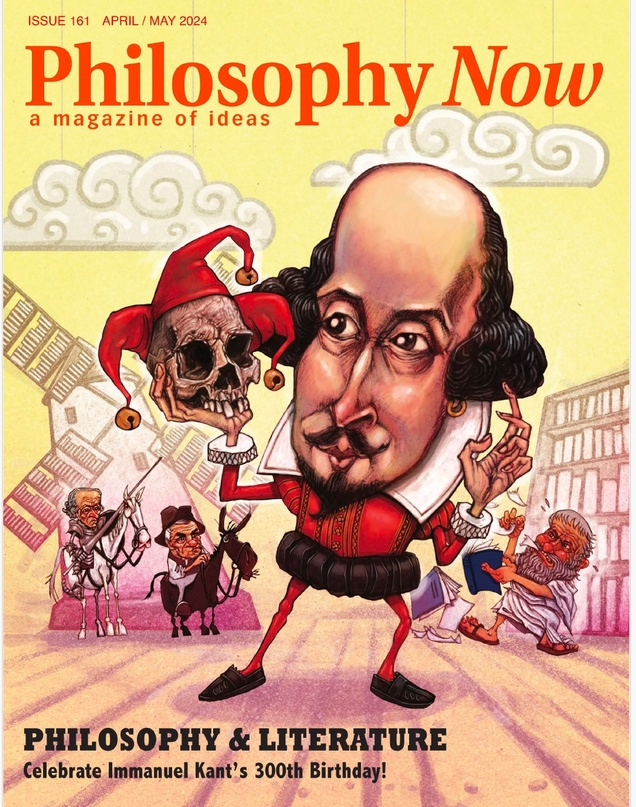
Philosophy Now Magazine (April/May 2024)The new issue features ‘Philosophy & Literature’ – Celebrate Immanuel Kant’s 300th Birthday….

How to Have a Good Life

Meena Danishmal asks if Seneca’s account of the good life is really practical.

According to the Oxford English Dictionary, the adjective ‘stoical’ means “resembling a Stoic in austerity, indifference, fortitude, repression of feeling and the like”. This gives us some idea of what it is like to be a Stoic. Indeed, the key teaching, arguably the fundamental point, of Stoicism, is that we should focus on controlling the things that are under our control, such as our thoughts, emotions, and actions, whilst accepting those things we cannot control, such as most things that are happening in the world. How did they get there?

To consider this question let’s look at the ideas of the Roman philosopher and statesman Lucius Annaeus Seneca the Younger (4 BCE-65 CE). As a top advisor to the paranoid and murderous Emperor Nero, he probably found Stoicism a particularly practical guide to life.

As a Stoic, Seneca believed the soul (Latin: anima or animus) to be a finer form of matter than the body; but matter it is. It was also described as a spark of the fire which had consumed the original matter. With such an understanding of the soul, where does the soul reside within the body? Stoics provided a rather simple answer: everywhere. The soul was considered to be a vital force that animates the whole body. The soul was also the source of reason, virtue, and moral character, which is what Stoic philosophy is built upon, as the rational soul guides individuals towards living in accordance with nature.

For us to understand this concept further, it’s vital to grasp the Stoic conception of reality. Stoics see the universe as interconnected and interwoven, and this unified cosmos as governed by rational principles. Within this holistic perspective, the soul is seen as part of the divine rational order of the universe. This understanding forms the basis of Stoic ethics, which emphasises the importance of cultivating reason and virtue in all aspects of life. This encouragement to align thoughts, actions, and desires with principles of reason, is a way for the soul to flourish.


Previews: The New Yorker Magazine – April 8, 2024

A person's silhouette walks up stairs toward a busy city street.

The New Yorker (April 1, 2024): The new issue‘s cover features Pascal Campion’s “Into the Light” – The artist depicts stepping out of the subway into the overwhelming glow of the city.

So You Think You’ve Been Gaslit

An anthropomorphic lantern being lit by a man.

What happens when a niche clinical concept becomes a ubiquitous cultural diagnosis.

By Leslie Jamison

When Leah started dating her first serious boyfriend, as a nineteen-year-old sophomore at Ohio State, she had very little sense that sex was supposed to feel good. (Leah is not her real name.) In the small town in central Ohio where she grew up, sex ed was basically like the version she remembered from the movie “Mean Girls”: “Don’t have sex, because you will get pregnant and die.”

Black Holes Are Even Weirder Than You Imagined

An artistic rendering of two supermassive black holes.

It’s now thought that they could illuminate fundamental questions in physics, settle questions about Einstein’s theories, and even help explain the universe.

By Rivka Galchen

Black holes are, of course, awesome. But, for scientists, they are more awesome. If a rainbow is marvellous, then understanding how all the colors of the rainbow are present, unified, in ordinary white light—that’s more marvellous. (Though, famously, in his poem “Lamia,” John Keats disagreed, blaming “cold philosophy” for unweaving the rainbow.) In recent years, the amount of data that scientists have discovered about black holes has grown exponentially. In January, astronomers announced that the James Webb Space Telescope had observed the oldest black hole yet—one present when the universe was a mere four hundred million years old. (It’s estimated that it’s now 13.8 billion years old.) Recently, two supermassive black holes, with a combined mass of twenty-eight billion suns, were measured and shown to have been rotating tightly around each other, but not colliding, for the past three billion years. And those are just the examples that are easiest for the public to make some sense of. To me, a supermassive black hole sounds sublime; to a scientist, it can also be a test of wild hypotheses. “Astrophysics is an exercise in incredible experiments not runnable on Earth,” Avery Broderick, a theoretical physicist at the University of Waterloo and at the Perimeter Institute, told me. “And black holes are an ideal laboratory.”

News: Elections In Turkey, Diplomacy In Australia, Vacancy Taxes In Austria

The Globalist (April 1, 2024): Voters head to the polls in Turkey to vote in local and mayoral elections in what’s being seen as a test for President Reccep Tayyip Erdogan.

Plus: the return of Isis, Australia’s diplomatic deficit and Austria’s vacancy tax.

The New York Times — Monday, April 1, 2024

Image

Some Potential Trump Witnesses Get Carrots. Michael Cohen Got the Stick.

Former President Donald J. Trump has taken different approaches to those who may testify at his trials. Some, he attacks publicly. Others he rewards for loyalty.

Protests Against Netanyahu Intensify as Cease-Fire Talks Resume

Thousands have taken to the streets of Israel to demand that Prime Minister Benjamin Netanyahu be replaced.

‘A Chance to Live’: How 2 Families Faced a Catastrophic Birth Defect

Cases of trisomy 18 may rise as many states restrict abortion. But some women choose to have the babies, love them tenderly and care for them devotedly.