
Tag Archives: Waves

Documentaries: What Causes ‘Monster Waves’?

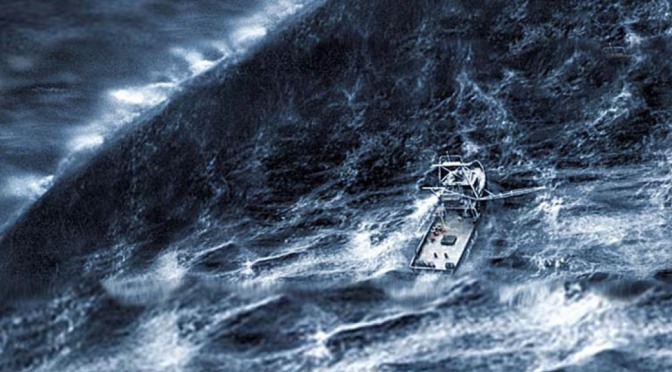
DW Documentary (April 30, 2023) – Statistically, a large ship is lost in the world’s oceans almost once every seven days. One reason for this: monster waves that appear to come from nowhere. Unlike tsunamis, they are completely unpredictable. That means there’s no way to issue any kind of warning.

Scientists still know astonishingly little about these freak waves. For centuries, many people dismissed them as the stuff of legend. The first scientific proof of their existence didn’t come until 1995. A laser on the Draupner oil rig in the North Sea measured a wave almost 26 meters high. Wave models in use at the time deemed this to be an impossibility.

But the data, captured by chance, changed the course of research forever. Scientists have focused on three theories in their bid to explain the emergence of freak waves. The first is the current model: currents flowing in opposite directions reduce the length of the waves, pushing them together to create a monster surge. But freak waves are also a phenomenon in regions where currents aren’t particularly strong.

That’s why researchers came up with a second theory: superposition. In this linear process, faster, longer waves catch up with short, slower waves. They overlap and form monster waves. But in some places, freak waves occur with a frequency that can’t be explained by this linear theory, either.

For several years now, scientists have been considering a third possibility: when non-linear wave trains are unstable, they can develop into monster waves through a highly complex energy “theft”. Research is divided over whether it’s the linear or non-linear effects that form freak waves out at sea – a question that’s crucial for shipping!
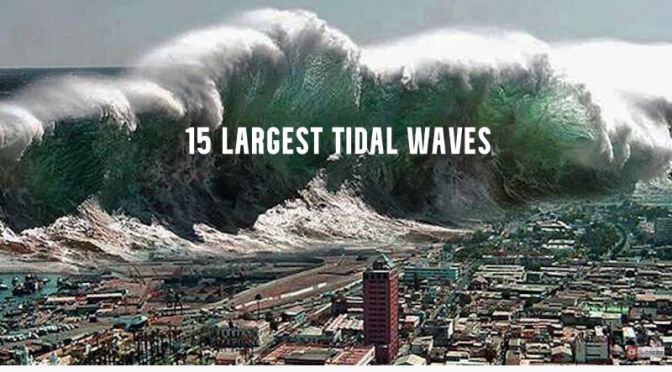
Catastrophic Events: History’s ’15 Largest Tidal Waves & Tsunamies’ (Video)

The largest tidal waves, tsunamis, and other types of waves throughout history. Never turn your back to the sea.

  • #1 Lituya Bay, Alaska – On the night of July 9, 1958, an earthquake along the Fairweather Fault in the Alaska Panhandle loosened about 40 million cubic yards (30.6 million cubic meters) of rock high above the northeastern shore of Lituya Bay. This mass of rock plunged from an altitude of approximately 3000 feet (914 meters) down into the waters of Gilbert Inlet (see map below). The impact force of the rockfall generated a local tsunami that crashed against the southwest shoreline of Gilbert Inlet. The wave hit with such power that it swept completely over the spur of land that separates Gilbert Inlet from the main body of Lituya Bay. The wave then continued down the entire length of Lituya Bay, over La Chaussee Spit and into the Gulf of Alaska. The force of the wave removed all trees and vegetation from elevations as high as 1720 feet (524 meters) above sea level. Millions of trees were uprooted and swept away by the wave. This is the highest wave that has ever been known.
  • #2 Krakatoa tsunami – The 27 August 1883 explosion of Krakatau Volcano in Indonesia is one example of an eruption-caused tsunami. The eruption generated a 30m tsunami in the Sunda Strait which killed about 36,000 people, as it washed away 165 coastal villages on Java and Sumatra.
  • #3 2004 Indian Ocean earthquake and tsunami occurred at 07:58:53 in local time on 26 December, with an epicentre off the west coast of northern Sumatra, Indonesia. It was an undersea megathrust earthquake that registered a magnitude of 9.1–9.3 Mw, reaching a Mercalli intensity up to IX in certain areas.

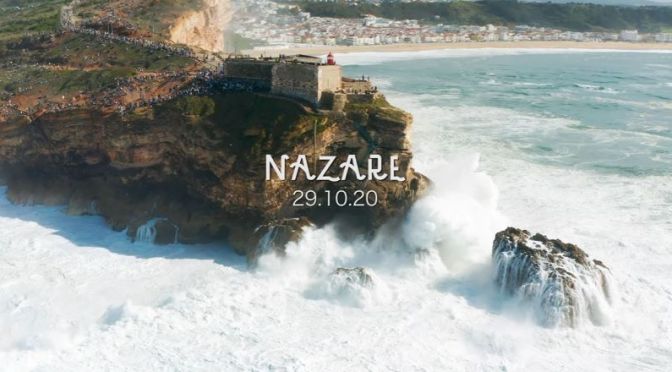
Travel & Adventure Video: ‘Nazaré, Portugal’ – Home Of Biggest Waves On Earth

Nazaré  is a municipality in Oeste region and Leiria District, in historic Estremadura province of Portugal.

It is one of the most popular seaside resorts in the Silver Coast (Costa de Prata). The population in 2011 was 15,158 in an area of 82.43 km². The present mayor is Walter Chicharro, a member of the Socialist Party. The municipal holiday is on 8 September, as part of the Our Lady of Nazaré Festival, a ten-day religious and secular celebration with processions, bullfights, fireworks, folk dancing and a fair.

The town consists of three neighbourhoods: Praia (along the beach), Sítio (an old village, on top of a cliff) and Pederneira (another old village, on a hilltop). Praia and Sítio are linked by the Nazaré Funicular, a funicular railway.

Website

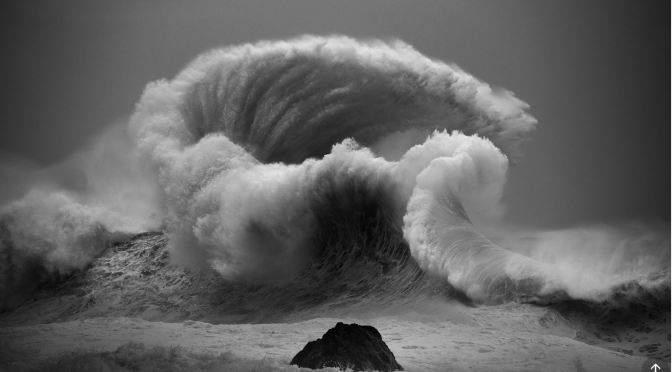
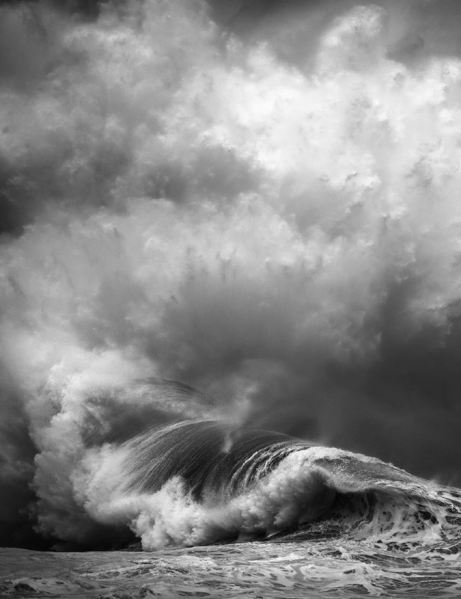
Top Photographers: Luke Shad Bolt’s “Roiling Majesty” Of Ocean Waves

From a Colossal online article:

Maelstrom 8, 2016 Luke Shad BoltIn a statement on the artist’s website, the Maelstrom series is described as “a cursory glimpse of the exchange, cycle and balance of power fundamental to the functioning of our planet and its oceans… Maelstrom encourages the viewer to reflect upon our own naivety and place as a species within the greater natural balance of power.”

Luke Shadbolt captures the roiling majesty of ocean waves in his large-scale aquatic photographs. Printed at 150 x 100 cm (nearly 6 feet by 3.3 feet), the color and black-and-white images show the dramatic shapes and dynamic textures of open water when agitated by major weather events.

https://lukeshadbolt.com/portfolio

The Acquiesce the Front series similarly seeks to draw connections between the human experience and our natural environment. “The physical manifestations portrayed are a deft reflection of those storms that are implicit to the human condition,” and our individual frailty in the face of big events. Yet Shadbolt finds hope in the potential “to learn and grow from these events. While we may be powerless to stop the storm from approaching, we can work to redirect the flood.”

To read more: https://www.thisiscolossal.com/2019/10/waves-by-luke-shadbolt/?mc_cid=e31c291cfd&mc_eid=28f9488a9b