
Tag Archives: The New York Times

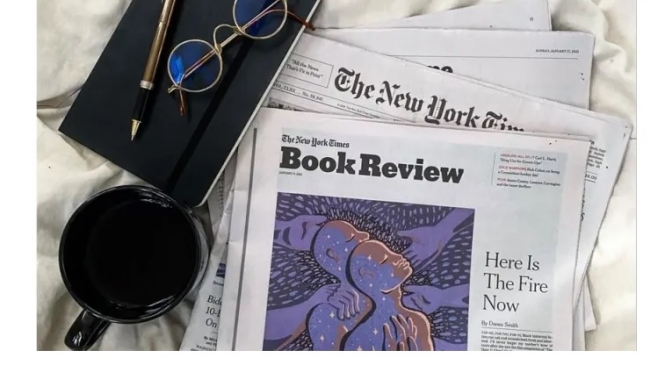
The New York Times Book Review – January 14, 2024

Image

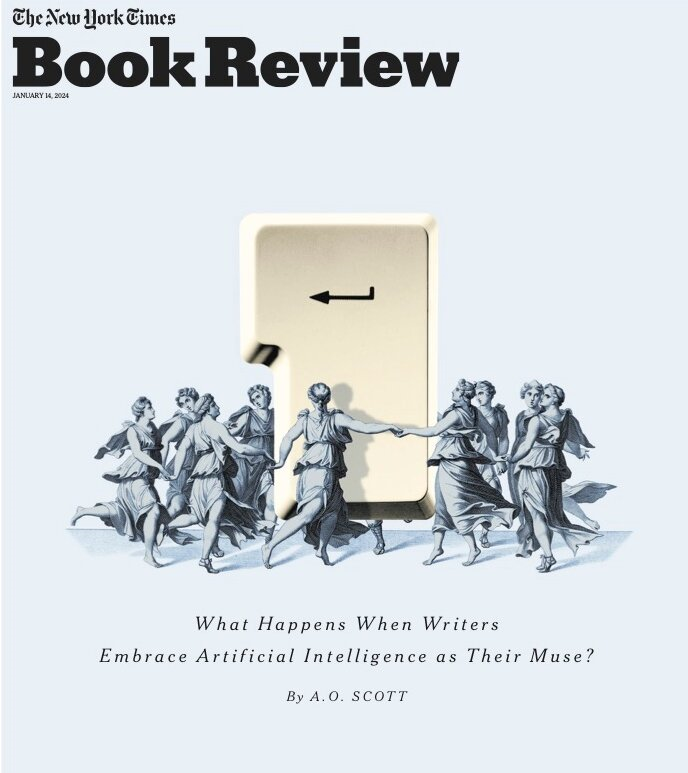
THE NEW YORK TIMES BOOK REVIEW (January 12, 2024): The latest issue features ‘What Happens When Writers Embrace Artificial Intelligence as Their Muse? by A.O. Scott…

Literature Under the Spell of A.I.

This image shows the nine female muses of Greek myth as miniature figures in shades of blue against a pale blue background. The muses are holding hands and encircling an enlarged return key of the sort that appears on a laptop keyboard.

What happens when writers embrace artificial intelligence as their muse?

By A.O. Scott

The robots of literature and movies usually present either an existential danger or an erotic frisson. Those who don’t follow in the melancholy footsteps of Frankenstein’s misunderstood monster march in line with the murderous HAL 9000 from “2001: A Space Odyssey,” unless they echo the siren songs of sexualized androids like the ones played by Sean Young in “Blade Runner” and Alicia Vikander in “Ex Machina.”

We fantasize that A.I. programs will seduce us or wipe us out, enslave us or make us feel unsure of our own humanity. Trained by such narratives, whether we find them in “Terminator” movies or in novels by Nobel laureates, we brace ourselves for a future populated by all kinds of smart, possibly sentient machines that will disrupt our most cherished notions of what it means to be human.

A Clash of Civilizations Brought to Life

In this close-up, black-and-white portrait, Álvaro Enrigue’s hair is windblown and he is holding his jacket’s collar up, obscuring part of his face.

For Álvaro Enrigue, a novelist fascinated with historical detail, the first meeting of the Aztecs and Spanish conquistadors is the obsession of a lifetime. He brings it to life in “You Dreamed of Empires.”

By Benjamin P. Russell

The Aug. 13, 2021 edition of The New York Times failed to mention the 500th anniversary of the fall of Tenochtitlan, the erstwhile Aztec capital out of which Mexico City was born. Álvaro Enrigue noticed. Of course.

The 54-year-old Enrigue, who grew up in Mexico City, believes that early meeting between Europe and the Americas changed the trajectory of global commerce, urbanism, industry and much else besides. Modernity itself, he argues, was born in the moment the Aztec emperor Moctezuma and Hernan Cortés, the Spanish conquistador, first looked each other in the eye in 1519, a clash of empires that set in motion the city’s capture two years later.

The New York Times Magazine- January 14, 2024

Image

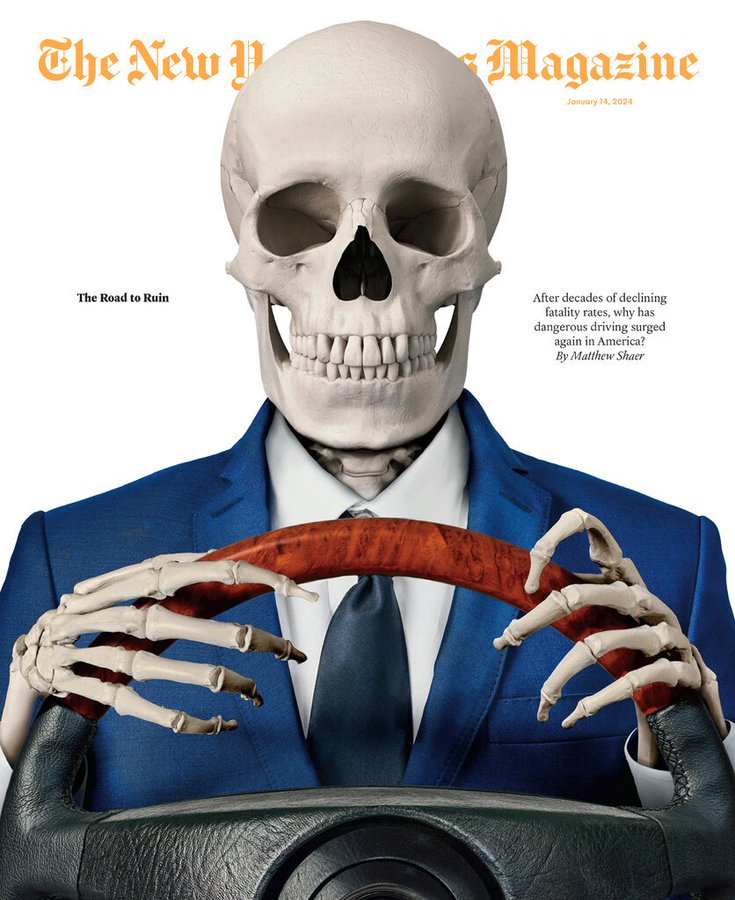
THE NEW YORK TIMES MAGAZINE (January 12, 2024): The new issue features ‘Why Are American Drivers So Deadly’ – After decades of declining fatality, dangerous driving has surged again….

Why Are American Drivers So Deadly?

A photo illustration of a skeleton in a suit driving a car.

After decades of declining fatality rates, dangerous driving has surged again.

By Matthew Shaer

In the summer of 1999, a few years after graduating from medical school, Deborah Kuhls moved from New York to Maryland, where she had been accepted as a surgical fellow at the R Adams Cowley Shock Trauma Center in Baltimore. Founded by a pioneer in emergency medicine, Shock Trauma is one of the busiest critical-care facilities in the country — in an average year, doctors there see approximately 8,000 patients, many of them close to death.

The All-Time-Great Coach Who Makes Football Fun

Andy Reid with Mahomes and other Chiefs players.

Andy Reid’s diligence and sense of mischief have made him one of the game’s best-ever coaches. Can he get his struggling Chiefs back to the Super Bowl?

By Michael Sokolove

Andy Reid, the coach of the Kansas City Chiefs, has won more than 250 games in his career, fourth all-time, which puts him high on any list of the N.F.L.’s greatest coaches. Most of the others in that pantheon are men who personify the sport’s militaristic soul — Vince Lombardi, for example, the fabled coach of the 1960s-era Green Bay Packers, or Reid’s contemporary, the grim Bill Belichick of the New England Patriots. But Reid is no Lombardi or Belichick; he’s Steve Jobs. He’s a designer, a tinkerer, a product engineer who imbues his football with creativity and even an occasional touch of whimsy.

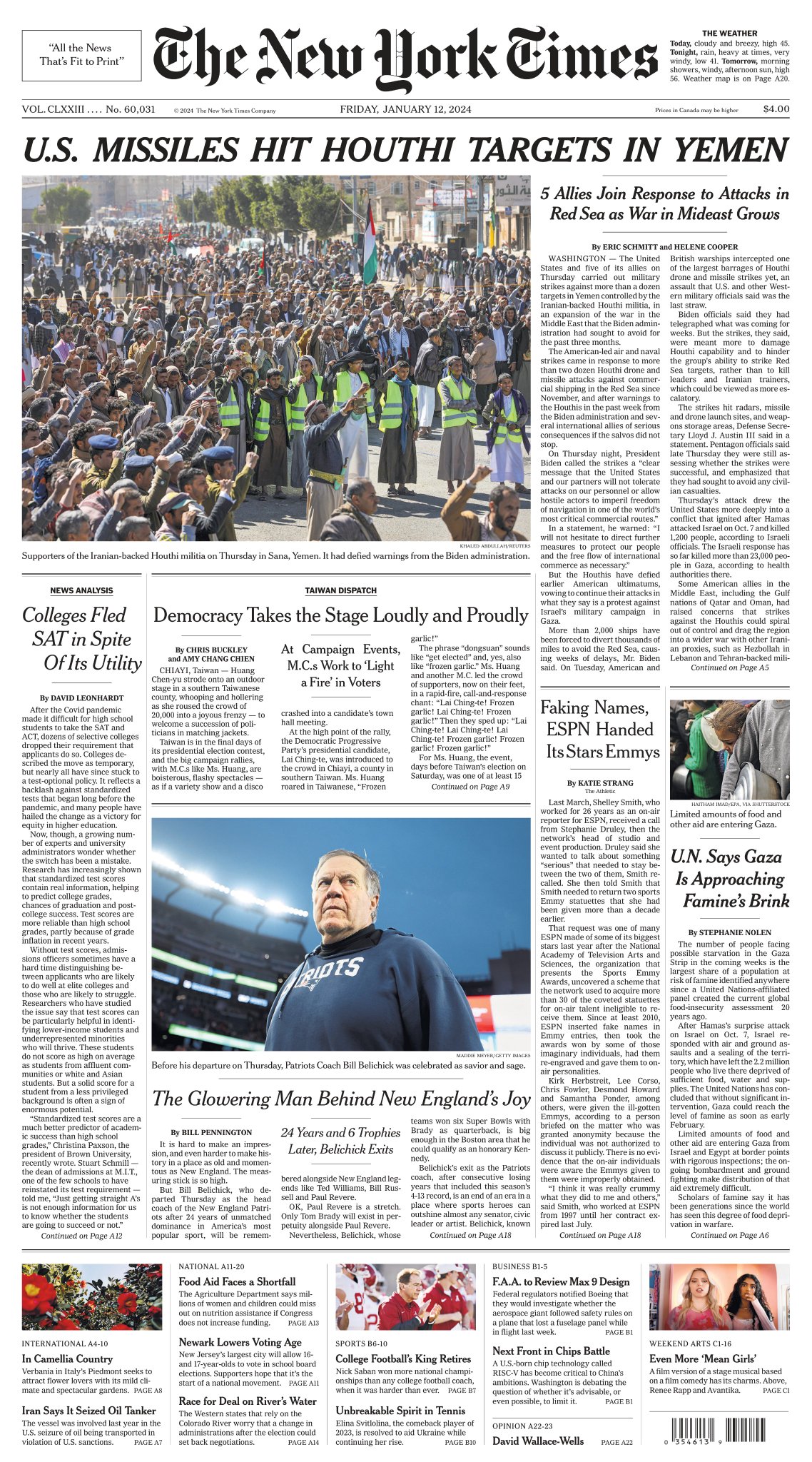
The New York Times — Friday, January 12, 2024

Image

U.S. Missiles Strike Targets in Yemen Linked to the Houthi Militia

A group of armed men raising their weapons.

The American-led strikes came in response to more than two dozen Houthi drone and missile attacks against commercial shipping in the Red Sea since the Israel-Hamas war began.

The Misguided War on the SAT

Colleges have fled standardized tests, on the theory that they hurt diversity. That’s not what the research shows.

‘Frozen Garlic!’ Taiwan Likes Its Democracy Loud and Proud

At the island’s election rallies, warming up the crowd for candidates is crucial. “You have to light a fire in their hearts,” one host says.

Looming Starvation in Gaza Shows Resurgence of Civilian Sieges in Warfare

A U.N.-affiliated panel said the territory could tip into famine very soon. International laws to protect people from human-made famines offer little help.

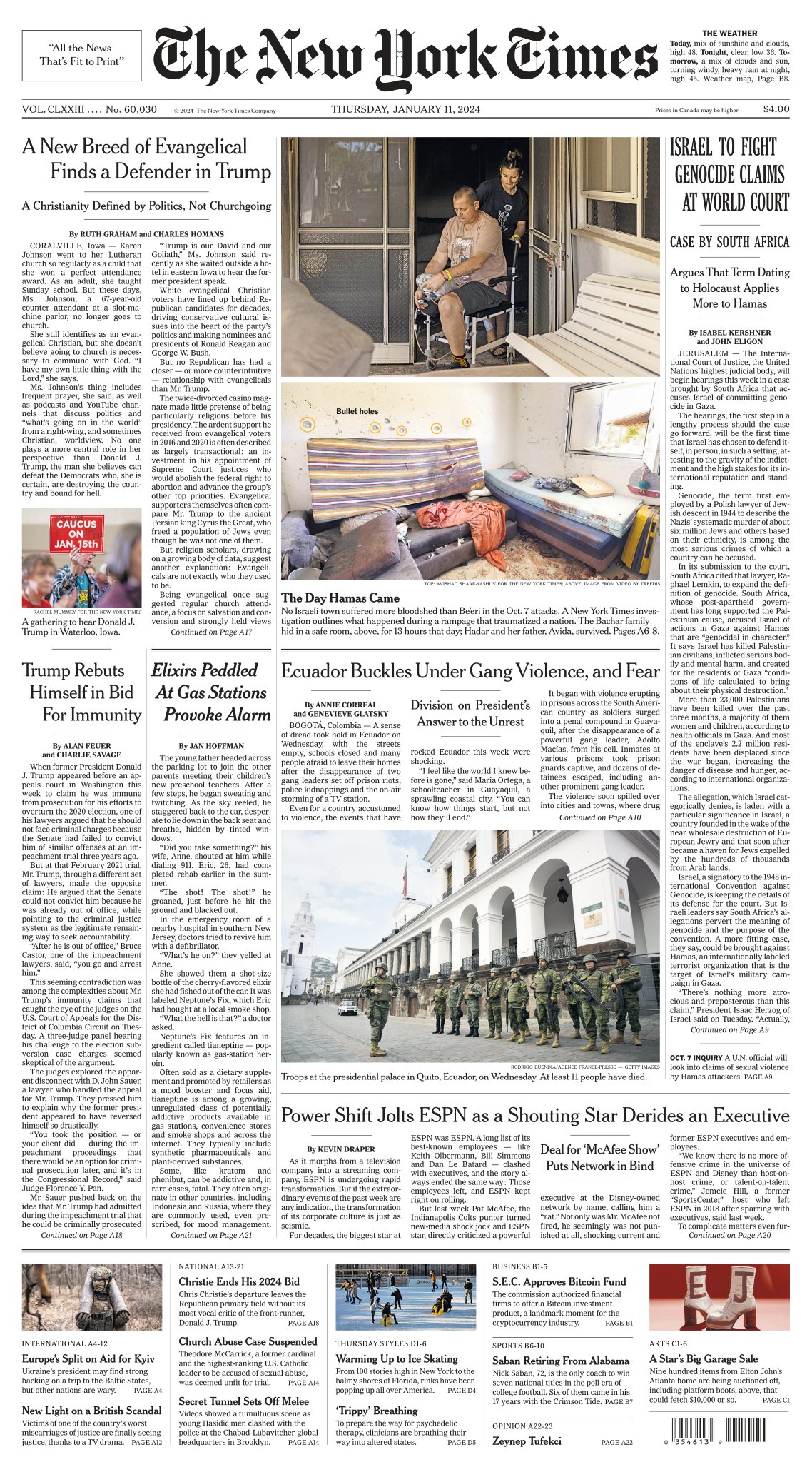
The New York Times — Thursday, January 11, 2024

Image

At World Court, Israel to Confront Accusations of Genocide

The Peace Palace which houses the International Court of Justice in The Hague, Netherlands. South Africa has brought a case accusing Israel of genocide against Palestinians in Gaza and is asking the court to order Israel to halt its attacks.

Israel has categorically rejected the allegations being brought this week in the International Court of Justice by South Africa.

The Day Hamas Came

No Israeli town suffered more bloodshed than Be’eri in the Hamas attacks on Oct. 7.

Trump Is Connecting With a Different Type of Evangelical Voter

They are not just the churchgoing, conservative activists who once dominated the G.O.P.

Trump’s Argument for Immunity in 2024 Is the Opposite of His Stance in 2021

During his second impeachment trial, the former president argued that criminal prosecution was a more appropriate way to seek accountability since he had left office.

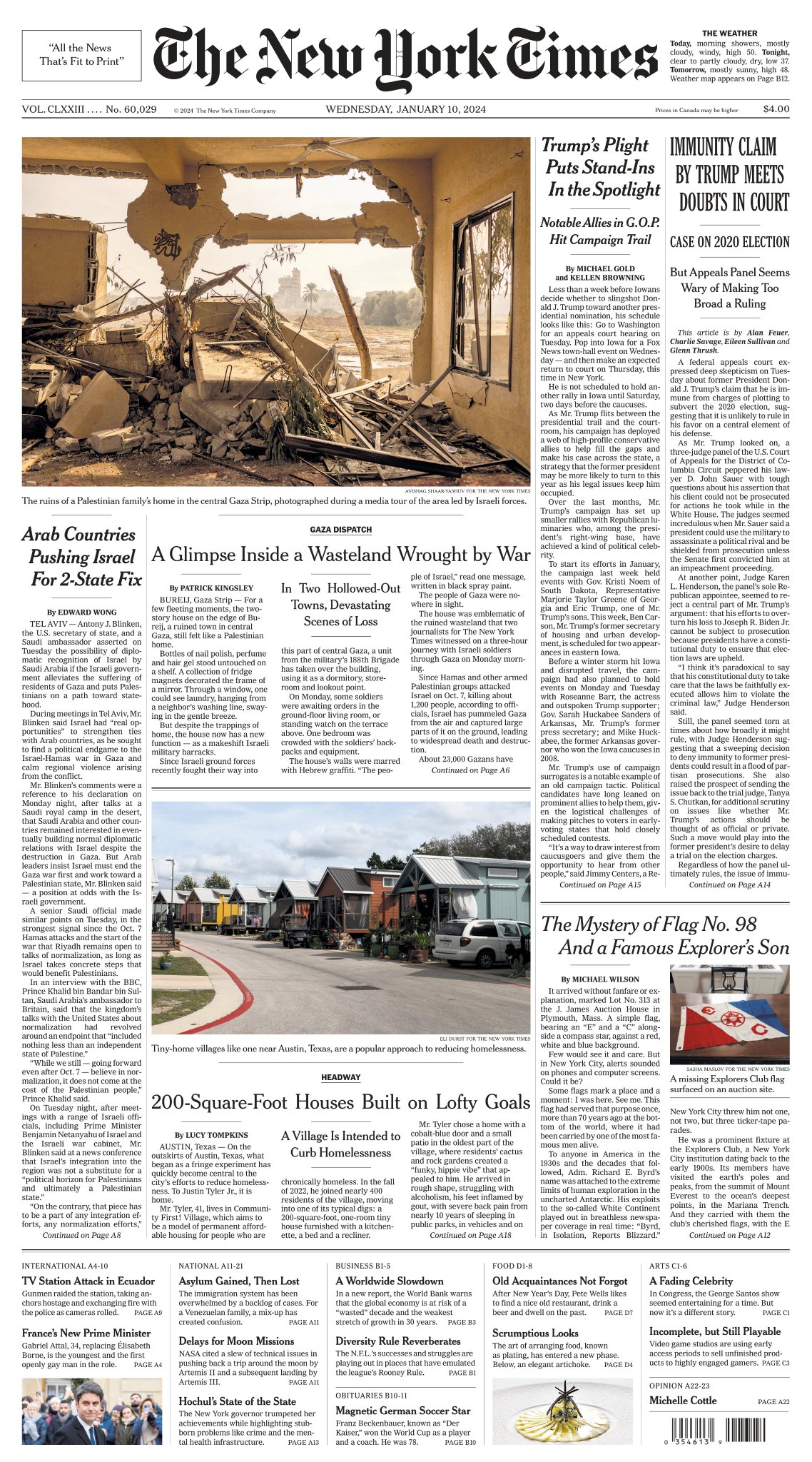
The New York Times — Wednesday, Jan 10, 2024

Image

Appeals Court Seems Skeptical of Trump’s Immunity Claim

A police car and police officer in front of barriers and a line of people outside of a courthouse in Washington.

A three-judge panel appeared unlikely to grant the former president’s request that it throw out federal criminal charges that he plotted to overturn the 2020 election.

Saudi-Israel Ties Depend on Steps Toward a Palestinian State, Blinken Says

In meetings with Israeli leaders, the U.S. secretary of state held out the prospect of Saudi recognition to prod Israel to curb combat operations in Gaza and accept a path to Palestinian statehood.

To Win Iowa, Trump Turns to Allies Like Marjorie Taylor Greene

With the former president busy defending himself in court from 91 felony charges, his campaign has deployed high-profile conservatives to help fill the gaps in Iowa.

A Glimpse Inside a Devastated Gaza

In the ruins of two Gazan towns, New York Times journalists witnessed the sheer destruction that Israel’s war has wrought and the devastation of Hamas’s operations.

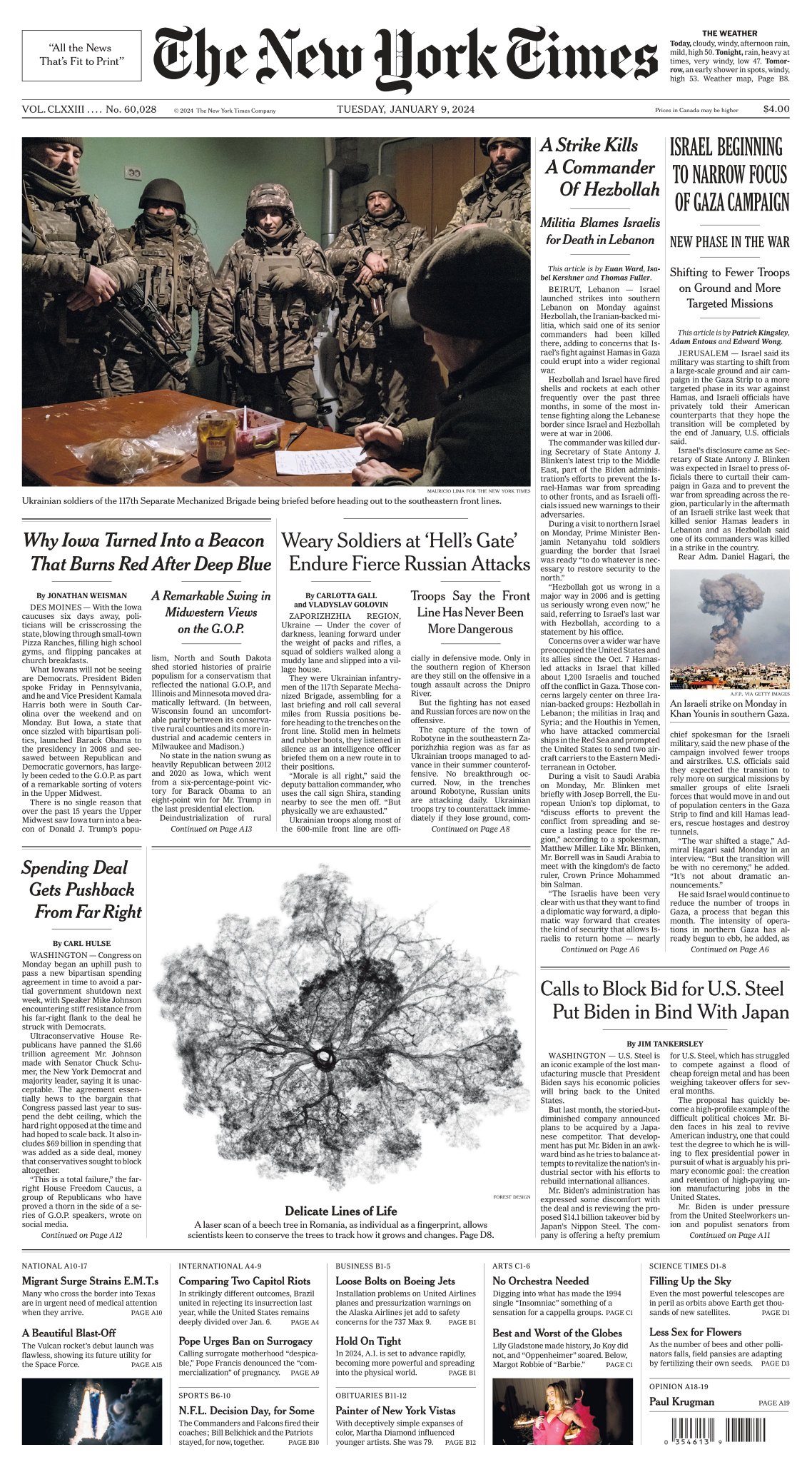
The New York Times — Tuesday, January 9, 2024

Image

Israel Says Its Military Is Starting to Shift to a More Targeted Gaza Campaign

Three Israeli soldiers wearing green uniforms in front of a tank.

Israeli officials privately say that they hope to complete the transition by the end of January, but that the timeline could change.

Why Iowa Turned So Red When Nearby States Went Blue

Over the past 15 years, the Upper Midwest has seen a remarkable state-by-state sorting of voters along partisan lines.

Israeli Strikes in Lebanon Kill Hezbollah Commander, Militia Says

The latest strikes across Israel’s northern border came as the U.S. secretary of state made another trip to the Middle East in efforts to prevent a wider war.

Exhausted, on the Defensive and at ‘Hell’s Gate’ in Ukraine

The country’s forces along a broad stretch of the front say that, with Russia pushing forward, the war has never been so dangerous.

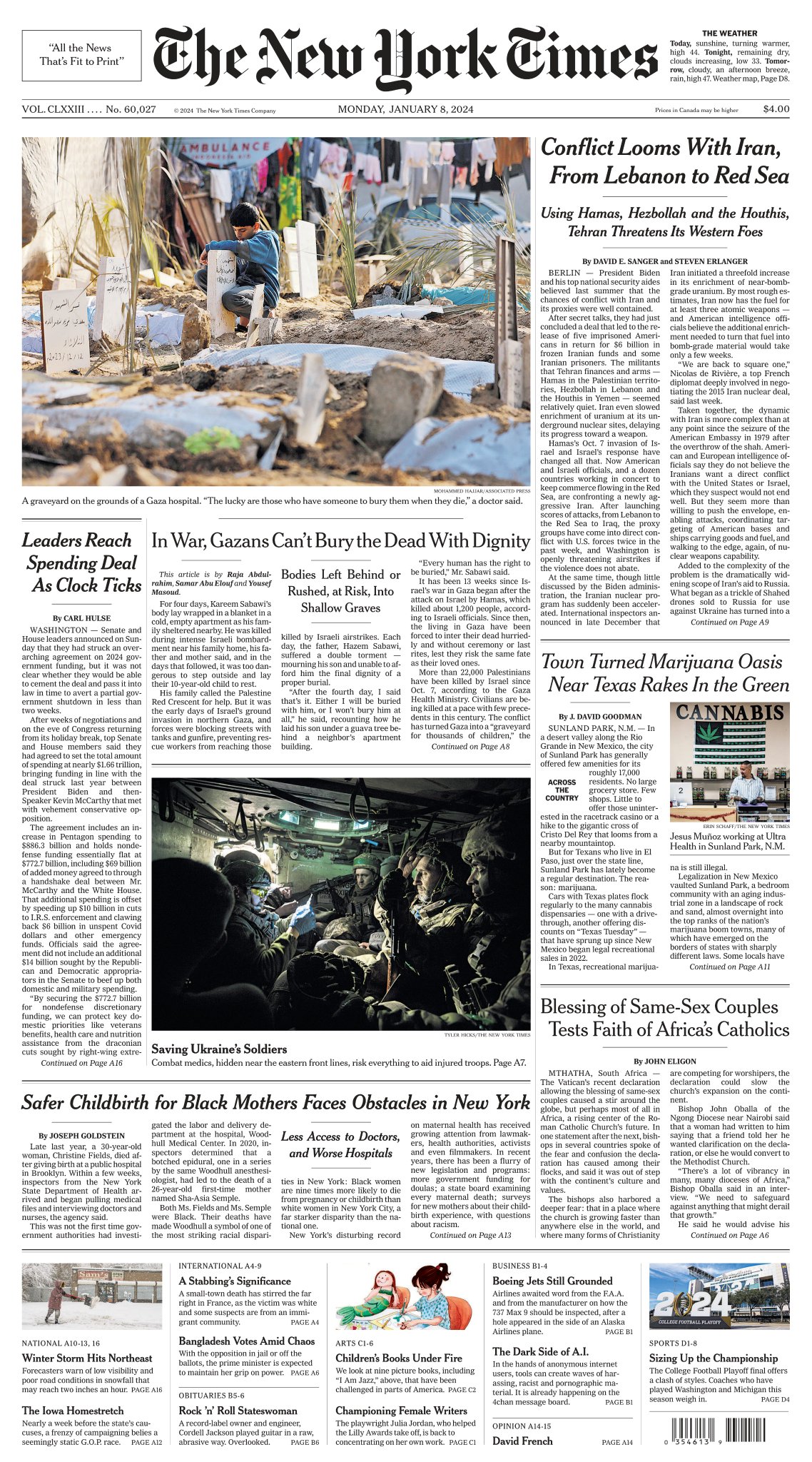
The New York Times — Monday, January 8, 2024

Image

From Lebanon to the Red Sea, a Broader Conflict With Iran Looms

An Iranian flag with buildings in the background.

With its proxies attacking from many vantage points and its nuclear program suddenly revived, Iran is posing a new challenge to the West — this time with Russia and China on its side.

As Gaza Losses Mount Under Strikes, Dignified Burials Are Another Casualty

“The lucky are those who have someone to bury them when they die,” Dr. Mohammad Abu Moussa, a radiologist at one Gaza hospital, said of those killed by Israeli airstrikes.

With Shutdown Looming, House and Senate Leaders Agree on Spending Levels

Despite the deal, time is short to assemble and pass legislation putting the agreement in force before a Jan. 19 deadline.

Marijuana Buyers From Texas Fuel a ‘Little Amsterdam’ in New Mexico

Sunland Park, along the Rio Grande, has joined the ranks of U.S. cities transformed by state cannabis laws. But the good times may not last forever.

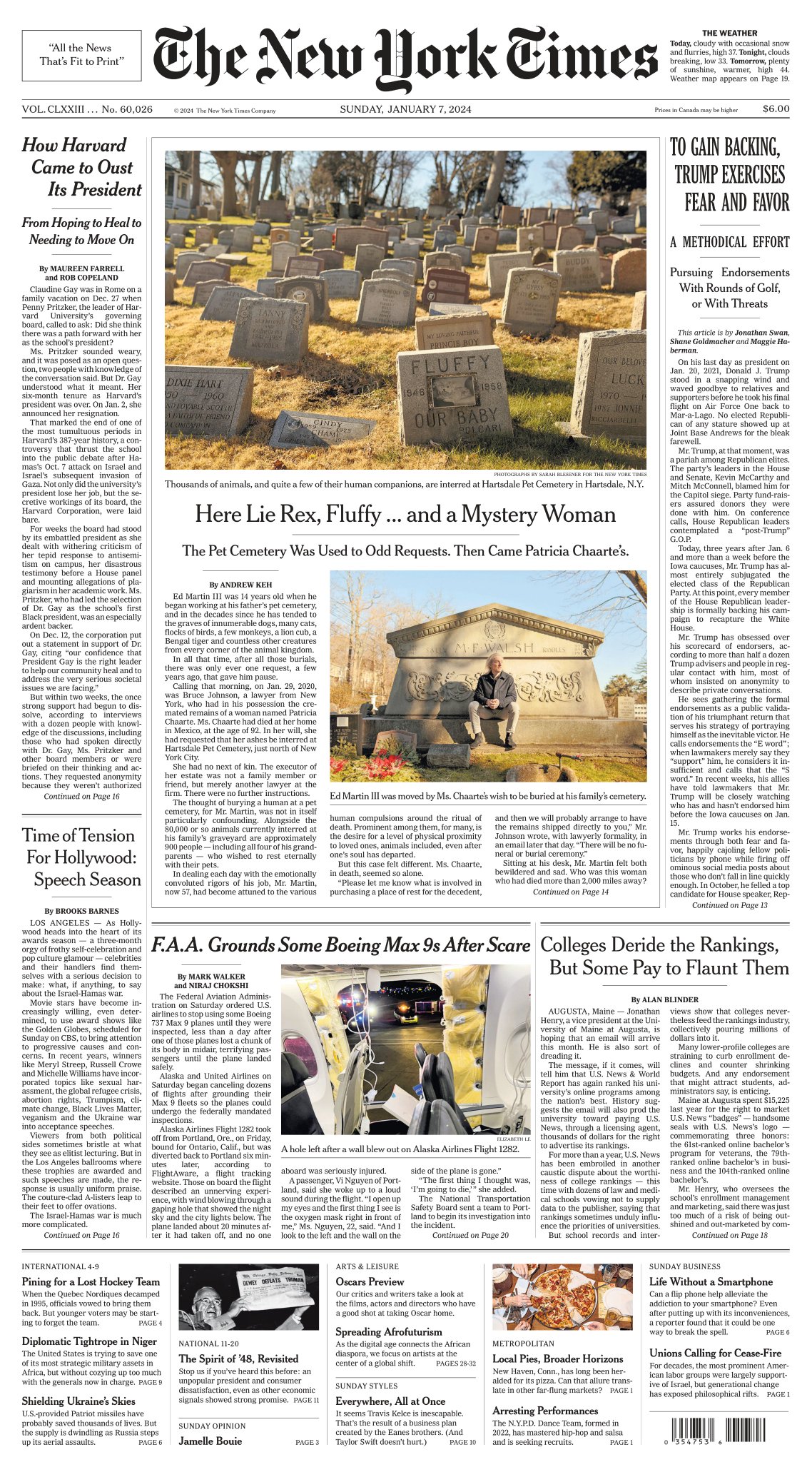
The New York Times — Sunday, January 7, 2024

Image

How Trump Has Used Fear and Favor to Win Republican Endorsements

Former President Donald J. Trump during a campaign rally last month in Durham, N.H.

The former president keeps careful watch over his endorsements from elected Republicans, aided by a disciplined and methodical behind-the-scenes operation.

How Harvard’s Board Broke Up With Claudine Gay

Claudine Gay looking slightly up to the side and into the distance.
Claudine Gay, the first Black president of Harvard, resigned only six months into her job amid accusations of plagiarism and her response to campus antisemitism.Credit…Sophie Park for The New York Times

Facing intense pressure, it went from standing behind her as the university’s president to pushing her out within weeks.

Who Was the Mysterious Woman Buried Alone at the Pet Cemetery?

At Hartsdale Pet Cemetery, Ed Martin III had become accustomed to unusual requests. Then came Patricia Chaarte.

U.S. News Makes Money From Some of Its Biggest Critics: Colleges

U.S. News sells “badges” to colleges, so they can promote their rankings — whether they are 1st, 10th or much, much lower.

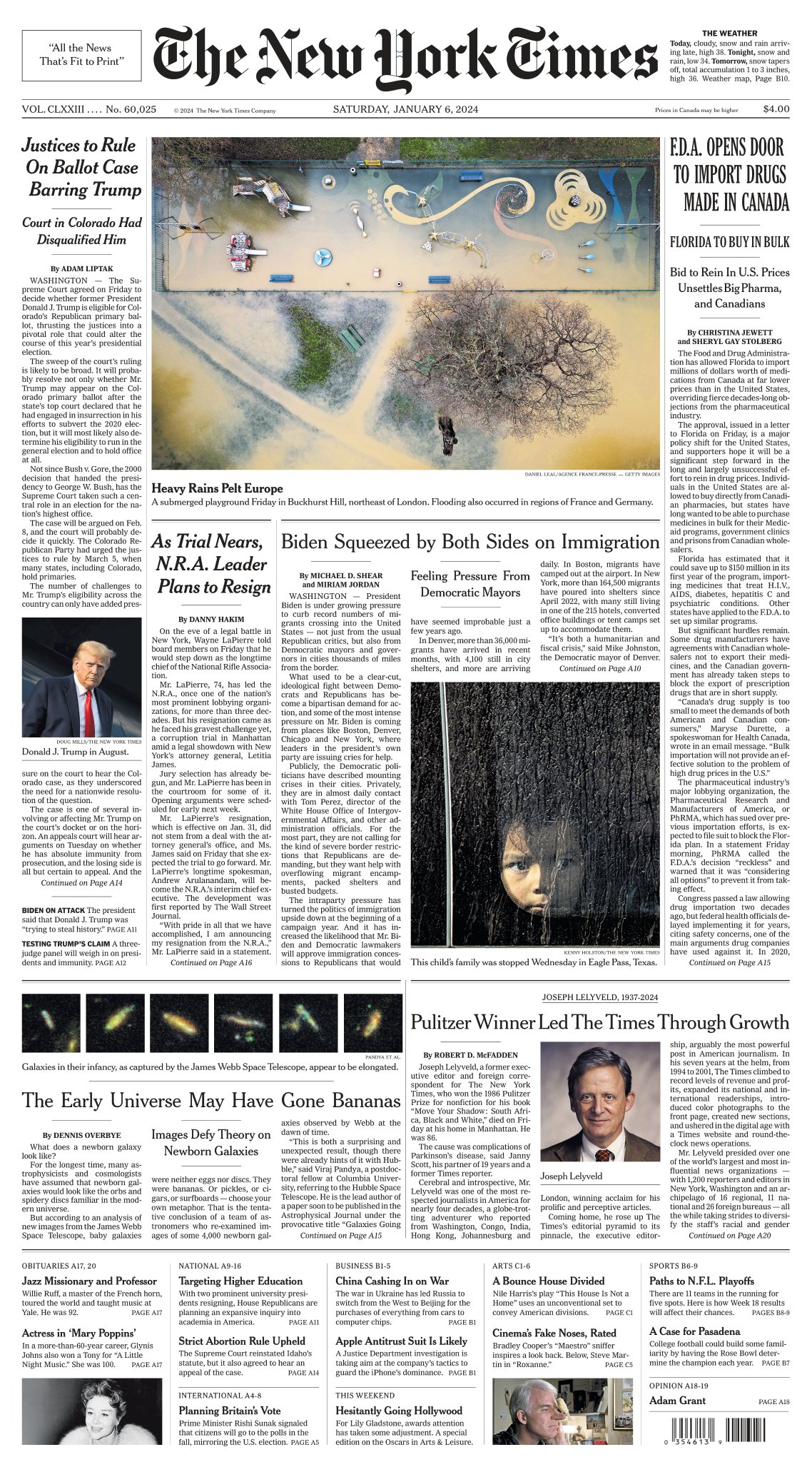
The New York Times — Saturday, January 6, 2024

Image

F.D.A. Issues First Approval for Mass Drug Imports to States From Canada

A pharmacy technician in blue reaches for a high shelf lined white pill bottles of all sizes in a pharmacy.

The agency authorized Florida to purchase medicines directly from wholesalers in Canada, where prices are far cheaper. Pharmaceutical companies oppose the plan.

Justices to Decide Whether Trump Is Eligible for Colorado Ballot

The Colorado Supreme Court ruled last month that the former president could not appear on the state’s Republican primary ballot because he had engaged in insurrection.

Heavy Rain in U.K. Causes Hundreds of Flood Warnings and Travel Disruptions

In London, around 50 people were evacuated from rising waters. Heavy rain brought similar scenes to parts of France and Germany.

Biden Faces Pressure on Immigration, and Not Just From Republicans

Mayors and governors from President Biden’s own party are looking for help with overflowing migrant encampments, packed shelters and busted budgets.

The New York Times Book Review – January 7, 2024

Image

THE NEW YORK TIMES BOOK REVIEW (January 5): The latest issue features ‘Read This And Learn’ – For decades, Juan Rulfo’s novel, “Pedro Páramo,” has cast an uncanny spell on writers. A new translation may bring it broader appeal.

A Masterpiece That Inspired Gabriel García Márquez to Write His Own

A black-and-white photograph of a man resting his chin on his hand over a small wooden table. An Aztec skull sits next to his face.

For decades, Juan Rulfo’s novel, “Pedro Páramo,” has cast an uncanny spell on writers. A new translation may bring it broader appeal.

By Valeria Luiselli

Readers of Latin American literature may have heard one of the many versions of this story:

It is 1961 and Gabriel García Márquez has just arrived in Mexico City, penniless but full of literary ambition, trying desperately to work on a new novel. One day, he is sitting in the legendary Café La Habana, where Fidel Castro and Che Guevara were said to have plotted the Cuban Revolution. Julio Cortázar walks in, carrying a copy of Juan Rulfo’s novel “Pedro Páramo.” With a swift gesture, as if he’s dealing cards, Cortázar throws the book on García Márquez’s table. “Tenga, pa que aprenda,” he says. “Read this and learn.”

Willa Cather and Yehudi Menuhin: An Unlikely, Unwavering Friendship

A pair of black-and-white historical photographs show Willa Cather and Yehudi Menuhin, holding a violin.

These two titans of 20th-century literature and music formed a profound, yearslong relationship across generations and backgrounds.

By Joshua Barone

Early in 1935, a blizzard blew through New York City. The storm was so fierce, it virtually emptied Central Park. But Willa Cather spent her morning there, sledding with the violin prodigy Yehudi Menuhin and his sisters.