
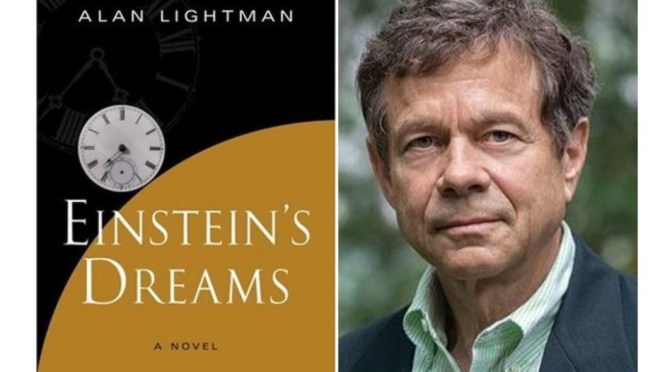
From a New York Times online article (February 13, 2020):
“I love physics, but what was even more important to me was leading a creative life,” Dr. Lightman said. “And I knew that writers could continue doing their best work later in life.”
Lightman is best known in literary circles for his 1992 novel, “Einstein’s Dreams,” which is all about the vicissitudes – romantic, physical and otherwise – of time. It recounts the nightly visions of a young patent clerk in Bern, Switzerland, as he struggles to finish his theory of relativity.
But before that, Dr. Lightman was an astrophysicist, a card-carrying wizard of space and time, with a Ph.D. from the California Institute of Technology and subsequent posts at Cornell and Harvard In 1989, at the peak of his prowess as a physicist, he began to walk away from the world of black holes to enter the world of black ink and the uncertain, lonely life of the writer.
Recently he was in New York for the opening of “Einstein’s Dreams,” an off-Broadway play based on his book. There have been dozens of such stage adaptations over the last 30 years.
 In this episode of the podcast, Nature reporter Davide Castelvecchi joins us to talk about the big science events to look out for in 2020. We’ll hear about multiple missions to Mars, a prototype electric car, efforts to prevent dengue, and more.
 The podcast team share some of their highlights from the past 12 months: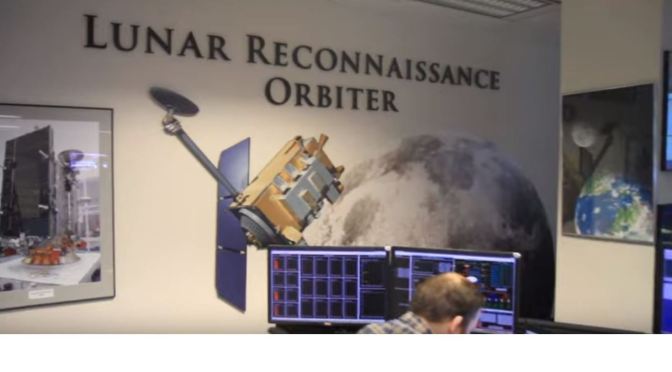
 About one-third of people with epilepsy are treatment resistant. Up until now, epilepsy treatments have focused on taming seizures rather than the source of the disease and for good reason—so many roads lead to epilepsy: traumatic brain injury, extreme fever and infection, and genetic disorders, to name a few. Staff Writer Jennifer Couzin-Frankel talks with host Sarah Crespi about researchers that are
  Boomers Daily