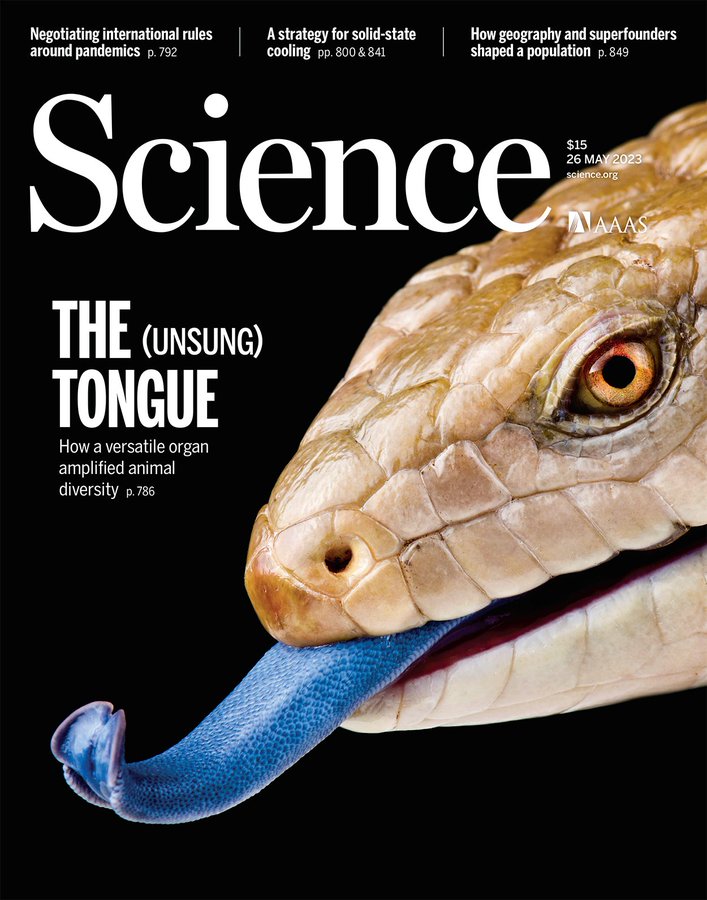
Science Magazine – May 26, 2023 issue: Tongues are thought to have evolved when vertebrates first moved onto land and could no longer rely on suction to ingest food. Since then, they have helped drive animal diversification by adopting functions as varied as pumping nectar, snagging prey, shaping speech, and, in the case of Australia’s northern blue-tongued skink (Tiliqua scincoides intermedia), startling enemies.
Since first evolving 350 million years ago, the tongue has taken myriad forms, unlocking new niches and boosting the diversity of life
Twice, quarterback Patrick Mahomes has led the Kansas City Chiefs to victory in the Super Bowl, the pinnacle of U.S. football. Although most fans have their eyes on the ball as Mahomes prepares to throw, his tongue does something just as interesting.
Science Magazine – May 19, 2023 issue: More than half of the world’s largest lakes have declined over the past three decades. Human water consumption, warming climate, and sedimentation are largely responsible. Lake Powell, shown here, with its once-submerged walls that now appear as whitened surfaces, exemplifies this drying trend.
Cloning vigorous crops, and finding the first romantic kiss First up this week, building resilience into crops. Staff Writer Erik Stokstad joins host Sarah Crespi to discuss all the tricks farmers use now to make resilient hybrid crops of rice or wheat and how genetically engineering hybrid crop plants to clone themselves may be the next step. After that we ask: When did we start kissing? Troels Pank Arbøll is an assistant professor of Assyriology in the department of cross-cultural and regional studies at the University of Copenhagen. He and Sarah chat about the earliest evidence for kissing—romantic style—and why it is unlikely that such kisses had a single place or time of origin.
On this week’s show: How sci-fi writer Kurt Vonnegut foresaw many of today’s ethical dilemmas, and 70 years of tunas, billfishes, and sharks as sentinels of global ocean health
First up this week on the podcast, we revisit the works of science fiction author Kurt Vonneugt on what would have been his 100th birthday. News Intern Zack Savitsky and host Sarah Crespi discuss the work of ethicists, philosophers, and Vonnegut scholars on his influence on the ethics and practice of science. Researchers featured in this segment:
Peter-Paul Verbeek, a philosopher of science and technology at the University of Amsterdam and chair of the World Commission on the Ethics of Scientific Knowledge and Technology David Koepsell, a philosopher of science and technology at Texas A&M University, College Station Christina Jarvis, a Vonnegut scholar at the State University of New York, Fredonia, and author of the new book Lucky Mud & Other Foma: A Field Guide to Kurt Vonnegut’s Environmentalism and Planetary Citizenship Sheila Jasanoff, a science studies scholar at Harvard University
Next, producer Kevin McLean discusses the connection between fishing pressure and extinction risk for large predatory fish such as tunas and sharks. He’s joined by Maria José Juan Jordá, a postdoc at the Spanish Institute for Oceanography, to learn what a new continuous Red List Index using the past 70 years of fisheries data can tell us about the effectiveness and limits of fishing regulations. Finally, in a sponsored segment from the Science/AAAS Custom Publishing Office, Sean Sanders, director and senior editor for custom publishing, interviews Joseph Hyser, assistant professor in the Department of Molecular Virology and Microbiology at Baylor College of Medicine about his use of wide-field fluorescence live cell microscopy to track intercellular calcium waves created following rotavirus infection.
Enteric viruses, such as norovirus, cause a significant health burden around the world and are generally considered to only spread via the faecal-oral route.
However, new research in mice suggests that saliva may also be a route of transmission for these viruses, which the authors say could have important public health implications.
How devouring space rocks helped Jupiter to get so big, and what analysing teeth has revealed about the diet of the extinct super-sized megalodon shark.
For decades there have been hints of the existence of tetraneutrons, strange systems composed of four neutrons, and now researchers may have created one in the lab. This breakthrough could tell us more about the strong nuclear force that holds matter together.
Last Friday the US supreme court struck down the constitutional right to abortion. In the wake of this ruling, Nature has been turning to research to ask what we can expect in the coming weeks and months.
A headbashing relative gives insights into giraffe evolution – How the giraffe got its long neck is a longstanding question in science. One possibility is that giraffes evolved longer necks for sexual competition, with males engaging in violent neck-swinging fights.
Now, a team have described fossils of an ancient giraffoid species with a thick headpiece adapted for fighting, which could add weight to this hypothesis.
05:18 A wave of resignations signals discontent in academia
Around the world, the ‘great resignation’ has seen huge numbers of workers re-evaluating their careers and lifestyles and choosing to leave their jobs following the pandemic. Academia is no exception, with many scientists deciding to leave the sector in the face of increased workloads, systemic biases and pressure to publish.
Earlier this year, NASA’s MAVEN spacecraft, which has been orbiting Mars since 2014, developed some serious equipment issues that prevented it from keeping its correct orientation in space. In a race against time, a team on Earth fixed the problem by developing a system that allowed the spacecraft to navigate by the stars.
14:28 The Perseverance rovers continues its rock collection
NASA’s Perseverance rover has arrived at an ancient Martian river delta where it will spend the next few months exploring, while scientists assess where to drill and extract rock samples. It’s thought that rocks from this region have the best chance of containing evidence of Martian life, and plans are being developed to return them to Earth in the future.
The puzzle of Palaeospondylus – Over a hundred years ago, archaeologists discovered fossils of the aquatic animal Palaeospondylus. But since then researchers have been unable to place where this animal sits on the tree of life. Now, new analysis of Palaeospondylus’s anatomy might help to solve this mystery.
08:18 Research Highlights
A strong, silk-based version of mother of pearl, and the parrots that use their heads when climbing.
10:51 How lasers revealed an ancient Amazonian civilization
Archaeologists have used LiDAR to uncover evidence of an ancient civilization buried in the Bolivian Amazon. The team’s work suggests that this area was not as sparsely populated in pre-Hispanic times as previously thought.
We discuss some highlights from the Nature Briefing. This time, the debate surrounding the first transplant of pig kidneys into humans, and the plants grown in lunar soil.
Dark matter makes up most of the matter in the Universe, and is thought to be needed for galaxies to form. But four years ago, astronomers made a perplexing, and controversial discovery: two galaxies seemingly devoid of dark matter.
This week the team suggests that a cosmic collision may explain how these, and a string of other dark-matter-free galaxies, could have formed.
10:49 Researchers experiences of the war in Ukraine
We hear the stories of scientists whose lives have been affected by Russia’s invasion of Ukraine, including researchers who have become refugees, soldiers and activists in the face of a horrifying conflict.
20:46 Imaging the black hole at the centre of the Milky Way
Last week, a team of researchers released an image of Sagittarius A*, the supermassive blackhole at the centre of our galaxy. We hear how they took the image and what it is revealing about these enormous objects.
Research efforts to learn more about diseases of the human eye have been hampered as these organs degrade rapidly after death, and animal eyes are quite different to those from humans.
To address this, a team have developed a new method to revive retinas taken from donors shortly after their death. They hope this will provide tissue for new studies looking into the workings of the human eye and nervous system.
How did the earliest biochemical process evolve from Earth’s primordial soup? One popular theory is that life began in an ‘RNA world’ from which proteins and DNA evolved. However, this week a new paper suggests that a world composed of RNA alone is unlikely, and that life is more likely to have begun with molecules that were part RNA and part protein.
We discuss some highlights from the Nature Briefing. This time, the ‘polarised sunglasses’ that helped astronomers identify an ultra-bright pulsar, and how a chemical in sunscreen becomes toxic to coral.
How a move to microbial protein could affect emissions. It’s well understood that the production of meat has large impacts on the environment.
This week, a team show that replacing 20% of future meat consumption with protein derived from microbes could reduce associated emissions and halve deforestation rates.
How saltwater crocodiles’ penchant for pigs is driving population recovery in Australia, and solving the mystery of some eighteenth-century porcelain’s iridescent lustre.
10:47 The neurons that help mosquitoes distinguish smell
Female Aedes aegypti mosquitoes strongly prefer human odours to those of animals, but how they distinguish between them is not well understood. Now, researchers have shown that human odours strongly activate a specific area in the brains of these insects, a finding that could have important implications for mosquito-control strategies.
We discuss some highlights from the Nature Briefing. This time, how climate change could affect virus transmission between mammals, and how the link between a dog’s breed and its temperament may not be as close as previously thought.




 Boomers Daily