

Bees, termites, and ants can teach us a lot about cooperation, communication, and the skills that keep societies together. But these so-called social insects may also hold secrets that could reshape our understanding of human aging. Many social insects exhibit surprising aging characteristics that cause their life spans to shift depending on their roles.
Following the death of a queen Indian jumping ant, for example, workers fight for the right to transform into an egg-laying ant. Much is at stake: the life expectancy of an egg-layer is five times longer than that of a worker’s. Though fruit flies, mice, and nematodes currently dominate aging research, some scientists say social insects’ aging behaviors could help dissect aging mechanisms in humans. This video will take you deep into the catacombs—er, honeycombs—of insect aging.
Read the story ($): https://scim.ag/3cFO0k0
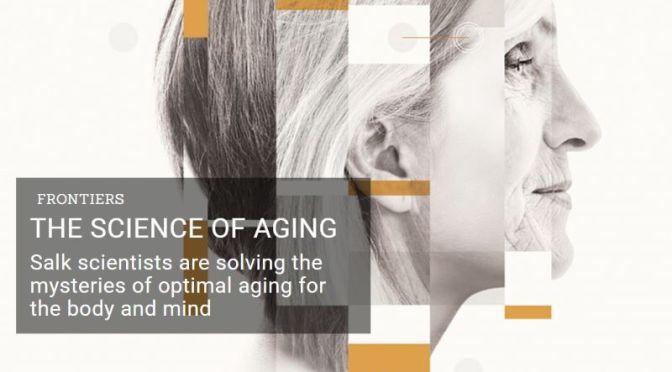
“Aging is such a profound part of not only the human experience but all life on Earth,” says Salk Vice President/Chief Science Officer Martin Hetzer. “It’s one of the big, untapped opportunities in biomedical research, particularly around questions on what role exercise, nutrition and cognitive stimulation play in staying healthy throughout life. It is important not to forget that getting older also comes with benefits; we want to take a holistic view of human health at all ages and understand it from all angles.”
Scientists want to answer intriguing questions: Why are some people able to “age well,” trekking up mountain ranges or rafting through white water in their nineties, while others live just as long, disease-free, but grow inexplicably frail decades sooner? Worse yet, why does advanced age sometimes diminish cognitive ability or even lead to dementia?
In numerous diseases, age itself is the major risk factor. Cancer, Alzheimer’s, heart disease and many other afflictions become profoundly more likely the older we get. Aside from extending our life spans, scientists want to know how we can also extend our health during advanced age. What is emerging from research is that aging–loosely defined as a systems-wide deterioration of our cells, organs and genetic material that results in disease or damage–is a collective and complex process in the body.

 Boomers Daily