

Staff Writer Meredith Wadman and host Sarah Crespi discuss what to expect from the two messenger RNA–based vaccines against COVID-19 that have recently released encouraging results from their phase III trials and the short-term side effects some recipients might see on the day of injection.
Sarah also talks with researcher Xing Chen, a project co-leader and postdoctoral scientist at the Netherlands Institute for Neuroscience, about using brain stimulation to restore vision. Researchers have known for about 70 years that electrical stimulation at certain points in the brain can lead to the appearance of a phosphene—a spot of light that appears not because there’s light there, but because of some other stimulation, like pressing on the eyeball. If electrical stimulation can make a little light appear, how about many lights? Can we think about phosphenes as pixels and draw a picture for the brain? How about a moving picture?
Many schools closed in the spring, during the first wave of the coronavirus pandemic. Many opened in the fall. Staff Writer Jennifer Couzin-Frankel joins host Sarah Crespi to talk about what was learned in spring about how coronavirus spreads in schools that might help keep children safe as cases surge once again.
Also this week: What makes leaves fall off deciduous trees when they do—is it the short, cold nights? Or is the timing of so-called “leaf senescence” linked to when spring happens? Sarah talked to Constantin Zohner, a lead scientist at the Institute of Integrative Biology at ETH Zurich, about his tree leaf timing study. Sarah also spoke with commentary author Christy Rollinson, a forest ecologist at the Morton Arboretum, about how important these trees and the timing of their leaf drop is for climate change. In the books segment, host Kiki Sanford talks with Ruth DeFries about her book, What Would Nature Do? A Guide for Our Uncertain Times.
These days, about half of the protein the world’s population eats is from seafood. Staff Writer Erik Stokstad joins host Sarah Crespi to talk about how brand-new biotech and old-fashioned breeding programs are helping keep up with demand, by expanding where we can farm fish and how fast we can grow them.
Sarah also spoke with Jan Claesen, an assistant professor at the Cleveland Clinic’s Lerner Research Institute, about skin microbes that use their own antibiotic to fight off harmful bacteria. Understanding the microbes native to our skin and the molecules they produce could lead to treatments for skin disorders such as atopic dermatitis and acne. Finally, in a segment sponsored by MilliporeSigma, Science’s Custom Publishing Director and Senior Editor Sean Sanders talks with Timothy Cernak, an assistant professor of medicinal chemistry and chemistry at the University of Michigan, Ann Arbor, about retrosynthesis—the process of starting with a known chemical final product and figuring out how to make that molecule efficiently from available pieces.
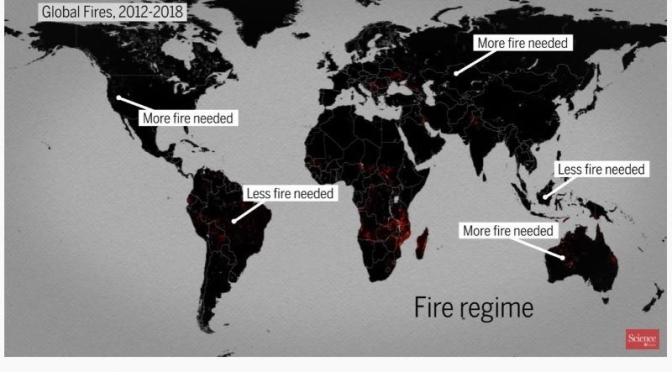
Raging fires throughout the U.S. and Australia over the past year have put vulnerable species at risk. But not all blazes are devastating—in fact, fire can promote biodiversity. In grasslands, fires prevent trees and roots from taking hold. This allows grazing animals the space and vegetation they need to thrive. As the pattern of wildfires changes, a new review in Science outlines effective ways to let natural fires burn, while preventing out-of-control blazes. Watch to learn how a few of these techniques have been applied around the world.
Read the research: https://scim.ag/3pIRjv7
This week the whole show focuses on keeping cool in a warming world. First up, host Sarah Crespi talks with Senior News Correspondent Elizabeth Pennisi about the latest research into how to stay safe when things heat up—whether you’re running marathons or fighting fires.
Sarah also talks with Po-Chun Hsu, assistant professor of mechanical engineering and materials science at Duke University, about the future of cooling fabrics for everyday use. It turns out we can save a lot of energy and avoid carbon dioxide emissions by wearing clothing designed to keep us cool in slightly warmer buildings than we’re used to now. But the question is, will cooling clothes ever be “cool”? Visit the whole special issue on cooling.








 Boomers Daily