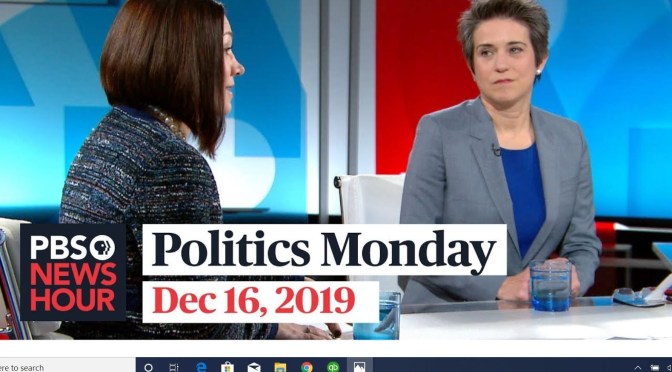
NPR’s Tamara Keith and Amy Walter of the Cook Political Report join Judy Woodruff to discuss the latest political news, including the two articles of impeachment passed by the House Judiciary Committee, political stakes for a potential Senate trial, public opinion on impeachment, a labor dispute threatens the next Democratic debate and how many Democratic voters have already chosen a candidate.
In Part 3 of our series on pivotal moments in the lives of the 2020 Democratic presidential contenders, we spoke with Elizabeth Warren about how she came to be known as the blow-it-up candidate. The Massachusetts senator describes her transformation from Republican law professor to progressive candidate for the Democratic presidential nomination.
With help from Andrew Ross Sorkin, a financial columnist at The Times and founder of DealBook; Harry Reid, a former Senate majority leader; and David Axelrod, a former Obama adviser, we explore Ms. Warren’s rise to prominence as an advocate for overhauling the financial system — and why those beliefs can help us understand her run for president now.
Boris Johnson has won historic landslide victory today for the Conservatives in the 2019 General Election. On a catastrophic night for Labour, Jeremy Corbyn’s party was predicted to end the day with just 196 seats, down 66 on the last election in their worst result since 1935.
NPR’s Tamara Keith and Amy Walter of the Cook Political Report join Amna Nawaz to discuss the latest political news, including campaign sparring between Sen. Elizabeth Warren and Pete Buttigieg and which candidates might leverage it, how much transparency matters to Democratic voters, lack of racial diversity in the next debate and reaction to the inspector general’s report on the Russia probe.
Syndicated columnist Mark Shields and New York Times columnist David Brooks join Judy Woodruff to discuss the week’s political news, including how the first House Judiciary Committee hearing on impeachment affected the case against President Trump, what Trump’s contentious visit to a NATO summit means for U.S. foreign policy and the fallout from Sen. Kamala Harris’ withdrawal from the 2020 race.
Amy Walter of the Cook Political Report and Domenico Montenaro of NPR join Yamiche Alcindor to discuss the latest political news, including shifting dynamics in the 2020 Democratic presidential primaries, how congressional Democrats and Republicans view the facts of the impeachment investigation differently, political pressure on moderates and how impeachment could affect the 2020 race.
Syndicated columnist Mark Shields and New York Times columnist David Brooks join Judy Woodruff to discuss the week in politics, including public opinion and legal debate in the impeachment inquiry into President Trump, the shifting race among 2020 Democrats and what we’re thankful for during this holiday week.
AHEAD OF the 2020 American presidential election, John Prideaux, The Economist‘s US editor, talks to Bill Weld, a former governor of Massachusetts, Joe Walsh, a talk radio host and former Illinois congressman, and Mark Sanford, a former governor of South Carolina. While Donald Trump enjoys near 90% approval ratings among his party, can anyone challenge him for the Republican presidential nomination? And how has he changed what it means to be a Republican?
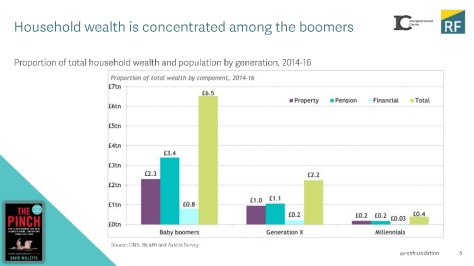
Willetts had stumbled onto one of the great divides of modern politics: young versus old. In Britain, age is now a better predictor of voting intention than social class. Overall, the Boomers voted for Brexit in 2016 and the Conservatives in 2017; their Millennial children voted Remain and Labour. The single biggest error that Theresa May, the prime minister in the lead-up to the 2017 election, made during that process was to float the idea that older people might have to contribute more to the spiraling costs of their own retirement care. The “dementia tax” prompted an immediate, ferocious response, and May backed down.
That is not an isolated example. A guiding principle of politics in Britain, and elsewhere in the West, is: What Boomers want, Boomers get. Working-age benefits, for example, have been frozen since the 2015 budget, but the state pension has consistently risen. (At this election, Britain’s two main parties have both promised to keep increasing pensions; Jeremy Corbyn’s Labour has also pledged £58 billion ($74.7 billion) to Boomer women affected by the rise in the female state pension age from 60 to 66.
The debate is also about so much more than abstract disagreements over policy and government funding. Caring for the elderly, for example, becomes wrapped up in assertions of “just deserts”—I’ve worked hard all my life and paid my taxes—and fears about money-grubbing children selling off their parents’ houses. It is also, like taxes on inheritance, a subject that prods at many people’s deep desire to pass something on to their offspring.
NPR’s Tamara Keith and Amy Walter of the Cook Political Report join Judy Woodruff to discuss the latest political news, including whether two weeks of public impeachment hearings have shifted public opinion about President Trump and the investigation into his Ukraine policy, potential pressure on Republican lawmakers and the late entrance of Michael Bloomberg into the 2020 Democratic race.
News, Views and Reviews For The Intellectually Curious

 NPR’s Tamara Keith and Amy Walter of the Cook Political Report join Judy Woodruff to discuss the latest political news, including the two articles of impeachment passed by the House Judiciary Committee, political stakes for a potential Senate trial, public opinion on impeachment, a labor dispute threatens the next Democratic debate and how many Democratic voters have already chosen a candidate.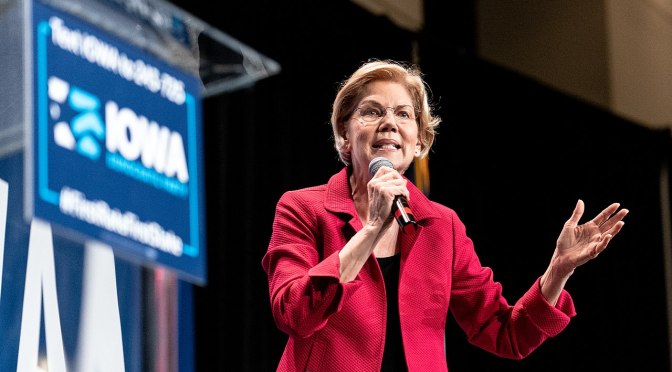
 In Part 3 of our series on pivotal moments in the lives of the 2020 Democratic presidential contenders, we spoke with Elizabeth Warren about how she came to be known as the blow-it-up candidate. The Massachusetts senator describes her transformation from Republican law professor to progressive candidate for the Democratic presidential nomination.
 With help from Andrew Ross Sorkin, a financial columnist at The Times and founder of DealBook; Harry Reid, a former Senate majority leader; and David Axelrod, a former Obama adviser, we explore Ms. Warren’s rise to prominence as an advocate for overhauling the financial system — and why those beliefs can help us understand her run for president now.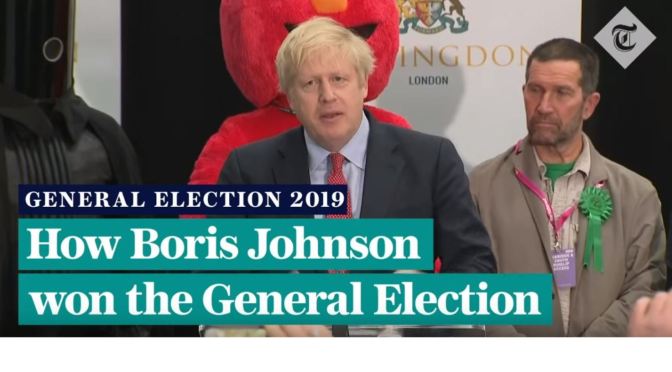

 NPR’s Tamara Keith and Amy Walter of the Cook Political Report join Amna Nawaz to discuss the latest political news, including campaign sparring between Sen. Elizabeth Warren and Pete Buttigieg and which candidates might leverage it, how much transparency matters to Democratic voters, lack of racial diversity in the next debate and reaction to the inspector general’s report on the Russia probe.
 Syndicated columnist Mark Shields and New York Times columnist David Brooks join Judy Woodruff to discuss the week’s political news, including how the first House Judiciary Committee hearing on impeachment affected the case against President Trump, what Trump’s contentious visit to a NATO summit means for U.S. foreign policy and the fallout from Sen. Kamala Harris’ withdrawal from the 2020 race.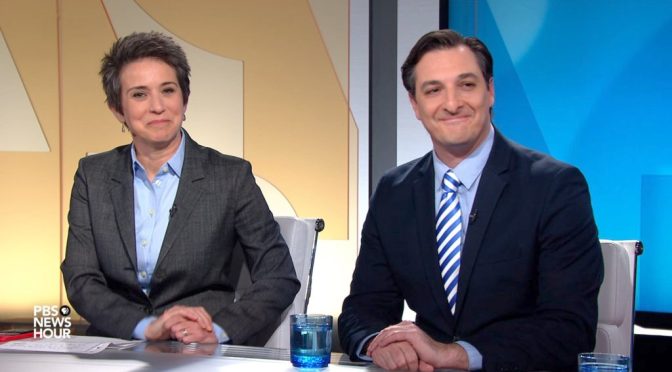
 Amy Walter of the Cook Political Report and Domenico Montenaro of NPR join Yamiche Alcindor to discuss the latest political news, including shifting dynamics in the 2020 Democratic presidential primaries, how congressional Democrats and Republicans view the facts of the impeachment investigation differently, political pressure on moderates and how impeachment could affect the 2020 race.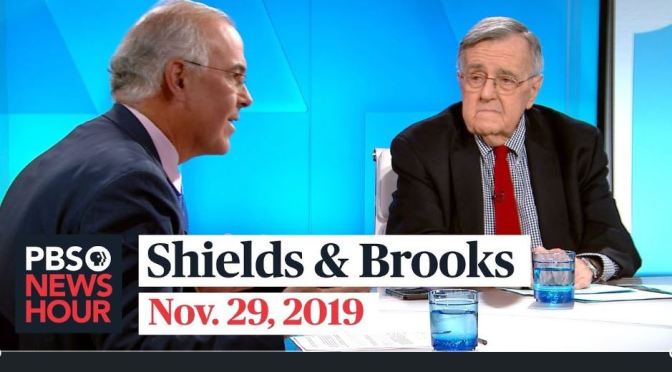
 Syndicated columnist Mark Shields and New York Times columnist David Brooks join Judy Woodruff to discuss the week in politics, including public opinion and legal debate in the impeachment inquiry into President Trump, the shifting race among 2020 Democrats and what we’re thankful for during this holiday week.
 AHEAD OF the 2020 American presidential election, John Prideaux, The Economist‘s US editor, talks to Bill Weld, a former governor of Massachusetts,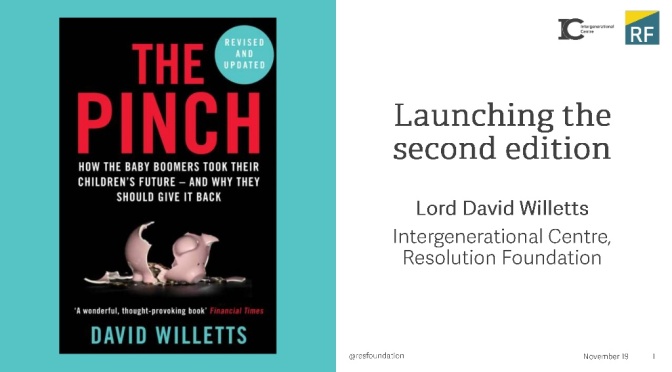
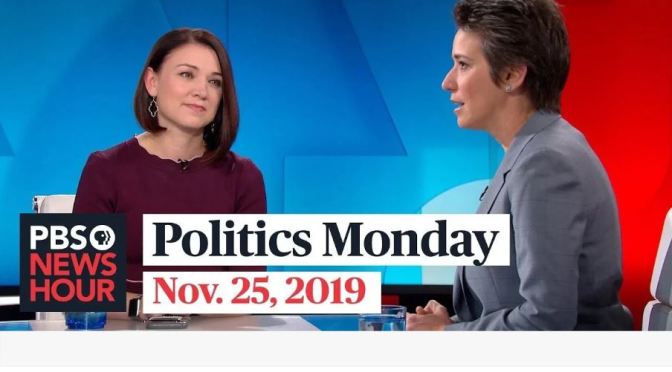
 NPR’s Tamara Keith and Amy Walter of the Cook Political Report join Judy Woodruff to discuss the latest political news, including whether two weeks of public impeachment hearings have shifted public opinion about President Trump and the investigation into his Ukraine policy, potential pressure on Republican lawmakers and the late entrance of Michael Bloomberg into the 2020 Democratic race.
 Boomers Daily