
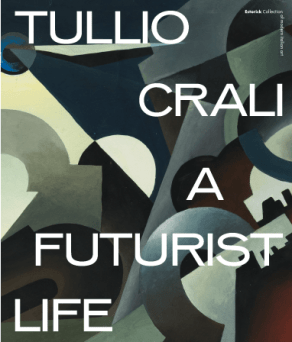
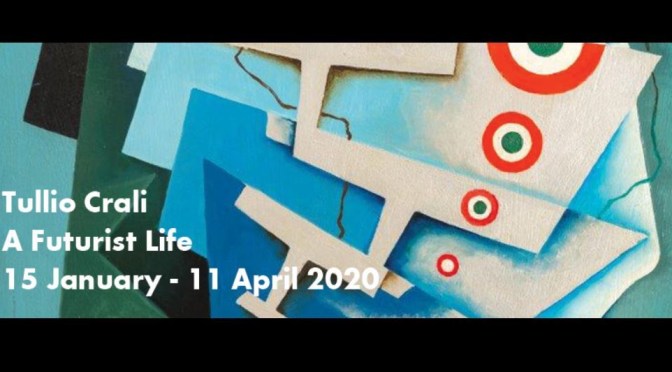
 London – For Tullio Crali (1910-2000) Futurism was not just a school of painting, but an attitude to life itself. Reflecting the movement’s enthusiasm for the modern world, his imagery embraced technology and the machine as important sources of creative inspiration. However, with its particular focus on “the immense visual and sensory drama of flight”, Crali’s work is most closely associated with the genre of ‘aeropainting’, which dominated Futurist research during the 1930s.
Crali discovered Futurism when he was just fifteen years old. An immediate convert, he officially joined the movement in 1929 and quickly developed his own distinctive interpretation of its artistic principles. Despite incorporating recognisable details such as clouds, wings and propellers, Crali’s thrilling
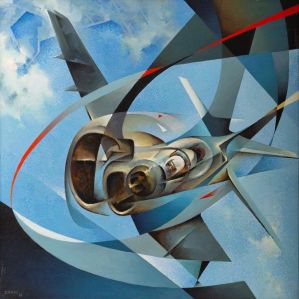
imagery challenged conventional notions of realism by means of its dynamic perspectives, simultaneous viewpoints and powerful combination of both figurative and abstract elements.
As a result of his talent, versatility and unshakable commitment to Futurist ideas, Crali swiftly became one of the movement’s key representatives. He continued to be its staunchest advocate during the post-war era, remaining faithful to Futurism’s aesthetic tenets throughout his life.
Featuring rarely seen works from the 1920s to the 1980s, this exhilarating exhibition covers every phase of the artist’s remarkably coherent career, including iconic aeropaintings, experimental works of visual poetry and mixed-media reliefs, as well as examples of ‘cosmic’ imagery dating from the 1960s, inspired by advances in space exploration. Also featured are a large number of Crali’s famous Sassintesi: enigmatic compositions of stone and rock, ‘sculpted’ by natural forces.
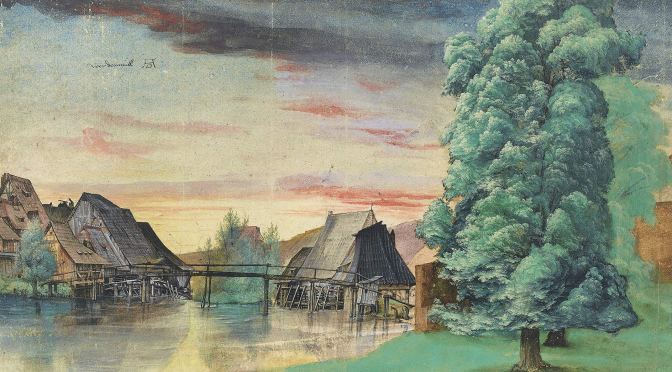
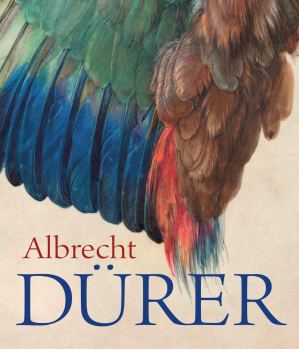 This book showcases more than 100 of Dürer’s drawings including Hare, Self Portrait at the Age of 13, and Melencolia I, along with paintings and prints. Featuring scholarly essays and beautifully reproduced works, this book shows the reader not only how important Dürer’s drawings are to his own oeuvre, but also how he helped drawing become an appreciated medium in its own right.
During his lifetime, Dürer found tremendous success as a painter and printmaker, taking commissions from prominent figures such as Frederick the Wise and Holy Roman Emperor Maximilian I. His drawings and studies reveal his interest in human proportions, anatomy, and perspective. Featured in this book are Dürer’s drawings from the Albertina Museum’s preeminent collection including family portraits, studies of animals and plants, and studies of the human body.
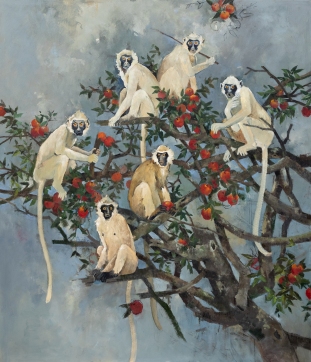 Berggruen Gallery is proud to present John Alexander: Landscape and Memory, an exhibition of recent paintings and drawings by Texas-born, New York-based artist John Alexander. This show marks Alexander’s second solo exhibition with the gallery and will be on view January 9 through February 15, 2020. The gallery will host an opening reception for the artist on Thursday, January 16 from 5:00 to 7:00pm.
John Alexander’s most recent body of work presents a detailed collection of landscapes, botanicals, sea life, and animals – each subject an emblem of the artist’s own mind and memory. Alexander grew up between the bayous and the wooded wilderness of East Texas, enjoying camping and fishing trips within the lush, diverse landscape that would ultimately become so influential to him. Moreover, Alexander’s understanding and appreciation for the natural world was fortified by his father’s environmentalism. For Alexander, developing an environmental acuity, especially for his native Texas, was familial. Today, the artist creates work in reference to the nature-based consciousness he developed in his youth.
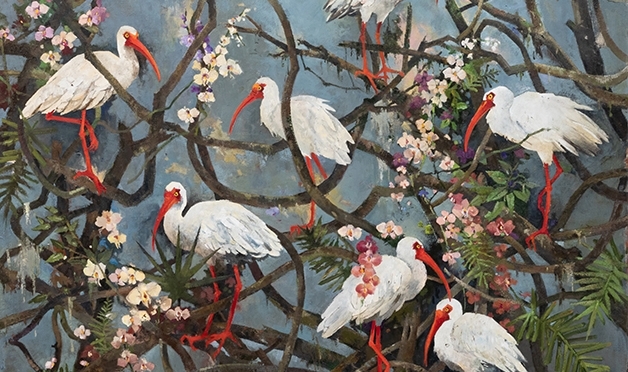
 The introspective nature of Alexander’s work is revealed through the artist’s keen observations of his surrounding environment and the vivid way in which he paints it. Employing bold, painterly strokes, Alexander maintains an acute sensibility of his subject matter – whether it be the detailed rendering of the spiny lobster, an expressive portrayal of grackles and ibises perched in branches, or more expansive, floating florals. The artist also injects elements of whimsy; the playful monkeys he paints peer out of their canvases to almost directly engage the viewer. And thus each work is imbued with an authentic, raggedly pristine, emotional sense of the earth we all inhabit. In this way, Alexander creates scenes that are deeply personal, yet also shared…nostalgic yet ongoing…exotic yet familiar…of the world yet otherworldly. Saturating his landscapes with humor, sentimentality, and veneration, Alexander reveals as much about himself as he does about nature.
John Alexander: Landscape and Memory is comprised of nine paintings and four drawings, work that comes together in reverence for the formal tradition of landscape painting. Paying homage to an Impressionist Master, Claude Monet, Alexander paints dreamy hollyhocks. Invoking the more recent Hudson River School, Alexander carefully creates bucolic scenes of both reality and idealization. Perhaps most unexpectedly, Alexander also nods to the Abstract Expressionists, applying thick strokes of paint in a gestural, emotional meditation. In turn, Alexander’s work pays tribute to the long and varied legacy of landscape painting before him while simultaneously remaining true to his own, very personal, connection to nature. Through the amalgamation of art historical context, environmental conservation, and the integration of a more intimate narrative, Alexander produces a body of work that is raw, compelling, and perhaps above all else, natural.
John Alexander was born in Beaumont, Texas, in 1945. He received his B.F.A. from Lamar University in Beaumont in 1968 and his M.F.A. from the Southern Methodist University in Dallas in 1970. Following graduate school, Alexander taught at the University of Houston. Though the artist’s Texas roots influence much of his work, to solely categorize Alexander as a “Texas” artist would be inaccurate. In 1979, having established himself in Houston as a prominent local artist, Alexander moved to New York City. Today the artist divides his time between his SoHo studio loft and home in Amagansett, East Hampton. Alexander’s work has been widely exhibited at such prestigious institutions as the Corcoran Gallery of Art and the Smithsonian American Art Museum, both in Washington, D.C., and the Museum of Fine Arts, Houston. His work is featured in the permanent collections of several leading institutions, including The Metropolitan Museum of Art, New York; the Dallas Museum of Art; and the Museum of Contemporary Art, Los Angeles; as well as many other public and private collections worldwide.
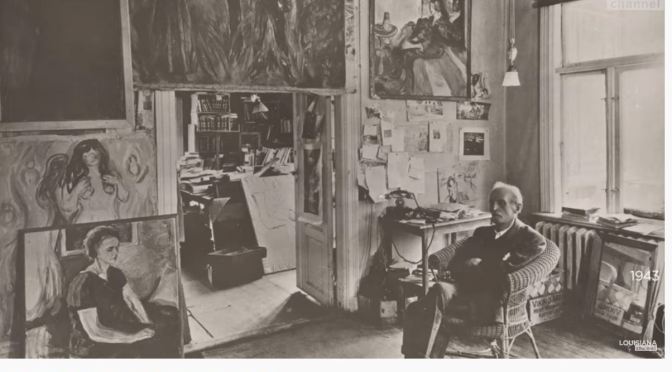
 Enjoy this engaging and far-reaching conversation between two giants of art and literature, Scottish artist Peter Doig and Norwegian author Karl Ove Knausgård about the legendary Norwegian painter Edvard Munch (1863-1944).
Peter Doig (b. 1959) is a Scottish artist, who is celebrated as one of the most important representational painters working today. He has held several solo exhibitions including at the Scottish National Gallery in Edinburgh, Faurschou Foundation in Beijing, Louisiana Museum of Modern Art in Humlebæk, Musée des Beaux-Arts de Montreal, Musée d’Art Moderne de la Ville de Paris, and Tate Britain in London. His works are held in the collections of the Art Institute of Chicago, the National Gallery of Art in Washington, D.C., and Schirn Kunsthalle in Frankfurt, among others. Doig has received several prestigious awards such as the Prix Eliette von Karajan (1994) and the Wolfgang Hahn Prize of the Society for Modern Art (2008).
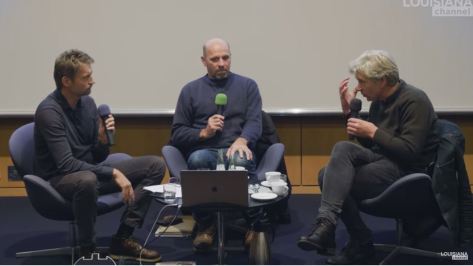
Karl Ove Knausgård (b. 1968) is a Norwegian author, internationally recognized for his prizewinning novel ‘My Struggle’. The novel, in which the author describes his own life, is in six volumes spanning over 3,000 pages. He is also the author of a four-volume series following the seasons – ‘On Spring’, ‘On Summer’, ‘On Fall’ and ‘On Winter’ (2015-16), ‘Inadvertent (Why I Write) (2018), and ‘So Much Longing in So Little Space: The Art of Edvard Munch’ (2019). Knausgård is the recipient of several prestigious prizes including the Austrian State Prize for European Literature.
Edvard Munch (1863-1944) is a Norwegian painter and one of the most important artists of the early 20th century. Munch was part of the Symbolist movement in the 1890s, and a pioneer of Expressionism. Among his most iconic paintings are ‘The Scream’ and ‘The Sick Child’.
Peter Doig and Karl Ove Knausgård were on stage with Christian Lund at Kunstsammlung Nordrhein-Westfalen in Düsseldorf in connection with the exhibition ‘Edvard Munch’, curated by Karl Ove Knausgård, in November 2019.
Camera: Jakob Solbakken
Edited by Klaus Elmer
Produced by Christian Lund
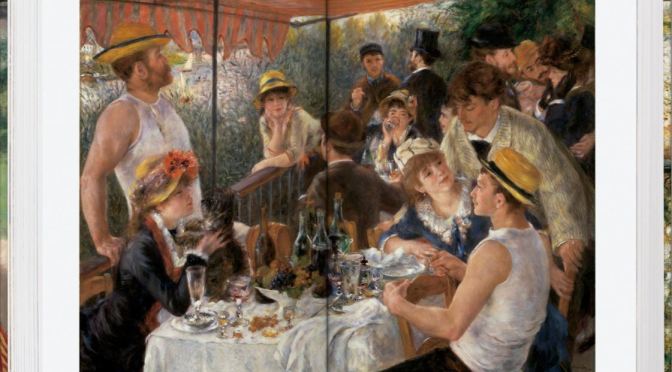
 In an incisive text tracing the artist’s career and stylistic evolution, Gilles Néret shows how Renoir reinvented the painted female form, with his everyday goddesses and their plump forms, rounded hips and breasts. Renoir’s later phase, marked by his return to the simple pleasure of the female nude in his baigneuses series, was his most innovative and stylistically influential, and would inspire such masters as Matisse and Picasso.
Pierre-Auguste Renoir’s (1841–1919) timelessly charming paintings still reflect our ideals of happiness, love, and beauty. Derived from our large-format volume, the most comprehensive retrospective of his work published to date, this compact edition examines the personal history and motivation behind the legend. Though he began by painting landscapes in the Impressionist style, Renoir found his true affinity in portraits, after which he abandoned the Impressionists altogether. Though often misunderstood, Renoir remains one of history’s most well-loved painters—undoubtedly because his works exude such warmth, tenderness, and good spirit.
Gilles Néret (1933–2005) was an art historian, journalist, writer, and museum correspondent. He organized several art retrospectives in Japan and founded the SEIBU Museum and the Wildenstein Gallery in Tokyo. He directed art reviews such as L’Œil and Connaissance des Arts and received the Élie Faure Prize in 1981 for his publications. His TASCHEN titles include Salvador Dalí: The Paintings, Matisse, and Erotica Universalis.
 In the 2000s, California-based painter Wayne Thiebaud began focusing on a series of mountain paintings, a subject he had first addressed in the 1960s and 1970s. Rendered in his signature confectionary palette, these colorful works combine memories of mountains he had seen in childhood and observations of the summits of the Sierra Nevada Range in Yosemite. With their heroic, exaggerated proportions and unusual perspectives, these paintings seem to combine fiction and reality. Conveying a sense of the sublime and the vast magnitude of our surroundings, they draw upon the history of landscape painting of the American West.
Michael M. Thomas is a former curator at the Metropolitan Museum of Art and former investment partner of Lehman Brothers. He lives in Brooklyn, New York.
Margaretta Lovell is professor of American Art at UC Berkeley.
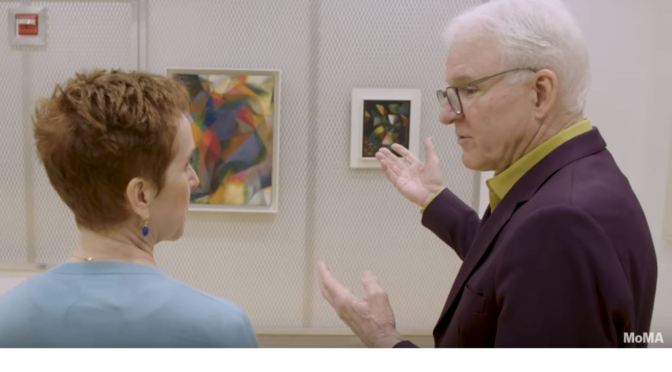
 In this episode of “The Way I See It,” actor and comedian Steve Martin looks at paintings by two early pioneers of American abstraction and takes us on a journey of seeing—shape and color transform into mountains, sky, and water. Find “The Way I See It” on BBC Sounds or wherever you get your podcasts. https://www.bbc.co.uk/programmes/m000…
 Over 200 of the world’s leading international Modern and contemporary art galleries display artworks by over 4,000 artists, including paintings, sculptures, installations, photography, film, video, and digital art. Visitors can find works ranging from editioned pieces by young artists to museum-caliber masterpieces.
Website: https://www.artbasel.com/miami-beach
‘Nameless and Friendless’ was painted in 1857 by Emily Mary Osborn. It captures a single woman trying, and failing, to earn a living as an artist in Victorian England. In a trade traditionally occupied by men, she becomes nameless and friendless.
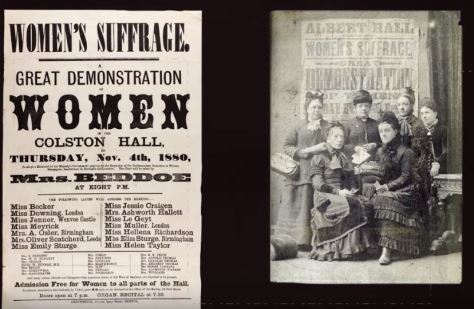
Osborn was actively involved in the campaign for women’s rights during the mid-19th century. She was supported by wealthy patrons, including Queen Victoria. But she used her position of power to help improve the lives of women like those depicted in her paintings.
Website: https://www.tate.org.uk/



 Boomers Daily