

But on its own, “BMI [body mass index] remains a strong independent risk factor” for severe COVID-19, according to several studies that adjusted for age, sex, social class, diabetes, and heart conditions, says Naveed Sattar, an expert in cardiometabolic disease at the University of Glasgow. “And it seems to be a linear line, straight up.”
- For starters, the blood of people with obesity has an increased tendency to clot—an especially grave risk during an infection that, when severe, independently peppers the small vessels of the lungs with clots
- Immunity also weakens in people with obesity, in part because fat cells infiltrate the organs where immune cells are produced and stored, such as the spleen, bone marrow, and thymus, says Catherine Andersen, a nutritional scientist at Fairfield University. “We are losing immune tissue in exchange for adipose tissue, making the immune system less effective in either protecting the body from pathogens or responding to a vaccine,” she says.
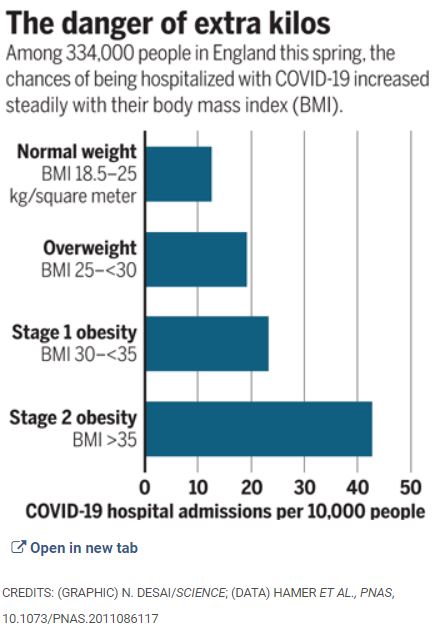
The impact extends to the 32% of people in the United States who are overweight. The largest descriptive study yet of hospitalized U.S. COVID-19 patients, posted as a preprint last month by Genentech researchers, found that 77% of nearly 17,000 patients hospitalized with COVID-19 were overweight (29%) or obese (48%). (The Centers for Disease Control and Prevention defines overweight as having a BMI of 25 to 29.9 kilograms per square meter, and obesity as a BMI of 30 or greater.)
 “Having normal body weight is crucial in the prevention of type 2 diabetes, regardless of genetic predisposition.”
 Boomers Daily