
Tag Archives: Inclusiveness

Judiciary On Trial: States Rights vs. Federal Power

By Michael Cummins, Editor, August 10, 2025
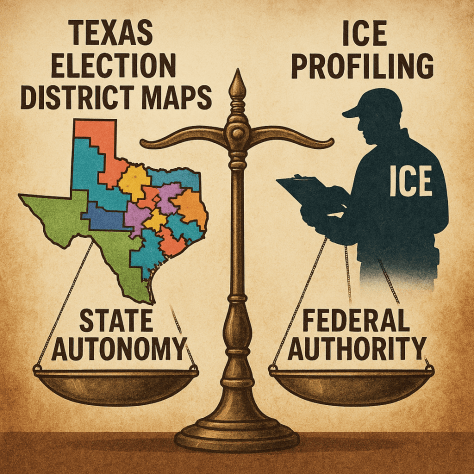
The American system of government, with its intricate web of checks and balances, is a continuous negotiation between competing sources of authority. At the heart of this negotiation lies the judiciary, tasked with the unenviable duty of acting as the final arbiter of power. The Bloomberg podcast “Weekend Law: Texas Maps, ICE Profiling & Agency Power” offers a compelling and timely exploration of this dynamic, focusing on two seemingly disparate legal battles that are, in essence, two sides of the same coin: the struggle to define the permissible boundaries of government action.

This essay will argue that the podcast’s true essence lies in its powerful synthesis of these cases, presenting them not as isolated political events but as critical manifestations of an ongoing judicial project: to determine the limits of legislative, executive, and administrative power in the face of constitutional challenges. This judicial project, as recent scholarly works have shown, is unfolding within a broader shift in American federalism, where a newly assertive judiciary and a highly politicized executive branch are rebalancing the relationship between federal and state power in unprecedented ways.

“The judiciary’s role is not merely to interpret the law, but to act as the ultimate check on a government’s temptation to consolidate power at the expense of its people.” — Emily Berman, law professor, Texas Law Review (2025)

The Supreme Court’s role as the final arbiter of these powers is not an original constitutional given, but rather a power it asserted for itself in the landmark 1803 case Marbury v. Madison. In that foundational ruling, Chief Justice John Marshall established the principle of judicial review, asserting that “it is emphatically the province and duty of the judicial department to say what the law is.” This declaration laid the groundwork for the judiciary to act as a check on both the legislative and executive branches, a power that would be tested and expanded throughout history. The two cases explored in the “Weekend Law” podcast are the latest iterations of this long-standing judicial project, demonstrating how the courts continue to shape the contours of governance in the face of contemporary challenges.

This is particularly relevant given the argument in the Harvard Law Review note “Federalism Rebalancing and the Roberts Court: A Departure from Historical Patterns” (March 2025), which contends that the Roberts Court has consciously moved away from historical trends and is now uniquely pro-state, often altering existing federal-state relationships. This broader jurisprudential shift provides a crucial backdrop for understanding Texas’s increasingly assertive actions, as it suggests the state is operating within a legal landscape more receptive to its claims of sovereignty.

Legislative Power and the Gerrymandering Divide

The first case study, the heated Texas redistricting battle, serves as a vivid illustration of the tension between legislative power and fundamental voting rights. The podcast effectively frames the drama: Texas Democrats, in a last-ditch effort, fled the state to deny the Republican-controlled legislature a quorum, thereby attempting to block the passage of a new congressional map. The stakes of this political chess match are immense, as the proposed map, crafted following the census, could solidify the Republican party’s narrow majority in the U.S. House. The legal conflict hinges on the subtle but consequential distinction between “racial” and “political” gerrymandering, a dichotomy that the Supreme Court has repeatedly struggled to define.

While the Court has held that drawing district lines to dilute the voting power of a racial minority is unconstitutional under the Fourteenth Amendment’s Equal Protection Clause and the Voting Rights Act of 1965, it has also ruled in cases like Rucho v. Common Cause (2019) that political gerrymandering is a “political question” beyond the purview of federal courts. The Bipartisan Policy Center’s explainer, “What to Know About Redistricting and Gerrymandering” (August 2025), is particularly relevant here, as it directly references a similar 2003 case where the Supreme Court allowed a Texas mid-decade map to stand. This history of judicial deference provides the specific legal precedent that empowers Texas to pursue its current redistricting efforts with confidence, and it helps contextualize the judiciary’s reluctance to intervene.

The Texas case exploits this judicial gray area. The state legislature, while acknowledging its aim to benefit the Republican Party—a seemingly permissible “political” objective—faces accusations from Democrats and civil rights groups that the new map disproportionately dilutes the power of Black and Hispanic voters, particularly in urban areas. The podcast highlights the argument that race and political preference are often so tightly intertwined that it becomes nearly impossible to separate them. This is precisely the kind of argument the Supreme Court has had to grapple with, as seen in recent cases like Alexander v. South Carolina State Conference of the NAACP (2024). In that case, the Court’s majority, led by Justice Alito, held that challengers must provide direct, not just circumstantial, evidence that race, rather than politics, was the “predominant” factor in drawing a district. This ruling, and others like it, effectively “stack the deck” against plaintiffs, creating novel and significant roadblocks to a successful racial gerrymandering claim.

“The Supreme Court has relied upon the incoherent racial gerrymandering claim because the Court lacks the right tools to police certain political conduct that might be impermissibly racist, partisan, or both.” — Rick Hasen, election law expert

Legal experts like Rick Hasen, whose work on election law is foundational, would likely view this trend with deep concern. Hasen has long argued for a more robust defense of voting rights, noting the Constitution’s surprising lack of an affirmative right to vote and the Supreme Court’s incremental, often restrictive, interpretations of voting protections. The Texas situation, in his view, is not a bug in the system but a feature of a constitutional framework that has been slowly eroded by a Court that has become increasingly deferential to state legislatures. The podcast’s narrative here is a cautionary tale of a legislative body wielding its power to entrench itself, and of a judiciary that, by its own precedents, may be unable or unwilling to intervene effectively.

The political theater of the Democrats’ walkout, therefore, is not merely a symbolic act; it is a desperate attempt to use the legislative process itself to challenge a power grab that the judiciary has made more difficult to contest. This is further complicated by the analysis in Publius – The Journal of Federalism article “State of American Federalism 2024–2025” (July 2025), which explores the concept of “transactional federalism,” where presidents reward loyal states and punish those that are not. This framework provides a vital lens for understanding how a state like Texas, with a strong political alignment to the executive branch, might feel empowered to take such aggressive redistricting actions.

Reining in Executive Overreach: The ICE Profiling Case

On the other side of the legal spectrum, the podcast turns to the Ninth Circuit’s ruling against U.S. Immigration and Customs Enforcement (ICE) in Southern California. This case shifts the focus from legislative overreach to executive overreach, particularly the conduct of an administrative agency. The court’s decision upheld a lower court’s temporary restraining order, barring ICE agents from making warrantless arrests based on a broad “profile” that included apparent race, ethnicity, language, and location. This is a critical challenge to the authority of a federal agency, forcing it to operate within the constraints of the Fourth Amendment. The court’s ruling, as highlighted in the podcast, was predicated on a “mountain of evidence” demonstrating that ICE’s practices amounted to unconstitutional racial profiling.

“The Ninth Circuit’s decision is a critical affirmation that the Fourth Amendment does not have a carve-out for immigration enforcement. A person’s skin color is not probable cause.” — David Carden, ACLU immigration attorney (July 2025)

The legal principles at play here are equally profound. The Fourth Amendment protects “the right of the people to be secure in their persons, houses, papers, and effects, against unreasonable searches and seizures.” The Ninth Circuit’s ruling essentially states that a person’s appearance, the language they speak, or where they work is not enough to establish the “reasonable suspicion” necessary for a warrantless stop. This decision is a powerful example of the judiciary acting as a check on the executive branch, affirming that even in the context of immigration enforcement, constitutional rights apply to all individuals within the nation’s borders. The podcast emphasizes the chilling effect of these raids, which created an atmosphere of fear and terror in communities of color. The court’s decision serves as a crucial bulwark against an “authoritarian” approach to law enforcement, as noted by ACLU attorneys.

Immigration attorney Leon Fresco, who is featured in the podcast, provides a nuanced perspective on the case, discussing the complexities of agency authority. While the government argued that its agents were making stops based on a totality of factors, not just race, the court’s rejection of this argument underscores a significant judicial shift. This is not a new conflict, as highlighted in the Georgetown Law article “Sovereign Resistance To Federal Immigration Enforcement In State Courthouses” (published after November 2020), which examines the historical and legal foundation for state and individual resistance to federal immigration enforcement. The article identifies the “normative underpinnings” of this resistance and explores the constitutional claims that states and individuals use to challenge federal authorities.

This historical context is essential for understanding the sustained nature of this conflict. This judicial skepticism toward expansive agency power is further illuminated by the Columbia Law School experts’ analysis of 2025 Supreme Court rulings (July 2025), which focuses on the federalism battle over immigration law and the potential for a ruling on the federal government’s ability to condition funding on state compliance with immigration laws. This expert commentary shows that the judicial challenges to federal immigration authority, as seen in the Ninth Circuit case, are part of a broader, ongoing legal battle at the highest levels of the judiciary.

The Judicial Project: Unifying Principles of Power

The true genius of the podcast is its ability to weave these two disparate threads into a single, cohesive tapestry of legal thought. The Texas redistricting fight and the ICE profiling case, while geographically and thematically distinct, are both fundamentally about the limits of power. In Texas, we see a state legislature exercising its power to draw district lines in a way that, critics argue, subverts democratic principles. In Southern California, we see a federal agency exercising its power to enforce immigration laws in a way that, the court has ruled, violates constitutional rights. In both scenarios, the judiciary is called upon to step in and draw a line.

“It is emphatically the province and duty of the judicial department to say what the law is.” — Chief Justice John Marshall, Marbury v. Madison (1803)

The podcast’s synthesis of these cases highlights the central role of the Supreme Court in this ongoing process. The Court, through its various rulings, has crafted the very legal tools and constraints that govern these conflicts. The precedents it sets—on gerrymandering, on the Voting Rights Act, and on judicial deference to agencies—become the battleground for these legal fights. The podcast suggests that the judiciary is not merely a passive umpire but an active player whose decisions over time have shaped the very rules of the game. For example, the Court’s decisions have made it harder to sue over gerrymandering and, simultaneously, have recently made it harder for agencies to act without judicial scrutiny. This creates a fascinating and potentially contradictory legal landscape where the judiciary appears to be simultaneously retreating from one area of political contention while advancing into another.

Conclusion: A New Era of Judicial Scrutiny

Ultimately, “Weekend Law” gets to the essence of a modern American dilemma. The legislative process is increasingly characterized by partisan gridlock, forcing a reliance on executive and administrative actions to govern. At the same time, a judiciary that is more ideological and assertive than ever before is stepping in to review these actions, often with a skepticism that questions the very foundations of the administrative state.

The cases in Texas and Southern California are not just about voting maps or immigration sweeps; they are about the fundamental structure of American governance. They illustrate how the judiciary, from district courts to the Supreme Court, has become the primary battleground for defining the scope of constitutional rights and the limits of state and federal power. This is occurring within a new legal environment where, according to the Harvard Law Review, the Roberts Court is uniquely pro-state, and where the executive branch, as discussed in the Publius article, is engaging in a form of “transactional federalism.”

The podcast masterfully captures this moment, presenting a world where the most profound political questions of our time are no longer settled in the halls of Congress, but in the solemn chambers of the American courthouse. As we look ahead, we are left to ponder a series of urgent questions. Will the judiciary’s new skepticism toward administrative power lead to a more accountable government or a paralyzed one? What will be the long-term impact on voting rights if the courts continue to make it more difficult to challenge gerrymandering?

“When the map is drawn to silence the voter, the very promise of democracy is fractured. The judiciary’s silence is not neutrality; it is complicity in the decay of a fundamental right.” — Professor Sarah Levinson, University of Texas School of Law (2025)

And, in an era of intense political polarization, can the judiciary—a branch of government itself increasingly viewed through a partisan lens—truly be trusted to fulfill its historic role as a neutral arbiter of the Constitution? The essence of the podcast, then, is a sober reflection on the state of American democracy, filtered through the lens of legal analysis. It portrays a system where power is constantly tested, and the judiciary, despite its own internal divisions and evolving doctrines, remains the indispensable mechanism for mediating these tests.

“A government that justifies racial profiling on the streets is no different from one that seeks to deny justice in its courthouses. The Ninth Circuit has held a line, declaring that our Constitution protects all people, not just citizens, from the long shadow of authoritarian overreach.” — Maria Elena Lopez, civil rights attorney, ACLU of Southern California (2025)

The podcast’s narrative arc—from the political brinkmanship in Texas to the constitutional defense of individual rights in California—serves as a powerful reminder that the rule of law is a dynamic, living concept, constantly being shaped and reshaped by the cases that come before the courts and the decisions that are rendered. It is a story of power, rights, and the enduring, if often contentious, role of the American judiciary in keeping the two in balance.


THIS ESSAY WAS WRITTEN AND EDITED UTILIZING AI

ADVANCING TOWARDS A NEW DEFINITION OF “PROGRESS”

By Michael Cummins, Editor, August 9, 2025

The very notion of “progress” has long been a compass for humanity, guiding our societies through eras of profound change. Yet, what we consider an improved or more developed state is a question whose answer has shifted dramatically over time. As the Cambridge Dictionary defines it, progress is simply “movement to an improved or more developed state, or to a forward position.” But whose state is being improved? And toward what future are we truly moving? The illusion of progress is perhaps most evident in the realm of technology, where breathtaking innovation often masks a troubling truth: the benefits are frequently unevenly shared, concentrating power and wealth while leaving many behind.

Historically, the definition of progress was a reflection of the era’s dominant ideology. In the medieval period, progress was a spiritual journey, a devout path toward salvation and the divine kingdom. The great cathedrals were not just architectural feats; they were monuments to this singular, sacred definition of progress. The Enlightenment shattered this spiritual paradigm, replacing it with the ascent of humanity through reason, science, and the triumph over superstition and tyranny. Thinkers like Voltaire and Condorcet envisioned a linear march toward a more enlightened, rational society.

This optimism fueled the Industrial Revolution, where figures like Auguste Comte and Herbert Spencer saw progress as a social evolution—an unstoppable climb toward knowledge and material prosperity. But this vision was a mirage for many. The steam engines that powered unprecedented economic growth also subjected workers to brutal, dehumanizing conditions, where child labor and dangerous factories were the norm. The Gilded Age, following this revolution, enriched railroad magnates and steel barons, while workers struggled in poverty and faced violent crackdowns on their efforts to organize.

Today, a similar paradox haunts our digital age. Meet Maria, a fictional yet representative 40-year-old factory worker in Flint, Michigan. For decades, her livelihood was a steady source of income for her family. But last year, the factory where she worked introduced an AI-powered assembly line, and her job, along with hundreds of others, was automated away. Maria’s story is not an isolated incident; it is a global narrative that reflects the experiences of billions. Technologies like the microchip, the algorithm, and generative AI promise to lift economies and solve complex problems, yet they often leave a trail of deepened inequality in their wake. Her story is a poignant call to arms, demanding that we re-examine our collective understanding of progress.

This essay argues for a new, more deliberate definition of progress—one that moves beyond the historical optimism rooted in automatic technological gains and instead prioritizes equity, empathy, and sustainability. We will explore the clash between techno-optimism, a blind faith in technology’s ability to solve all problems, and techno-realism, a balanced approach that seeks inclusive and ethical innovation. Drawing on the lessons of history and the urgent struggles of individuals like Maria, we will chart a course toward a progress that uplifts all, not just the powerful and the privileged.


The Myth of Automatic Progress

The allure of technology is undeniable. It is a siren’s song, promising a frictionless world of convenience, abundance, and unlimited potential. Marc Andreessen’s 2023 “Techno-Optimist Manifesto” captured this spirit perfectly, a rallying cry for the belief that technology is the engine of all good and that any critique is a form of “demoralization.” However, this viewpoint ignores the central lesson of history: innovation is not inherently a force for equality.

The Industrial Revolution, while a monumental leap for humanity, was a masterclass in how progress can widen the chasm between the rich and the poor. Factory owners, the Andreessens of their day, amassed immense wealth, while the ancestors of today’s factory workers faced dangerous, low-wage jobs and lived in squalor. Today, the same forces are at play. A 2023 McKinsey report projected that up to 30% of jobs in the U.S. could be automated by 2030, a seismic shift that will disproportionately affect low-income workers, the very demographic to which Maria belongs.

Progress, therefore, is not an automatic outcome of innovation; it is a result of conscious choices. As economists Daron Acemoglu and Simon Johnson argue in their pivotal 2023 book Power and Progress, the benefits of technology are not predetermined.

“The distribution of a technology’s benefits is not predetermined but rather a result of governance and societal choices.” — Daron Acemoglu and Simon Johnson, Power and Progress: Our Thousand-Year Struggle Over Technology and Prosperity

Redefining progress means moving beyond the naive assumption that technology’s gains will eventually “trickle down” to everyone. It means choosing policies and systems that uplift workers like Maria, ensuring that the benefits of automation are shared broadly, rather than being captured solely as corporate profits.


The Uneven Pace of Progress

Our perception of progress is often skewed by the dizzying pace of digital advancements. We see the exponential growth of computing power, the rapid development of generative AI, and the constant stream of new gadgets, and we mistakenly believe this is the universal pace of all human progress. But as Vaclav Smil, a renowned scholar on technology and development, reminds us, this is a dangerous illusion.

In his recent book, The Illusion of Progress, Smil meticulously dismantles this notion, arguing that while digital technologies soar, fundamental areas of human need—like energy and food production—are advancing at a far slower, more laborious pace.

“We are misled by the hype of digital advances, mistaking them for universal progress.” — Vaclav Smil, The Illusion of Progress: The Promise and Peril of Technology

A look at the data confirms Smil’s point. According to the International Energy Agency (IEA), the global share of fossil fuels in the primary energy mix only dropped from 85% to 80% between 2000 and 2022—a change so slow it is almost imperceptible. Simultaneously, despite technological advancements, global crop yields for staples like wheat have largely plateaued since 2010, according to a 2023 report from the Food and Agriculture Organization (FAO). This stagnation, combined with global population growth, has left an estimated 735 million people undernourished in 2022, a stark reminder that our most fundamental challenges are not being solved by the same pace of innovation we see in Silicon Valley.

Even the very tools of the digital revolution can be a source of regression. Social media, a technology once heralded as a democratizing force, has become a powerful engine for division and misinformation. For example, a 2023 BBC report documented how WhatsApp was used to fuel ethnic violence during the Kenyan elections. These platforms, while distracting us with their endless streams of content, often divert our attention from the deeper, more systemic issues squeezing families like Maria’s, such as stagnant wages and rising food prices.

Yet, progress is possible when innovation is directed toward systemic challenges. The rise of microgrid solar systems in Bangladesh, which has provided electricity to millions of households, demonstrates how targeted, appropriate technology can bridge gaps and empower communities. Redefining progress means prioritizing these systemic solutions over the next shiny gadget.


Echoes of History in Today’s World

Maria’s job loss in Flint is not a modern anomaly; it is an echo of historical patterns of inequality and division. It resonates with the Gilded Age of the late 19th century, when railroad monopolies and steel magnates like Carnegie amassed colossal fortunes while workers faced brutal, 12-hour days in unsafe factories. The violent Homestead Strike of 1892, where workers fought against wage cuts, is a testament to the bitter class struggle of that era. Today, wealth inequality rivals that gilded age, with a recent Oxfam report showing that the world’s richest 1% have captured almost two-thirds of all new wealth created since 2020. Families like Maria’s are left to struggle with rising rents and stagnant wages, a reality far removed from the promise of prosperity.

“History shows that technological progress often concentrates wealth unless society intervenes.” — Daron Acemoglu and Simon Johnson, Power and Progress

Another powerful historical parallel is the Dust Bowl of the 1930s. Decades of poor agricultural practices and corporate greed, driven by a myopic focus on short-term profit, led to an environmental catastrophe that displaced 2.5 million people. This environmental mismanagement is an eerie precursor to our current climate crisis. A recent NOAA report on California’s wildfires and other extreme weather events shows how a similar failure to prioritize long-term well-being over short-term gains is now displacing millions more, just as it did nearly a century ago.

In Flint, the social fabric is strained, with some residents blaming immigrants for economic woes—a classic scapegoat tactic that ignores the significant contributions of immigrants to the U.S. economy. This echoes the xenophobic sentiment of the 1920s Red Scare and the anti-immigrant rhetoric of the Great Depression. The rise of modern nationalism, fueled by social media and political leaders, mirrors the post-WWI isolationism that deepened the Great Depression. Unchecked AI-driven misinformation and viral “deepfakes” on platforms like X are the modern equivalent of 1930s radio propaganda, amplifying fear and division in our daily feeds.

“We shape our tools, and thereafter our tools shape us, often reviving old divisions.” — Yuval Noah Harari, Homo Deus: A Brief History of Tomorrow

Yet, history is not just a cautionary tale; it is also a source of hope. Germany’s proactive refugee integration programs in the mid-2010s, which trained and helped integrate hundreds of thousands of migrants into the workforce, show that societies can learn from past mistakes and choose inclusion over exclusion. A new definition of progress demands that we confront these cycles of inequality, fear, and division. By choosing empathy and equity, we can ensure that technology serves to bridge divides and uplift communities like Maria’s, rather than fracturing them further.


The Perils of Techno-Optimism

The belief that technology will, on its own, solve our most pressing problems—a phenomenon some scholars have termed “technowashing”—is a seductive but dangerous trap. It promises a quick fix while delaying the difficult, structural changes needed to address crises like climate change and social inequality.

In their analysis of climate discourse, scholars Sofia Ribeiro and Viriato Soromenho-Marques argue that techno-optimism is a distraction from necessary action.

“Techno-optimism distracts from the structural changes needed to address climate crises.” — Sofia Ribeiro and Viriato Soromenho-Marques, The Techno-Optimists of Climate Change

The Arctic’s indigenous communities, like the Inuit, face the existential threat of melting permafrost, which a 2023 IPCC report warns could threaten much of their infrastructure. Meanwhile, some oil companies continue to tout expensive and unproven technologies like direct air capture to justify continued fossil fuel extraction, all while delaying the real solutions—a massive investment in renewable energy—that could save trillions of dollars. This is not progress; it is a corporate strategy to externalize costs and delay accountability, echoing the tobacco industry’s denialism of the 1980s. As Nathan J. Robinson’s 2023 critique in Current Affairs notes, techno-optimism is a form of “blind faith” that ignores the need for regulation and ethical oversight, risking a repeat of catastrophes like the 2008 financial crisis, which cost the global economy trillions.

The gig economy is a perfect microcosm of this peril. Driven by AI platforms like Uber, it exemplifies how technology can optimize for profits at the expense of fairness. A recent study from UC Berkeley found that a significant portion of gig workers earn below the minimum wage, as algorithms prioritize efficiency over worker well-being. This echoes the unchecked speculative frenzy of the 1990s dot-com bubble, which ended with trillions in losses. Today, unchecked AI is amplifying these harms, with a 2023 Reuters study finding that a large percentage of content on platforms like X is misleading, fueling division and distrust.

“Technology without politics is a recipe for inequality and instability.” — Evgeny Morozov, The Net Delusion: The Dark Side of Internet Freedom

Yet, rejecting blind techno-optimism is not a rejection of technology itself. It is a demand for a more responsible, regulated approach. Denmark’s wind energy strategy, which has made it a global leader in renewables, is a testament to how pragmatic government regulation and public investment can outpace the empty promises of technowashing. Redefining progress means embracing this kind of techno-realism.


Choosing a Techno-Realist Path

To forge a new definition of progress, we must embrace techno-realism, a balanced approach that harnesses innovation’s potential while grounding it in ethics, transparency, and human needs. As Margaret Gould Stewart, a prominent designer, argues, this is an approach that asks us to design technology that serves society, not just markets.

This path is not about rejecting technology, but about guiding it. Think of the nurses in rural Rwanda, where drones zip through the sky, delivering life-saving blood and vaccines to remote clinics. According to data from the company Zipline, these drones have saved thousands of lives. This is technology not as a shiny, frivolous toy, but as a lifeline, guided by a clear human need.

History and current events show us that this path is possible. The Luddites of 1811, often dismissed as anti-progress, were not fighting against technology; they were fighting for fairness in the face of automation’s threat to their livelihoods. Their spirit lives on in the European Union’s landmark AI Act, which mandates transparency and safety standards to protect workers like Maria from biased algorithms. In Chile, a national program is retraining former coal miners to become renewable energy technicians, creating thousands of jobs and demonstrating that a just transition to a sustainable future is possible when policies prioritize people.

The heart of this vision is empathy. Finland’s national media literacy curriculum, which has been shown to be effective in combating misinformation, is a powerful model for equipping citizens to navigate the digital world. In communities closer to home, programs like Detroit’s urban gardens bring neighbors together to build solidarity across racial and economic divides. In Mexico, indigenous-led conservation projects are blending traditional knowledge with modern science to heal the land.

As Nobel laureate Amartya Sen wrote, true progress is about a fundamental expansion of human freedom.

“Development is about expanding the freedoms of the disadvantaged, not just advancing technology.” — Amartya Sen, Development as Freedom

Costa Rica’s incredible achievement of powering its grid with nearly 100% renewable energy is a beacon of what is possible when a nation aligns innovation with ethics. These stories—from Rwanda’s drones to Mexico’s forests—prove that technology, when guided by history, regulation, and empathy, can serve all.


Conclusion: A Progress We Can All Shape

Maria’s story—her job lost to automation, her family struggling in a community beset by historical inequities—is not a verdict on progress but a powerful, clear-eyed challenge. It forces us to confront the fact that progress is not an inevitable, linear march toward a better future. It is a series of deliberate choices, a constant negotiation between what is technologically possible and what is ethically and socially responsible. The historical echoes of inequality, environmental neglect, and division are loud, but they are not our destiny.

Imagine Maria today, no longer a victim of technological displacement but a beneficiary of a new, more inclusive model. Picture her retrained as a solar technician, her hands wiring a community-owned energy grid that powers Flint’s homes with clean energy. Imagine her voice, once drowned out by economic hardship, now rising on social media to share stories of unity and resilience, drowning out the divisive noise. This vision—where technology is harnessed for all, guided by ethics and empathy—is the progress we must pursue.

The path forward lies in action, not just in promises. It requires us to engage in our communities, pushing for policies that protect and empower workers. It demands that we hold our leaders accountable, advocating for a future where investments in renewable energy and green infrastructure are prioritized over short-term profits. It requires us to support initiatives that teach media literacy, allowing us to discern truth from the fog of misinformation. It is in these steps, grounded in the lessons of history, that we turn a noble vision into a tangible reality.

Progress, in its most meaningful sense, is not about the speed of a microchip or the efficiency of an algorithm. It is about the deliberate, collective movement toward a society where the benefits of innovation are shared broadly, where the most vulnerable are protected, and where our shared future is built on the foundations of empathy, community, and sustainability. It is a journey we must embark on together, a progress we can all shape.

Progress: movement to a collectively improved and more inclusively developed state, resulting in a lessening of economic, political, and legal inequality, a strengthening of community, and a furthering of environmental sustainability.


THIS ESSAY WAS WRITTEN AND EDITED UTILIZING AI