
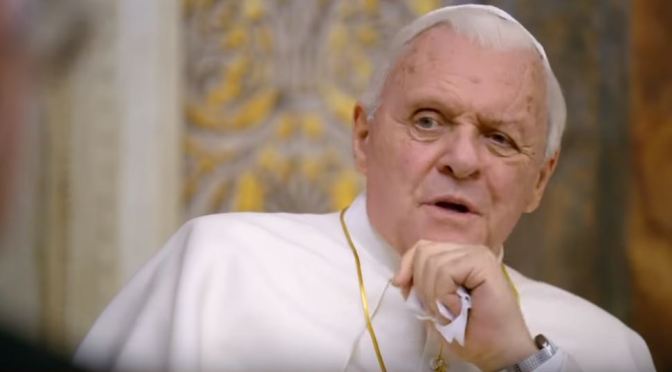
From a Wall Street Journal Magazine online interview:
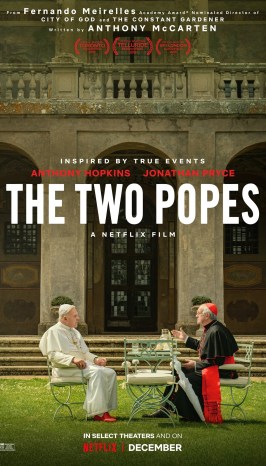 “The script is about questioning the nature of existence. I think about that every day of life. What is the purpose of life? As I get older, I look back on my own life as if it’s a novel written by someone else. To me it’s all a mystery. I started out over 60 years ago. My first job was, my God, 62 years ago and here I am. I don’t understand any of it. They gave me work, and I continued to work. It’s only just recently looking back, I thought, ‘My goodness, who designed this life? I certainly didn’t.’ I don’t know what’s life or destiny or kismet or God. I don’t want to get too philosophical about it. I’m fascinated about the mystery of life, about how we get through it, how we survive. I have no answers and I can’t take credit for any of it.”
Anthony Hopkins, who plays Pope Benedict XVI in this month’s Netflix movie The Two Popes, has a personal philosophy of not taking anything too seriously. “When I was younger, I was much more intense,” he says. “I got to a certain age, maybe 10 years ago, and thought, ‘Come on, just relax. Have some fun with it. Let’s have a ball!’” Hopkins’s surprising approach to playing the pope was to be as laid back as the actor, 81, appears on his lively Instagram account: He captures himself singing, dancing in his Thor costume and playing the piano with his cat perched on his lap.
To read more: https://www.wsj.com/articles/why-anthony-hopkins-doesnt-research-his-roles-11574343089?mod=read_more
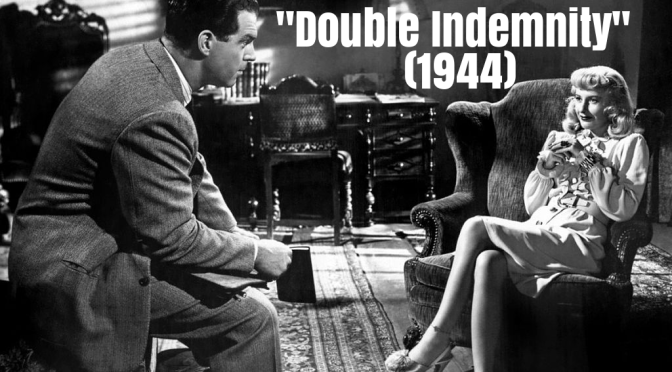
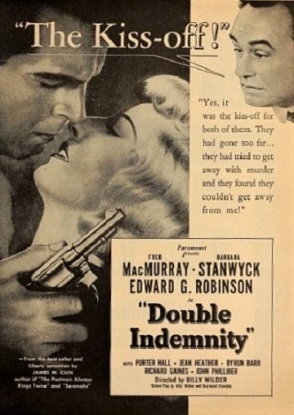 Seventy-five years ago, “Double Indemnity” opened in theaters across America. It was an instant hit, and remains to this day a staple offering of revival houses and on cable TV and streaming video. Yet little journalistic notice has been taken of the birthday of Billy Wilder’s first great screen drama, a homicidal thriller that nonetheless had—and has—something truly unsettling to say about the dark crosscurrents of middle-class American life.
 If you are among the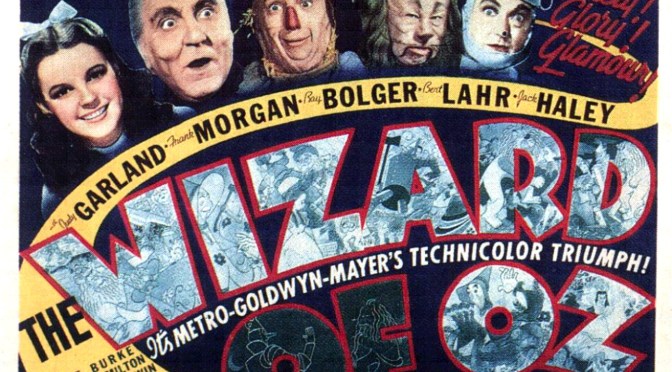
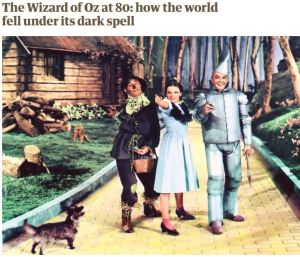 “…from Elton John’s albumGoodbye Yellow Brick Road to the Coen brothers’ O Brother, Where Art Thou?, which owes as much to Oz as it does to Homer’s Odyssey. Joel Coen once said: “Every movie ever made is an attempt to remake The Wizard of Oz.” In his 1992 essay about Fleming’s film, Salman Rushdie describes it as his “very first literary influence”. It was one of Derek Jarman’s favourite movies, and among the first he ever saw. (This is the key to its influence: the fact that everyone watches it in childhood. It seeps into your unconscious and stays there.) And there are the spin-offs, sequels and prequels – The Wiz, Return to Oz, Oz the Great and Powerful, Wicked.”
 Boomers Daily