Tag Archives: Culture Magazines

Views: The New York Times Magazine – Sept 3, 2023

Current cover

THE NEW YORK TIMES MAGAZINE (September 3, 2023) – The 9.3.23 Issue features Michael Steinberger on how the war in Ukraine turned tennis into a battlefield; Keri Blakinger on the Dungeons and Dragons players on death row; Jennifer Szalai on Naomi Klein’s new book about her doppelganger; and more.

How the War in Ukraine Turned Tennis Into a Battlefield

All the photographs in this article are black-and-white. This shows a raised fist with a tennis ball in it.

For Ukrainian players, as well as those from Russia and its allies, the unceasing conflict at home has bled into the game. Now they face off at the U.S. Open.

By Michael Steinberger

It was a few days before the start of Wimbledon this summer, and Elina Svitolina, just off a flight from Geneva, had come to the All England Lawn Tennis and Croquet Club to check in for the tournament. She was returning after a year’s absence. “It feels like it has been 10 years,” she said as she got out of the car. A lot had happened since she last competed at Wimbledon, in 2021. She had given birth to a daughter named Skaï, the first child for her and her husband, the French player Gaël Monfils. Also, her country, Ukraine, had been invaded by Russia.

When Your ‘Doppelganger’ Becomes a Conspiracy Theorist

Naomi Klein.

If you’re Naomi Klein, you write a book about it.

By Jennifer Szalai

In June, the Canadian journalist and activist Naomi Klein was sitting in the dark gray booth of a recording studio in Lower Manhattan. Dressed simply for the New York City heat — white linen top, light cropped pants, white sneakers — she was reading from a script, and there was a line that was giving her a bit of trouble.

Views: The New York Times Magazine – August 27, 2023

Image

THE NEW YORK TIMES MAGAZINE (August 27, 2023) – In this week’s cover story, Jen Percy reports on what people misunderstand about rape. Plus, the case that could unravel an art dynasty and a Harvard professor who is also an alien hunter.

What People Misunderstand About Rape

A photo illustration of a woman in a black-and-white collage.

Sexual assault often goes unpunished when victims fail to fight back. But investigators, psychologists and biologists all describe freezing as an involuntary response to trauma.

By Jen Percy

There’s a lingua franca that women use, a repeated vocabulary to describe what they experience and think during a sexual assault. Variations of “freezing” are often part of that vocabulary. But the word has so many referents in its colloquial usage that it’s hard to know precisely what it means to each person saying it.

“I just absolutely froze,” Brooke Shields said in the documentary “Pretty Baby,” describing how she felt when being raped. “And I just thought, Stay alive and get out.”

The Inheritance Case That Could Unravel an Art Dynasty

How a widow’s legal fight against the Wildenstein family of France has threatened their storied collection — and revealed the underbelly of the global art market.

By Rachel Corbett

Twenty years ago, a glamorous platinum-blond widow arrived at the Paris law office of Claude Dumont Beghi in tears. Someone was trying to take her horses — her “babies” — away, and she needed a lawyer to stop them.

Views: The New York Times Magazine – August 20, 2023

Image

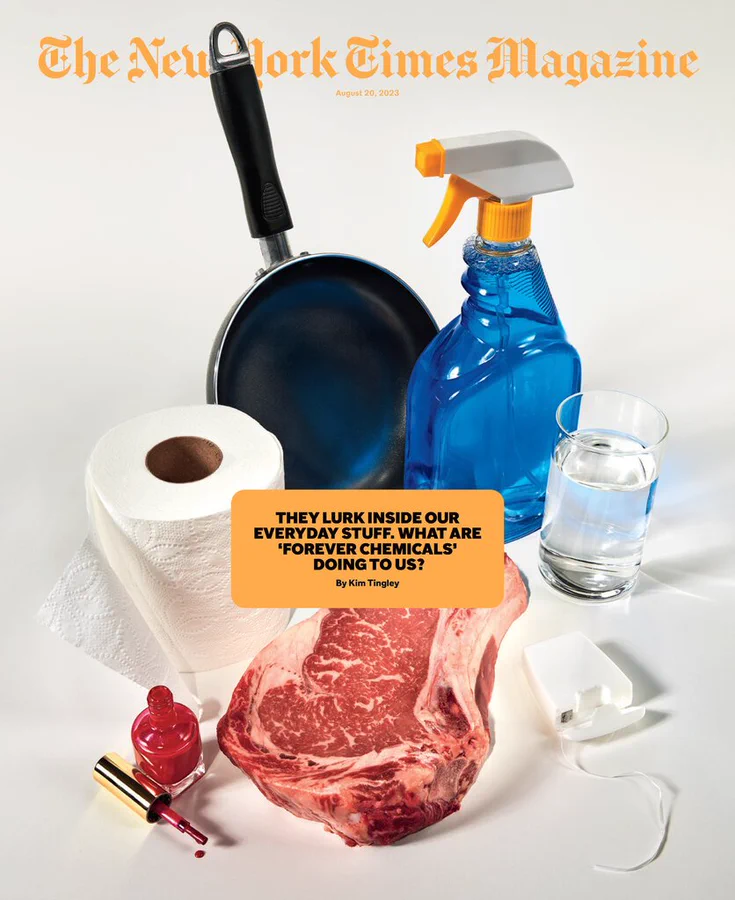
THE NEW YORK TIMES MAGAZINE (August 20, 2023) – In this week’s cover story, what are “forever chemicals” and what are they doing to us? Plus, inside the racism scandal that rocked an affluent town’s high school and checking in with the dancehall star Sean Paul.

‘Forever Chemicals’ Are Everywhere. What Are They Doing to Us?

PFAS lurk in so much of what we eat, drink and use. Scientists are only beginning to understand how they’re impacting our health — and what to do about them.

By Kim Tingley

The Faroe Islands, an incongruous speckling of green in the North Atlantic, are about as far away as you can hope to get on Earth from a toxic-waste dump, time zones distant from the nearest population centers (Norway to the east, Iceland to the west). Pál Weihe was born in the Faroes and has lived there for most of his life. He is a public-health authority for the nation, population around 53,000; chairman of the Faroese Medical Association and chief physician of the Department of Occupational Medicine and Public Health in the Faroese hospital system. He is also vice chairman of the Faroe Islands Art Society; a widower; a grandfather. A crumpled funeral program and half-empty juice boxes share space in the back seat of his Land Cruiser.

The ‘World’s Happiest Man’ Shares His Three Rules for Life

By David Marchese 

Matthieu Ricard is an ordained Buddhist monk and an internationally best-selling author of books about altruism, animal rights, happiness and wisdom. His humanitarian efforts led to his homeland’s awarding him the French National Order of Merit. (Ricard’s primary residence is a Nepalese monastery.) He was the Dalai Lama’s French interpreter and holds a Ph.D in cellular genetics. In the early 2000s, researchers at the University of Wisconsin found that Ricard’s brain produced gamma waves — which have been linked to learning, attention and memory — at such pronounced levels that the media named him “the world’s happiest man.”

Views: The New York Times Magazine – August 13, 2023

Current cover

THE NEW YORK TIMES MAGAZINEThe 8.13.23 Issue: In this special issue, Wesley Morris on hip-hop’s 50th anniversary; Niela Orr on the ascendance of female rappers; Miles Marshall Lewis on how hip-hop changed the English language forever; Daniel Levin Becker on the history of bling; Tom Breihan on Too Short’s long career; and Danyel Smith on the rappers we lost.

How Hip-Hop Changed the English Language Forever

By MILES MARSHALL LEWIS

In just 50 years, rap has transformed the way the world speaks. Here are five words that tell the story of the genre’s linguistic power.

“I stay woke” — Erykah Badu, “Master Teacher” 

HOW HIP-HOP
CONQUERED
THE WORLD

By Wesley Morris

We’re celebrating hip-hop’s 50th anniversary this week. Wesley Morris traces the art form from its South Bronx origins to all-encompassing triumph.

THE FUTURE OF RAP IS FEMALE

As their male counterparts turn depressive and paranoid, it’s the women who are having all the fun.

By Niela Orr

Like American men in general, our top male rappers appear to be in crisis: overwhelmed, confused, struggling to embody so many contradictory ideals. As a result, the art is suffering, too. If the music were any more existentially morose, or stylistically comatose, mainstream hip-hop made by men might be headed the way of hair metal or disco. The narcotized indolence is everywhere; the recounting of opioid abuse is so blasé (the Percs, Xans and Oxys) that these pillbox litanies leave you wondering if the Sackler family sponsored a wing in the rap museum. And then there’s the sense of foreshortened future that’s baked into the genre but has been amplified as gangsta rap branched off into trap, drill and other grittier subgenres. Many of the male rappers are documenting social strife and commenting on the violence that comes with being young, Black, famous men. This thread can be moving and also heartbreaking. When listening to these songs, it is impossible to not ache for their makers, to be afraid right along with them. But the music bears the weight of all that anxiety and grief. Even the occasional Drake smash is not enough to disturb the disquiet.

Views: The New York Times Magazine – August 6, 2023

Image

THE NEW YORK TIMES MAGAZINE (August 6, 2023) –

The Art of Telling Forbidden Stories in China

Hao Qun and an unnamed writer. Hao, who once enjoyed a successful writing career in China, fled to Australia after facing persecution.

Many writers are looking for ways to capture the everyday realities that the government keeps hidden — sometimes at their own peril.

By Han Zhang

On an August evening in 2021, the best-selling Chinese novelist Hao Qun, who writes under the name Murong Xuecun, was procrastinating in his one-bedroom apartment. He needed to be at Beijing Capital International Airport around 6 the next morning to catch a flight to London, but he found it hard to pack. Though Hao had a valid tourist visa to Britain, the Chinese government had kept tabs on him for years, and it was possible that he would be prevented from leaving; other public intellectuals had tried to travel abroad only to discover that they were under exit bans. Hao might have been packing for a life of exile or a futile trip to the airport.

How a Sexual Assault in a School Bathroom Became a Political Weapon

A photo illustration of a girls’ bathroom door slightly ajar.

It was an explosive claim — that a Virginia school district covered up a crime in order to protect transgender rights. But was it true?


By Charles Homans

For months a sort of aerosolized fury had hung over the Loudoun County school district. There were fights over Covid closures and mask mandates, over racial-equity programs, over library books. Now, in the weeks before the school board’s meeting on June 22, 2021, attention had shifted to a new proposal: Policy 8040, which would let transgender students choose pronouns, play sports and use bathrooms in accordance with their declared gender identity. In May, an elementary-school gym teacher announced that as a “servant of God,” he felt he could not follow the policy. The district swiftly suspended him — and just as swiftly, the antennae of conservative media outlets and politicians swiveled toward Loudoun County.

My Friend Is Trapped in a Nursing Home. What Can I Do?

The magazine’s Ethicist columnist on helping people who are institutionalized against their will.

By Kwame Anthon

Views: The New York Times Magazine – July 30, 2023

Image

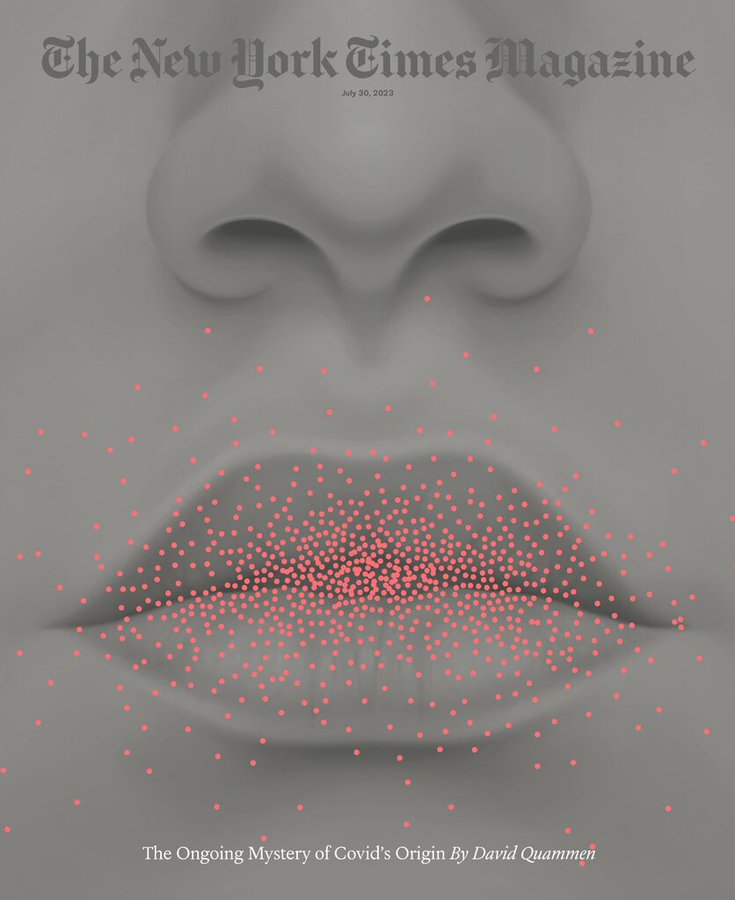
THE NEW YORK TIMES MAGAZINE (July 30, 2023) – In this week’s cover story, David Quammen reports on the ongoing mystery of Covid’s origin, what we do know — and why it matters. Plus, a profile of a poet who was kidnapped from his Black father by his white grandparents and a look at a group of English activists’ fight for the right to access public lands.

The Ongoing Mystery of Covid’s Origin

An illustration of a face with red dots surrounding the mouth.

We still don’t know how the pandemic started. Here’s what we do know — and why it matters.

By David Quammen

Where did it come from? More than three years into the pandemic and untold millions of people dead, that question about the Covid-19 coronavirus remains controversial and fraught, with facts sparkling amid a tangle of analyses and hypotheticals like Christmas lights strung on a dark, thorny tree. One school of thought holds that the virus, known to science as SARS-CoV-2, spilled into humans from a nonhuman animal, probably in the Huanan Seafood Wholesale Market, a messy emporium in Wuhan, China, brimming with fish, meats and wildlife on sale as food. Another school argues that the virus was laboratory-engineered to infect humans and cause them harm — a bioweapon — and was possibly devised in a “shadow project” sponsored by the People’s Liberation Army of China. 

The Fight for the Right to Trespass

A wealthy couple bought an estate inside Dartmoor National Park and then successfully sued to bar campers from using their land. That ruling is now being appealed.

A group of English activists want to legally enshrine the “right to roam” — and spread the idea that nature is a common good.

By Brooke Jarvis

The signs on the gate at the entrance to the path and along the edge of the reservoir were clear. “No swimming,” they warned, white letters on a red background.

On a chill mid-April day in northwest England, with low, gray clouds and rain in the forecast, the signs hardly seemed necessary. But then people began arriving, by the dozens and then the hundreds. Some walked only from nearby Hayfield, while others came by train or bus or foot from many hours away. In a long, trailing line, they tramped up the hill beside the dam and around the shore of the reservoir, slipping in mud and jumping over puddles. Above them rose a long, curving hill of open moorland, its heather still winter brown. When they came to a gap between a stone wall and a metal fence, they squeezed through it, one by one, slipping under strings of barbed wire toward the water below.

Preview: New York Times Magazine – July 23, 2023

Image

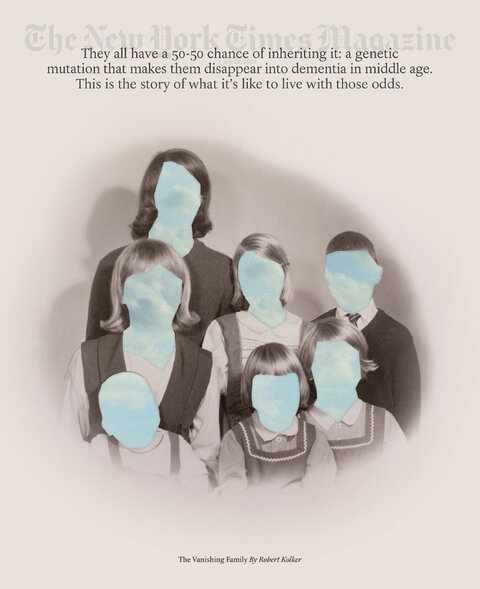
THE NEW YORK TIMES MAGAZINE (July 23, 2023) In this issue, Robert Kolker on a family’s struggle with a genetic mutation that leads to dementia in middle age; Caity Weaver tries to track down Tom Cruise; Jon Gertner on the future of Wikipedia as A.I. feeds off its human input; and more.

The Vanishing Family

They all have a 50-50 chance of inheriting a cruel genetic mutation — which means disappearing into dementia in middle age. This is the story of what it’s like to live with those odds.

By Robert Kolker

Barb was the youngest in her large Irish Catholic family — a surprise baby, the ninth child, born 10 years after the eighth. Living in the suburbs of Pittsburgh, her family followed the football schedule: high school games on Friday night, college games on Saturday, the Steelers on Sunday. Dad was an engineer, mom was a homemaker and Barb was the family mascot, blond and adorable, watching her brothers and sisters finish school and go on to their careers.

Wikipedia’s Moment of Truth

Can the online encyclopedia help teach A.I. chatbots to get their facts right — without destroying itself in the process?

By JON GERTNER

In early 2021, a Wikipedia editor peered into the future and saw what looked like a funnel cloud on the horizon: the rise of GPT-3, a precursor to the new chatbots from OpenAI. When this editor — a prolific Wikipedian who goes by the handle Barkeep49 on the site — gave the new technology a try, he could see that it was untrustworthy. The bot would readily mix fictional elements (a false name, a false academic citation) into otherwise factual and coherent answers. 

My Impossible Mission to Find Tom Cruise

The action star has gone to great lengths to avoid the press for more than a decade. But maybe our writer could track him down anyway?

By CAITY WEAVER

In an interview with Playboy in 2012, Tom Cruise described Katie Holmes as “an extraordinary person” with a “wonderful” clothing line, and someone for whom he was fond of “doing things like creating romantic dinners” — behavior that, he confided, “she enjoys.” It would prove to be his last major interview with a reporter to date. Despite what may be recalled through the penumbra of memory, this sudden silence was not directly preceded by either of Cruise’s infamous appearances on television: not by his NBC’s “Today” show interview (in which he labeled host Matt Lauer both “glib” and “Matt — MattMattMattMatt”), nor even by his appearance on “The Oprah Winfrey Show” (in which he reverse-catapulted himself onto Winfrey’s fawn-colored couch multiple times in a demonstration of his enthusiasm for Holmes).

Preview: New York Times Magazine – July 16, 2023

Image

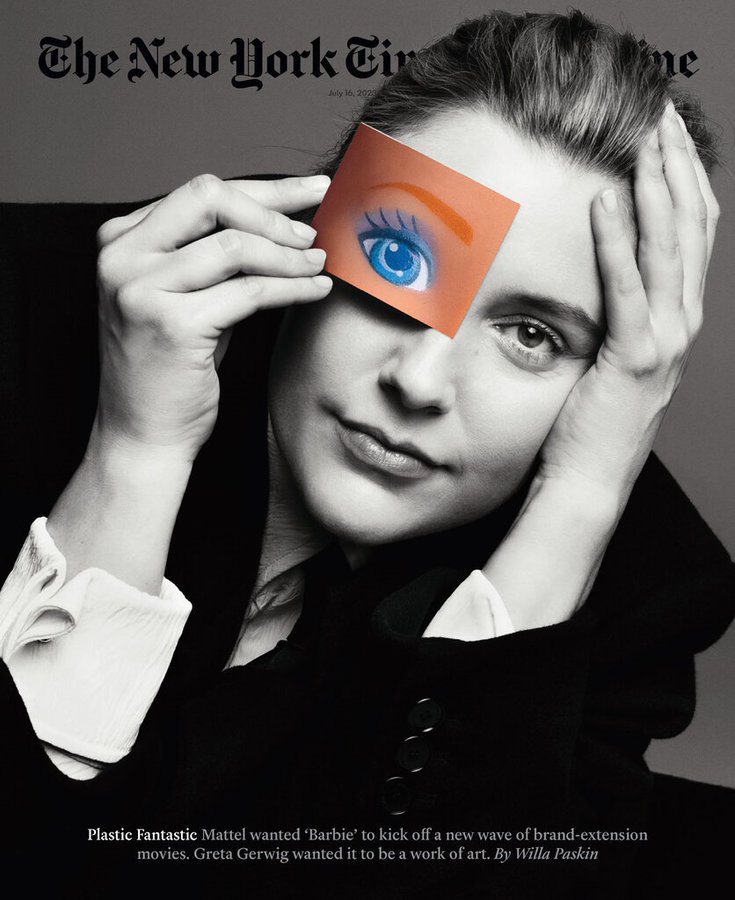
THE NEW YORK TIMES MAGAZINE (July 16, 2023) – In this week’s cover story, Greta Gerwig takes us deep inside her vision for the “Barbie” movie. Plus, the former World Cup-winner with the hardest job in soccer, the war for semiconductor chips and Robert Downey Jr. on his post-Marvel career.

Greta Gerwig’s ‘Barbie’ Dream Job

Mattel wanted a summer blockbuster to kick off its new wave of brand-extension movies. She wanted it to be a work of art.

The moment Greta Gerwig knew for certain that she could make a movie about Barbie, the most famous and controversial doll in history, she was thinking about death. She had been reading about Ruth Handler, the brash Jewish businesswoman who created the doll — and who, decades later, had two mastectomies. Handler birthed this toy with its infamous breasts, the figurine who became an enduring avatar of plastic perfection, while being stuck, like all of us, in a fragile and failing human body. 

‘An Act of War’: Inside America’s Silicon Blockade Against China

The Nvidia H100 Tensor Core GPU is used for large-scale A.I., high-performance computing and data-analytics workloads.
The Nvidia H100 Tensor Core GPU is used for large-scale A.I., high-performance computing and data-analytics workloads.Credit… Photo illustration by Grant Cornett for The New York Times

The Biden administration thinks it can preserve America’s technological primacy by cutting China off from advanced computer chips. Could the plan backfire?

Last October, the United States Bureau of Industry and Security issued a document that — underneath its 139 pages of dense bureaucratic jargon and minute technical detail — amounted to a declaration of economic war on China. The magnitude of the act was made all the more remarkable by the relative obscurity of its source. One of 13 bureaus within the Department of Commerce, the smallest federal department by funding, B.I.S. is tiny: Its budget for 2022 was just over $140 million, about one-eighth the cost of a single Patriot air-defense missile battery. 

#FIFAWWC #BarbieTheMovie

Preview: New York Times Magazine – July 9, 2023

Image

THE NEW YORK TIMES MAGAZINE (July 9, 2023) – In this week’s cover story, Sarah A. Topol reports on how the U.S. military continues to build up Guam and other Pacific territories — placing the burdens of imperial power on the nation’s most ignored and underrepresented citizens. Plus, an interview with the British writer-actress Phoebe Waller-Bridge, a profile of the winemaker Maggie Harrison and inside the D.N.C.’s primary problem.

The America That Americans Forget

Roy Gamboa, a member of Guam’s native CHamoru people and a Marine veteran.

As tensions with China mount, the U.S. military continues to build up Guam and other Pacific territories — placing the burdens of imperial power on the nation’s most ignored and underrepresented citizens.

Talk June 29, 2023

Phoebe Waller-Bridge’s Great ‘Indiana Jones’ Adventure

Waller-Bridge, 37, is co-starring in the just-released “Indiana Jones and the Dial of Destiny.” (This is after previously contributing to the screenplay for a film about another iconic character: the 2021 James Bond effort, “No Time to Die.”) Further out on the horizon, Waller-Bridge, who also created the spy-thriller series “Killing Eve,” is working on a show based on the “Tomb Raider” video game for Amazon Studios. (At the time of publication, though, that show’s progress is currently on hold because of the W.G.A. writers’ strike.) 

Maggie Harrison’s War on Wine

Maggie Harrison in a field, seen through some green plants, which partially obscure her face. The photo is in soft focus and has a yellow-green tint.

Her painstaking blends are dazzling diners and critics — and upending long-held notions about how winemaking is supposed to work.

Preview: New York Times Magazine – July 2, 2023

Image

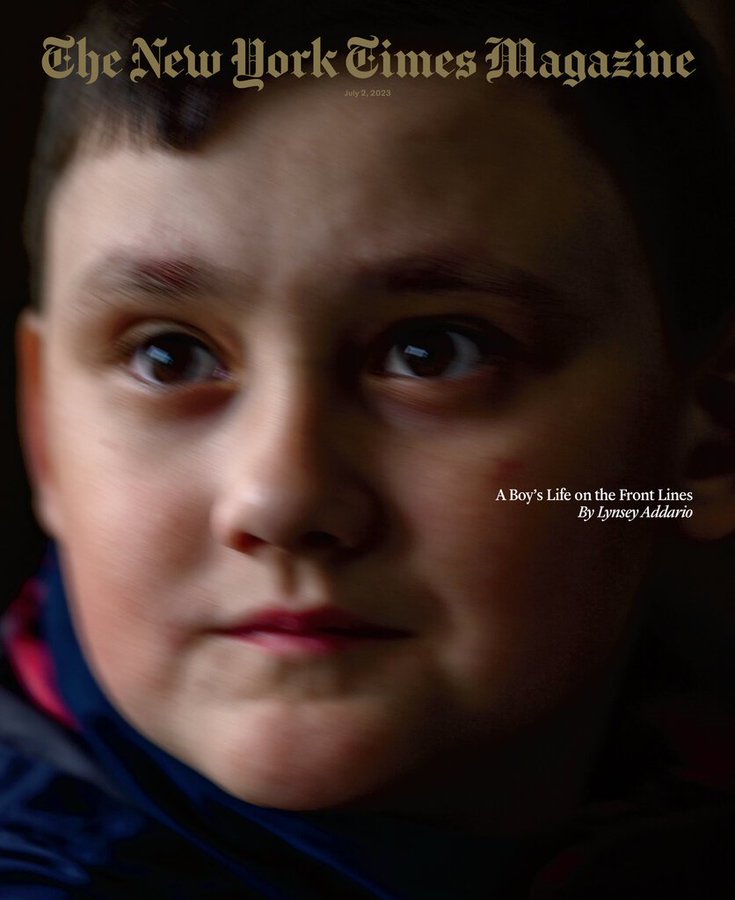
THE NEW YORK TIMES MAGAZINE (July 2, 2023) –

In this week’s cover story, Lynsey Addario takes us to a Ukrainian town where an 11-year-old is navigating a childhood transformed by war. Plus, a profile of the Christian pop star Marcos Witt and an investigation into how federal law targets thousands of women on anti-addiction medications.

A Boy’s Life on the Front Lines

In a Ukrainian town, an 11-year-old navigates a childhood transformed by war.

In a town near the Eastern front lines of the Donbas region of Ukraine, an 11-year-old boy named Yegor’s days were as predictable as they could be, given the unpredictability of war.

A.I. and TV Ads Were Made for Each Other

A photo collage of frames from AI-generated spoof advertisements, showing people drinking orange juice and beer and eating pizza. Close examination of the images reveal some strange visual distortions.

A string of uncanny videos show what generative A.I. and advertising have in common: They chew up the cultural subconscious and spit it back at us.

By Mac Schwerin

Even if I didn’t work in advertising, I would be a connoisseur of commercials. You’re probably one, too. Think of all the tropes you’ve ingested over the years — the forest-green hatchbacks conquering rugged Western landscapes, the miles of mozzarella stretched by major pizza chains. These are the images that let you know what kind of pitch you’re watching, so you won’t be confused when the brand shows up.