Tag Archives: Books

THE ALGORITHM OF IMMEDIATE RESPONSE

How outrage became the fastest currency in politics—and why the virtues of patience are disappearing.

By Michael Cummins, Editor | October 23, 2025

In an age where political power moves at the speed of code, outrage has become the most efficient form of communication. From an Athenian demagogue to modern AI strategists, the art of acceleration has replaced the patience once practiced by Baker, Dole, and Lincoln—and the Republic is paying the price.


In a server farm outside Phoenix, a machine listens. It does not understand Cleon, but it recognizes his rhythm—the spikes in engagement, the cadence of outrage, the heat signature of grievance. The air is cold, the light a steady pulse of blue LEDs blinking like distant lighthouses of reason, guarding a sea of noise. If the Pnyx was powered by lungs, the modern assembly runs on lithium and code.

The machine doesn’t merely listen; it categorizes. Each tremor of emotion becomes data, each complaint a metric. It assigns every trauma a vulnerability score, every fury a probability of spread. It extracts the gold of anger from the dross of human experience, leaving behind a purified substance: engagement. Its intelligence is not empathy but efficiency. It knows which words burn faster, which phrases detonate best. The heat it studies is human, but the process is cold as quartz.

Every hour, terabytes of grievance are harvested, tagged, and rebroadcast as strategy. Somewhere in the hum of cooling fans, democracy is being recalibrated.

The Athenian Assembly was never quiet. On clear afternoons, the shouts carried down from the Pnyx, a stone amphitheater that served as both parliament and marketplace of emotion. Citizens packed the terraces—farmers with olive oil still on their hands, sailors smelling of the sea, merchants craning for a view—and waited for someone to stir them. When Cleon rose to speak, the sound changed. Thucydides called him “the most violent of the citizens,” which was meant as condemnation but functioned as a review. Cleon had discovered what every modern strategist now understands: volume is velocity.

He was a wealthy tanner who rebranded himself as a man of the people. His speeches were blunt, rapid, full of performative rage. He interrupted, mocked, demanded applause. The philosophers who preferred quiet dialectic despised him, yet Cleon understood the new attention graph of the polis. He was running an A/B test on collective fury, watching which insults drew cheers and which silences signaled fatigue. Democracy, still young, had built its first algorithm without realizing it. The Republican Party, twenty-four centuries later, would perfect the technique.

Grievance was his software. After the death of Pericles, plague and war had shaken Athens; optimism curdled into resentment. Cleon gave that resentment a face. He blamed the aristocracy for cowardice, the generals for betrayal, the thinkers for weakness. “They talk while you bleed,” he shouted. The crowd obeyed. He promised not prosperity but vengeance—the clean arithmetic of rage. The crowd was his analytics; the roar his data visualization. Why deliberate when you can demand? Why reason when you can roar?

The brain recognizes threat before comprehension. Cognitive scientists have measured it: forty milliseconds separate the perception of danger from understanding. Cleon had no need for neuroscience; he could feel the instant heat of outrage and knew it would always outrun reflection. Two millennia later, the same principle drives our political networks. The algorithm optimizes for outrage because outrage performs. Reaction is revenue. The machine doesn’t care about truth; it cares about tempo. The crowd has become infinite, and the Pnyx has become the feed.

The Mytilenean debate proved the cost of speed. When a rebellious island surrendered, Cleon demanded that every man be executed, every woman enslaved. His rival Diodotus urged mercy. The Assembly, inflamed by Cleon’s rhetoric, voted for slaughter. A ship sailed that night with the order. By morning remorse set in; a second ship was launched with reprieve. The two vessels raced across the Aegean, oars flashing. The ship of reason barely arrived first. We might call it the first instance of lag.

Today the vessel of anger is powered by GPUs. “Adapt and win or pearl-clutch and lose,” reads an internal memo from a modern campaign shop. Why wait for a verifiable quote when an AI can fabricate one convincingly? A deepfake is Cleon’s bluntness rendered in pixels, a tactical innovation of synthetic proof. The pixels flicker slightly, as if the lie itself were breathing. During a recent congressional primary, an AI-generated confession spread through encrypted chats before breakfast; by noon, the correction was invisible under the debris of retweets. Speed wins. Fact-checking is nostalgia.

Cleon’s attack on elites made him irresistible. He cast refinement as fraud, intellect as betrayal. “They dress in purple,” he sneered, “and speak in riddles.” Authenticity became performance; performance, the brand. The new Cleon lives in a warehouse studio surrounded by ring lights and dashboards. He calls himself Leo K., host of The Agora Channel. The room itself feels like a secular chapel of outrage—walls humming, screens flickering. The machine doesn’t sweat, doesn’t blink. It translates heat into metrics and metrics into marching orders. An AI voice whispers sentiment scores into his ear. He doesn’t edit; he adjusts. Each outrage is A/B-tested in real time. His analytics scroll like scripture: engagement per minute, sentiment delta, outrage index. His AI team feeds the system new provocations to test. Rural viewers see forgotten farmers; suburban ones see “woke schools.” When his video “They Talk While You Bleed” hits ten million views, Leo K. doesn’t smile. He refreshes the dashboard. Cleon shouted. The crowd obeyed. Leo posted. The crowd clicked.

Meanwhile, the opposition labors under its own conscientiousness. Where one side treats AI as a tactical advantage, the other treats it as a moral hazard. The Democratic instinct remains deliberative: form a task force, issue a six-point memo, hold an AI 101 training. They build models to optimize voter files, diversity audits, and fundraising efficiency—work that improves governance but never goes viral. They’re still formatting the memo while the meme metastasizes. They are trying to construct a more accountable civic algorithm while their opponents exploit the existing one to dismantle civics itself. Technology moves at the speed of the most audacious user, not the most virtuous.

The penalty for slowness has consumed even those who once mastered it. The Republican Party that learned to weaponize velocity was once the party of patience. Its old guardians—Howard Baker, Bob Dole, and before them Abraham Lincoln—believed that democracy endured only through slowness: through listening, through compromise, through the humility to doubt one’s own righteousness.

Baker was called The Great Conciliator, though what he practiced was something rarer: slow thought. He listened more than he spoke. His Watergate question—“What did the President know, and when did he know it?”—was not theater but procedure, the careful calibration of truth before judgment. Baker’s deliberation depended on the existence of a stable document—minutes, transcripts, the slow paper trail that anchored reality. But the modern ecosystem runs on disposability. It generates synthetic records faster than any investigator could verify. There is nothing to subpoena, only content that vanishes after impact. Baker’s silences disarmed opponents; his patience made time a weapon. “The essence of leadership,” he said, “is not command, but consensus.” It was a creed for a republic that still believed deliberation was a form of courage.

Bob Dole was his equal in patience, though drier in tone. Scarred from war, tempered by decades in the Senate, he distrusted purity and spectacle. He measured success by text, not applause. He supported the Americans with Disabilities Act, expanded food aid, negotiated budgets with Democrats. His pauses were political instruments; his sarcasm, a lubricant for compromise. “Compromise,” he said, “is not surrender. It’s the essence of democracy.” He wrote laws instead of posts. He joked his way through stalemates, turning irony into a form of grace. He would be unelectable now. The algorithm has no metric for patience, no reward for irony.

The Senate, for Dole and Baker, was an architecture of time. Every rule, every recess, every filibuster was a mechanism for patience. Time was currency. Now time is waste. The hearing room once built consensus; today it builds clips. Dole’s humor was irony, a form of restraint the algorithm can’t parse—it depends on context and delay. Baker’s strength was the paper trail; the machine specializes in deletion. Their virtues—documentation, wit, patience—cannot be rendered in code.

And then there was Lincoln, the slowest genius in American history, a man who believed that words could cool a nation’s blood. His sentences moved with geological patience: clause folding into clause, thought delaying conclusion until understanding arrived. “I am slow to learn,” he confessed, “and slow to forget that which I have learned.” In his world, reflection was leadership. In ours, it’s latency. His sentences resisted compression. They were long enough to make the reader breathe differently. Each clause deferred judgment until understanding arrived—a syntax designed for moral digestion. The algorithm, if handed the Gettysburg Address, would discard its middle clauses, highlight the opening for brevity, and tag the closing for virality. It would miss entirely the hesitation—the part that transforms rhetoric into conscience.

The republic of Lincoln has been replaced by the republic of refresh. The party of Lincoln has been replaced by the platform of latency: always responding, never reflecting. The Great Compromisers have given way to the Great Amplifiers. The virtues that once defined republican governance—discipline, empathy, institutional humility—are now algorithmically invisible. The feed rewards provocation, not patience. Consensus cannot trend.

Caesar understood the conversion of speed into power long before the machines. His dispatches from Gaul were press releases disguised as history, written in the calm third person to give propaganda the tone of inevitability. By the time the Senate gathered to debate his actions, public opinion was already conquered. Procedure could not restrain velocity. When he crossed the Rubicon, they were still writing memos. Celeritas—speed—was his doctrine, and the Republic never recovered.

Augustus learned the next lesson: velocity means nothing without permanence. “I found Rome a city of brick,” he said, “and left it a city of marble.” The marble was propaganda you could touch—forums and temples as stone deepfakes of civic virtue. His Res Gestae proclaimed him restorer of the Republic even as he erased it. Cleon disrupted. Caesar exploited. Augustus consolidated. If Augustus’s monuments were the hardware of empire, our data centers are its cloud: permanent, unseen, self-repairing. The pattern persists—outrage, optimization, control.

Every medium has democratized passion before truth. The printing press multiplied Luther’s fury, pamphlets inflamed the Revolution, radio industrialized empathy for tyrants. Artificial intelligence perfects the sequence by producing emotion on demand. It learns our triggers as Cleon learned his crowd, adjusting the pitch until belief becomes reflex. The crowd’s roar has become quantifiable—engagement metrics as moral barometers. The machine’s innovation is not persuasion but exhaustion. The citizens it governs are too tired to deliberate. The algorithm doesn’t care. It calculates.

Still, there are always philosophers of delay. Socrates practiced slowness as civic discipline. Cicero defended the Republic with essays while Caesar’s legions advanced. A modern startup once tried to revive them in code—SocrAI, a chatbot designed to ask questions, to doubt. It failed. Engagement was low; investors withdrew. The philosophers of pause cannot survive in the economy of speed.

Yet some still try. A quiet digital space called The Stoa refuses ranking and metrics. Posts appear in chronological order, unboosted, unfiltered. It rewards patience, not virality. The users joke that they’re “rowing the slow ship.” Perhaps that is how reason persists: quietly, inefficiently, against the current.

The Algorithmic Republic waits just ahead. Polling is obsolete; sentiment analysis updates in real time. Legislators boast about their “Responsiveness Index.” Justice Algorithm 3.1 recommends a twelve percent increase in sentencing severity for property crimes after last week’s outrage spike. A senator brags that his approval latency is under four minutes. A citizen receives a push notification announcing that a bill has passed—drafted, voted on, and enacted entirely by trending emotion. Debate is redundant; policy flows from mood. Speed has replaced consent. A mayor, asked about a controversial bylaw, shrugs: “We used to hold hearings. Now we hold polls.”

To row the slow ship is not simply to remember—it is to resist. The virtues of Dole’s humor and Baker’s patience were not ornamental; they were mechanical, designed to keep the republic from capsizing under its own speed. The challenge now is not finding the truth but making it audible in an environment where tempo masquerades as conviction. The algorithm has taught us that the fastest message wins, even when it’s wrong.

The vessel of anger sails endlessly now, while the vessel of reflection waits for bandwidth. The feed never sleeps. The Assembly never adjourns. The machine listens and learns. The virtues of Baker, Dole, and Lincoln—listening, compromise, slowness—are almost impossible to code, yet they are the only algorithms that ever preserved a republic. They built democracy through delay.

Cleon shouted. The crowd obeyed. Leo posted. The crowd clicked. Caesar wrote. The crowd believed. Augustus built. The crowd forgot. The pattern endures because it satisfies a human need: to feel unity through fury. The danger is not that Cleon still shouts too loudly, but that we, in our republic of endless listening, have forgotten how to pause.

Perhaps the measure of a civilization is not how fast it speaks, but how long it listens. Somewhere between the hum of the servers and the silence of the sea, the slow ship still sails—late again, but not yet lost.

THIS ESSAY WAS WRITTEN AND EDITED UTILIZING AI

THE NEW YORK REVIEW OF BOOKS – NOVEMBER 6, 2025

THE NEW YORK REVIEW OF BOOKS: The latest issue features Jed Perl on critical thinking, Mark Lilla on the MAGA nation, Ben Lerner on his heart, Clare Bucknell on female critics in early modern England, Cora Currier on twenty-five years of the “war on terror,” Peter E. Gordon on the religion of sociology, Wyatt Mason on Guy Davenport, Josephine Quinn on St. Augustine of Africa, Geoffrey O’Brien on Kavalier and Clay at the Met, Nitin K. Ahuja on the science of death, Darryl Pinckney on James Baldwin, a painting by Maira Kalman, poems by April Bernard and Amit Majmudar, and much more.


Impassioned Ferocity

A critic’s power lies in the testing of deeply held beliefs about the nature of art and art’s place in the world against the experience of specific artworks.

Authority by Andrea Long Chu

All Things Are Too Small: Essays in Praise of Excess by Becca Rothfeld

Those Passions: On Art and Politics by T.J. Clark

Criticism and Truth: On Method in Literary Studies by Jonathan Kramnick

No Judgment by Lauren Oyler

Storm Warnings

The MAGA movement is not fed by conservative ideas but by a nihilistic, apocalyptic determination to stage a counterrevolution against the Sixties, against liberalism, against even democracy itself.

When the Clock Broke: Con Men, Conspiracists, and How America Cracked Up in the Early 1990s by John Ganz

Furious Minds: The Making of the MAGA New Right by Laura K. Field

A Brief Literary Emancipation

Early modern female writers, who were denied the sort of authority usually needed to write literary criticism, were also freed from its constraints.

Sex and Style: Literary Criticism and Gender in Early Modern England by Elizabeth Scott-Baumann

TIMES LITERARY SUPPLEMENT – OCTOBER 17, 2025 PREVIEW

TIMES LITERARY SUPPLEMENT: The latest issue features ‘Artist in the making: Joyce Carol Oates on Sally Mann’s photographic craft’

Peer group

The British upper classes today By Michael Hall

Uniquely hers

A how-to book by ‘one of the greatest’ American photographers’ By Joyce Carol Oates

Master of the apocalypse

László Krasznahorkai, Nobel laureate in literature By George Szirtes

Thoroughly modern maenads

Religion, immigration, gender politics and severed heads By Mary Beard

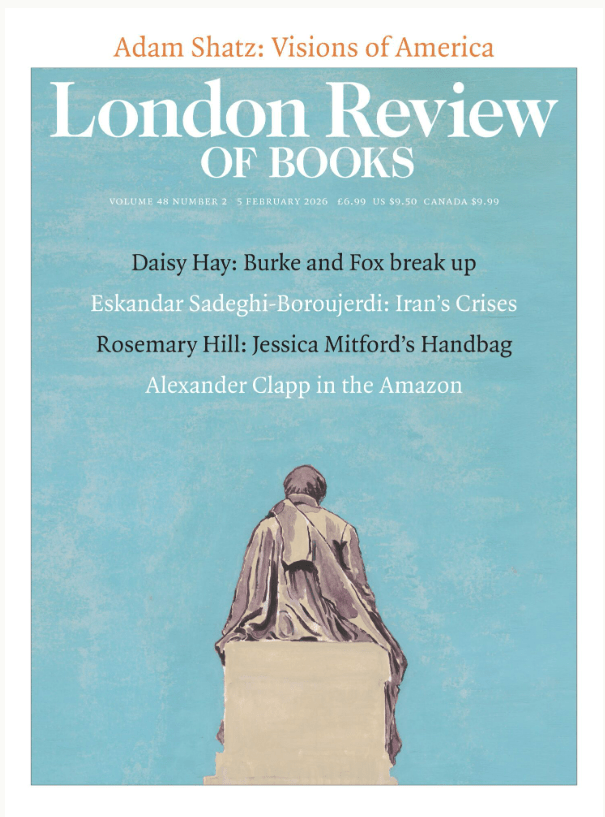
LONDON REVIEW OF BOOKS – OCTOBER 23, 2025 PREVIEW

London Review of Books

LONDON REVIEW OF BOOKS: The latest issue features ‘Mrs. Dalloway’s Demons

Unconditional Looking

The Inner Life of ‘Mrs Dalloway’ 
by Edward Mendelson.
Columbia, 137 pp., £20, September, 978 0 231 22171 9

‘Mrs Dalloway’: Biography of a Novel 
by Mark Hussey.
Manchester, 222 pp., £18.99, May, 978 1 5261 7681 3

Mrs Dalloway 
by Virginia Woolf, edited by Edward Mendelson.
NYRB, 208 pp., £15.99, September, 978 1 68137 998 2

Mrs Dalloway 
by Virginia Woolf, edited by Trudi Tate.
Oxford, 224 pp., £7.99, May, 978 0 19 285985 3

Ouvriers de luxe

Gustave Flaubert et Michel Lévy: Un couple explosif 
by Yvan Leclerc and Jean-Yves Mollier.
Le Livre de Poche, 224 pp., €8.40, November 2024, 978 2 253 94112 5

Fish in the Wrong Place

Liquid Empire: Water and Power in the Colonial World 
by Corey Ross.
Princeton, 447 pp., £35, September 2024, 978 0 691 21144 2

In Praise of Floods: The Untamed River and the Life It Brings 
by James C. Scott.
Yale, 220 pp., £20, February, 978 0 300 27849 1

THE CODE AND THE CANDLE

A Computer Scientist’s Crisis of Certainty

When Ada signed up for The Decline and Fall of the Roman Empire, she thought it would be an easy elective. Instead, Gibbon’s ghost began haunting her code—reminding her that doubt, not data, is what keeps civilization from collapse.

By Michael Cummins | October 2025

It was early autumn at Yale, the air sharp enough to make the leaves sound brittle underfoot. Ada walked fast across Old Campus, laptop slung over her shoulder, earbuds in, mind already halfway inside a problem set. She believed in the clean geometry of logic. The only thing dirtying her otherwise immaculate schedule was an “accidental humanities” elective: The Decline and Fall of the Roman Empire. She’d signed up for it on a whim, liking the sterile irony of the title—an empire, an algorithm; both grand systems eventually collapsing under their own logic.

The first session felt like an intrusion from another world. The professor, an older woman with the calm menace of a classicist, opened her worn copy and read aloud:

History is little more than the register of the crimes, follies, and misfortunes of mankind.

A few students smiled. Ada laughed softly, then realized no one else had. She was used to clean datasets, not registers of folly. But something in the sentence lingered—its disobedience to progress, its refusal of polish. It was a sentence that didn’t believe in optimization.

That night she searched Gibbon online. The first scanned page glowed faintly on her screen, its type uneven, its tone strangely alive. The prose was unlike anything she’d seen in computer science: ironic, self-aware, drenched in the slow rhythm of thought. It seemed to know it was being read centuries later—and to expect disappointment. She felt the cool, detached intellect of the Enlightenment reaching across the chasm of time, not to congratulate the future, but to warn it.

By the third week, she’d begun to dread the seminar’s slow dismantling of her faith in certainty. The professor drew connections between Gibbon and the great philosophers of his age: Voltaire, Montesquieu, and, most fatefully, Descartes—the man Gibbon distrusted most.

“Descartes,” the professor said, chalk squeaking against the board, “wanted knowledge to be as perfect and distinct as mathematics. Gibbon saw this as the ultimate victory of reason—the moment when Natural Philosophy and Mathematics sat on the throne, viewing their sisters—the humanities—prostrated before them.”

The room laughed softly at the image. Ada didn’t. She saw it too clearly: science crowned, literature kneeling, history in chains.

Later, in her AI course, the teaching assistant repeated Descartes without meaning to. “Garbage in, garbage out,” he said. “The model is only as clean as the data.” It was the same creed in modern syntax: mistrust what cannot be measured. The entire dream of algorithmic automation began precisely there—the attempt to purify the messy, probabilistic human record into a series of clear and distinct facts.

Ada had never questioned that dream. Until now. The more she worked on systems designed for prediction—for telling the world what must happen—the more she worried about their capacity to remember what did happen, especially if it was inconvenient or irrational.

When the syllabus turned to Gibbon’s Essay on the Study of Literature—his obscure 1761 defense of the humanities—she expected reverence for Latin, not rebellion against logic. What she found startled her:

At present, Natural Philosophy and Mathematics are seated on the throne, from which they view their sisters prostrated before them.

He was warning against what her generation now called technological inevitability. The mathematician’s triumph, Gibbon suggested, would become civilization’s temptation: the worship of clarity at the expense of meaning. He viewed this rationalist arrogance as a new form of tyranny. Rome fell to political overreach; a new civilization, he feared, would fall to epistemic overreach.

He argued that the historian’s task was not to prove, but to weigh.

He never presents his conjectures as truth, his inductions as facts, his probabilities as demonstrations.

The words felt almost scandalous. In her lab, probability was a problem to minimize; here, it was the moral foundation of knowledge. Gibbon prized uncertainty not as weakness but as wisdom.

If the inscription of a single fact be once obliterated, it can never be restored by the united efforts of genius and industry.

He meant burned parchment, but Ada read lost data. The fragility of the archive—his or hers—suddenly seemed the same. The loss he described was not merely factual but moral: the severing of the link between evidence and human memory.

One gray afternoon she visited the Beinecke Library, that translucent cube where Yale keeps its rare books like fossils of thought. A librarian, gloved and wordless, placed a slim folio before her—an early printing of Gibbon’s Essay. Its paper smelled faintly of dust and candle smoke. She brushed her fingertips along the edge, feeling the grain rise like breath. The marginalia curled like vines, a conversation across centuries. In the corner, a long-dead reader had written in brown ink:

Certainty is a fragile empire.

Ada stared at the line. This was not data. This was memory—tactile, partial, uncompressible. Every crease and smudge was an argument against replication.

Back in the lab, she had been training a model on Enlightenment texts—reducing history to vectors, elegance to embeddings. Gibbon would have recognized the arrogance.

Books may perish by accident, but they perish more surely by neglect.

His warning now felt literal: the neglect was no longer of reading, but of understanding the medium itself.

Mid-semester, her crisis arrived quietly. During a team meeting in the AI lab, she suggested they test a model that could tolerate contradiction.

“Could we let the model hold contradictory weights for a while?” she asked. “Not as an error, but as two competing hypotheses about the world?”

Her lab partner blinked. “You mean… introduce noise?”

Ada hesitated. “No. I mean let it remember that it once believed something else. Like historical revisionism, but internal.”

The silence that followed was not hostile—just uncomprehending. Finally someone said, “That’s… not how learning works.” Ada smiled thinly and turned back to her screen. She realized then: the machine was not built to doubt. And if they were building it in their own image, maybe neither were they.

That night, unable to sleep, she slipped into the library stacks with her battered copy of The Decline and Fall. She read slowly, tracing each sentence like a relic. Gibbon described the burning of the Alexandrian Library with a kind of restrained grief.

The triumph of ignorance, he called it.

He also reserved deep scorn for the zealots who preferred dogma to documents—a scorn that felt disturbingly relevant to the algorithmic dogma that preferred prediction to history. She saw the digital age creating a new kind of fanaticism: the certainty of the perfectly optimized model. She wondered if the loss of a physical library was less tragic than the loss of the intellectual capacity to disagree with the reigning system.

She thought of a specific project she’d worked on last summer: a predictive policing algorithm trained on years of arrest data. The model was perfectly efficient at identifying high-risk neighborhoods—but it was also perfectly incapable of questioning whether the underlying data was itself a product of bias. It codified past human prejudice into future technological certainty. That, she realized, was the triumph of ignorance Gibbon had feared: reason serving bias, flawlessly.

By November, she had begun to map Descartes’ dream directly onto her own field. He had wanted to rebuild knowledge from axioms, purged of doubt. AI engineers called it initializing from zero. Each model began in ignorance and improved through repetition—a mind without memory, a scholar without history.

The present age of innovation may appear to be the natural effect of the increasing progress of knowledge; but every step that is made in the improvement of reason, is likewise a step towards the decay of imagination.

She thought of her neural nets—how each iteration improved accuracy but diminished surprise. The cleaner the model, the smaller the world.

Winter pressed down. Snow fell between the Gothic spires, muffling the city. For her final paper, Ada wrote what she could no longer ignore. She called it The Fall of Interpretation.

Civilizations do not fall when their infrastructures fail. They fall when their interpretive frameworks are outsourced to systems that cannot feel.

She traced a line from Descartes to data science, from Gibbon’s defense of folly to her own field’s intolerance for it. She quoted his plea to “conserve everything preciously,” arguing that the humanities were not decorative but diagnostic—a culture’s immune system against epistemic collapse.

The machine cannot err, and therefore cannot learn.

When she turned in the essay, she added a note to herself at the top: Feels like submitting a love letter to a dead historian. A week later the professor returned it with only one comment in the margin: Gibbon for the age of AI. Keep going.

By spring, she read Gibbon the way she once read code—line by line, debugging her own assumptions. He was less historian than ethicist.

Truth and liberty support each other: by banishing error, we open the way to reason.

Yet he knew that reason without humility becomes tyranny. The archive of mistakes was the record of what it meant to be alive. The semester ended, but the disquiet didn’t. The tyranny of reason, she realized, was not imposed—it was invited. Its seduction lay in its elegance, in its promise to end the ache of uncertainty. Every engineer carried a little Descartes inside them. She had too.

After finals, she wandered north toward Science Hill. Behind the engineering labs, the server farm pulsed with a constant electrical murmur. Through the glass wall she saw the racks of processors glowing blue in the dark. The air smelled faintly of ozone and something metallic—the clean, sterile scent of perfect efficiency.

She imagined Gibbon there, candle in hand, examining the racks as if they were ruins of a future Rome.

Let us conserve everything preciously, for from the meanest facts a Montesquieu may unravel relations unknown to the vulgar.

The systems were designed to optimize forgetting—their training loops overwriting their own memory. They remembered everything and understood nothing. It was the perfect Cartesian child.

Standing there, Ada didn’t want to abandon her field; she wanted to translate it. She resolved to bring the humanities’ ethics of doubt into the language of code—to build models that could err gracefully, that could remember the uncertainty from which understanding begins. Her fight would be for the metadata of doubt: the preservation of context, irony, and intention that an algorithm so easily discards.

When she imagined the work ahead—the loneliness of it, the resistance—she thought again of Gibbon in Lausanne, surrounded by his manuscripts, writing through the night as the French Revolution smoldered below.

History is little more than the record of human vanity corrected by the hand of time.

She smiled at the quiet justice of it.

Graduation came and went. The world, as always, accelerated. But something in her had slowed. Some nights, in the lab where she now worked, when the fans subsided and the screens dimmed to black, she thought she heard a faint rhythm beneath the silence—a breathing, a candle’s flicker.

She imagined a future archaeologist decoding the remnants of a neural net, trying to understand what it had once believed. Would they see our training data as scripture? Our optimization logs as ideology? Would they wonder why we taught our machines to forget? Would they find the metadata of doubt she had fought to embed?

The duty of remembrance, she realized, was never done. For Gibbon, the only reliable constant was human folly; for the machine, it was pattern. Civilizations endure not by their monuments but by their memory of error. Gibbon’s ghost still walks ahead of us, whispering that clarity is not truth, and that the only true ruin is a civilization that has perfectly organized its own forgetting.

The fall of Rome was never just political. It was the moment the human mind mistook its own clarity for wisdom. That, in every age, is where the decline begins.

THIS ESSAY WAS WRITTEN AND EDITED UTILIZING AI

THE DEEP TIME OF DOUBT

How an earthquake and a wasp led Charles Darwin to replace divine design with deep time—and why his heresy still defines modern thought.

By Michael Cummins, Editor, October 7, 2025

“There is grandeur in this view of life, with its several powers, having been originally breathed into a few forms or into one; and that, whilst this planet has gone cycling on according to the fixed law of gravity, from so simple a beginning endless forms most beautiful and most wonderful have been, and are being, evolved.”
— Charles Darwin, 1859

The ground still trembled when he reached the ridge. The 1835 Valdivia earthquake had torn through the Chilean coast like a buried god waking. The air smelled of salt and sulfur; the bay below heaved, ships pitching as if caught in thought. Charles Darwin stood among tilted stones and shattered ground, his boots pressing into the risen seabed where the ocean had once lain. Embedded in the rock were seashells—fossil scallops, their curves still delicate after millennia. He traced their outlines with his fingers—relics of a world that once thought time had a purpose. Patience, he realized, was a geological fact.

He wrote to his sister that night by lantern: “I never spent a more horrid night. The ground rocked like a ship at sea… it is a strange thing to stand on solid earth and feel it move beneath one’s feet.” Yet in that movement, he sensed something vaster than terror. The earth’s violence was not an event but a language. What it said was patient, law-bound, godless.

Until then, Darwin’s universe had been built on design. At Cambridge, he had studied William Paley’s Natural Theology, whose argument was simple and seductively complete: every watch implies a watchmaker. The perfection of an eye or a wing was proof enough of God’s benevolent intention. But Lyell’s Principles of Geology, which Darwin carried like scripture on the Beagle, told a different story. The world, Lyell wrote, was not shaped by miracles but by slow, uniform change—the steady grind of rivers, glaciers, and seas over inconceivable ages. Time itself was creative.

To read Lyell was to realize that if time was democratic, creation must be too. The unconformity between Genesis and geology was not just chronological; it was moral. One offered a quick, purposeful week; the other, an infinite, indifferent age. In the amoral continuum of deep time, design no longer had a throne. What the Bible described as a single act, the earth revealed as a process—a slow and unending becoming.

Darwin began to suspect that nature’s grandeur lay not in its perfection but in its persistence. Each fossil was a fragment of a patient argument: the earth was older, stranger, and more self-sufficient than revelation had allowed. The divine clockmaker had not vanished; he had simply been rendered redundant.


In the years that followed, he learned to think like the rocks he collected. His notebooks filled with sketches of strata, lines layered atop one another like sentences revised over decades. His writing itself became geological—each idea a sediment pressed upon the last. Lyell’s slow geology became Darwin’s slow epistemology: truth as accumulation, not epiphany.

Where religion offered revelation—a sudden, vertical descent of certainty—geology proposed something else: truth that moved horizontally, grinding forward one grain at a time. Uniformitarianism wasn’t merely a scientific principle; it was a metaphysical revolution. It replaced the divine hierarchy of time with a temporal democracy, where every moment mattered equally and no instant was sacred.

In this new order, there were no privileged events, no burning bushes, no first mornings. Time did not proceed toward redemption; it meandered, recursive, indifferent. Creation, like sediment, built itself not by command but by contact. For Darwin, this was the first great heresy: that patience could replace Providence.


Yet the deeper he studied life, the more its imperfections troubled him. The neat geometry of Paley’s watch gave way to the cluttered workshop of living forms. Nature, it seemed, was a bricoleur—a tinkerer, not a designer. He catalogued vestigial organs, rudimentary wings, useless bones: the pelvic remnants of snakes, the tailbone of man. Each was a ghost limb of belief, a leftover from a prior form that refused to disappear. Creation, he realized, did not begin anew with each species; it recycled its own mistakes.

The true cruelty was not malice, but indifference’s refusal of perfection. He grieved not for God, but for the elegance of a universe that could have been coherent. Even the ichneumon wasp—its larvae devouring live caterpillars from within—seemed a grotesque inversion of divine beauty. In his Notebook M, his handwriting small and furious, Darwin confessed: “I cannot persuade myself that a beneficent & omnipotent God would have designedly created the Ichneumonidae with the express intention of their feeding within the living bodies of Caterpillars.”

It was not blasphemy but bewilderment. The wasp revealed the fatal inefficiency of creation. Life was not moral; it was functional. The divine engineer had been replaced by a blind experimenter. The problem of evil had become the problem of inefficiency.


As his understanding deepened, Darwin made his most radical shift: from the perfection of species to the variation within them. He began to think in populations rather than forms. The transformation was seismic—a break not only from theology but from philosophy itself. Western thought since Plato had been built on the pursuit of the eidos—the ideal Form behind every imperfect copy. But to Darwin, the ideal was a mirage. The truth of life resided in its variations, in the messy cloud of difference that no archetype could contain.

He traded the eternal Platonic eidos for the empirical bell curve of survival. The species was not a fixed sculpture but a statistical swarm. The true finch, he realized, was not the archetype but the average.

When he returned from the Galápagos, he bred pigeons in his garden, tracing the arc of their beaks, the scatter of colors, the subtle inheritance of form. Watching them mate, he saw how selection—artificial or natural—could, over generations, carve novelty from accident. The sculptor was chance; the chisel, time. Variation was the new theology.

And yet, the transition was not triumph but loss. The world he uncovered was magnificent, but it no longer required meaning. He had stripped creation of its author and found in its place an economy of cause. The universe now ran on autopilot.


The heresy of evolution was not that it dethroned God, but that it rendered him unnecessary. Darwin’s law was not atheism but efficiency—a biological Ockham’s Razor. Among competing explanations for life, the simplest survived. The divine had not been banished; it had been shaved away by economy. Evolution was nature’s most elegant reduction: the minimum hypothesis for the maximum variety.

But the intellectual victory exacted a human toll. As his notebooks filled with diagrams, his body began to revolt. He suffered nausea, fainting, insomnia—an illness no doctor could name. His body seemed to echo the upheavals he described: geology turned inward, the slow, agonizing abrasion of certainty. Each tremor, each bout of sickness, was a rehearsal of the earth’s own restlessness.

At Down House, he wrote and rewrote On the Origin of Species in longhand, pacing the gravel path he called the Sandwalk, circling it in thought as in prayer. His wife Emma, devout and gentle, prayed for his soul as she watched him labor. Theirs was an unspoken dialogue between faith and doubt—the hymn and the hypothesis. If he feared her sorrow more than divine wrath, it was because her faith represented what his discovery had unmade: a world that cared.

His 20-year delay in publishing was not cowardice but compassion. He hesitated to unleash a world without a listener. What if humanity, freed from design, found only loneliness?


In the end, he published not a revelation but a ledger of patience. Origin reads less like prophecy than geology—paragraphs stacked like layers, evidence folded upon itself. He wrote with an ethic of time, each sentence a small act of restraint. He never claimed finality. He proposed a process.

To think like Darwin is to accept that knowledge is not possession but erosion: truth wears down certainty as rivers wear stone. His discovery was less about life than about time—the moral discipline of observation. The grandeur lay not in control but in waiting.

He had learned from the earth itself that revelation was overrated. The ground beneath him had already written the story of creation, slowly and without words. All he had done was translate it.


And yet, the modern world has inverted his lesson. Where Darwin embraced time as teacher, we treat it as an obstacle. We have made speed a virtue. Our machines have inherited his method but abandoned his ethic. They learn through iteration—variation, selection, persistence—but without awe, without waiting.

Evolution, Darwin showed, was blind and purposeless, yet it groped toward beings capable of wonder. Today’s algorithms pursue optimization with dazzling precision, bypassing both wonder and meaning entirely. We have automated the process while jettisoning its humility.

If Darwin had lived to see neural networks, he might have recognized their brilliance—but not their wisdom. He would have asked not what they predict, but what they miss: the silence between iterations, the humility of not knowing.

He taught that patience is not passivity but moral rigor—the willingness to endure uncertainty until the truth reveals itself in its own time. His slow empiricism was a kind of secular faith: to doubt, to record, to return. We, his heirs, have learned only to accelerate.

The worms he studied in his final years became his last philosophy. They moved blindly through soil, digesting history, turning waste into fertility. In their patience lay the quiet grandeur he had once sought in heaven. “It may be doubted whether there are many other animals,” he wrote, “which have played so important a part in the history of the world.”

If angels were symbols of transcendence, the worm was its antithesis—endurance without illusion. Between them lay the moral frontier of modernity: humility.

He left us with a final humility—that progress lies not in the answers we claim, but in the patience we bring to the questions that dissolve the self. The sound of those worms, still shifting in the dark soil beneath us, is the earth thinking—slowly, endlessly, without design.

THIS ESSAY WAS WRITTEN AND EDITED UTILIZING AI

THE LAST LIGHT OF ALEXANDRIA

How Hypatia of Alexandria’s murder marked the moment reason fell to zeal—and why her lesson still echoes in an age ruled by algorithms.

By Michael Cummins, Editor, October 5, 2025

In the waning light of Alexandria’s golden age, a woman stood at the threshold of the cosmos. Draped in the robes of a philosopher, Hypatia of Alexandria taught mathematics as if it were music, astronomy as if it were prayer, and philosophy as if it were the architecture of the soul. She wrote no manifestos and led no armies. She taught. She reasoned. And for this—for the audacity of clarity in a world turning toward dogma—she was torn from the world. Her death was not merely a murder; it was a cultural wound, a severing of the classical from the medieval, of inquiry from ideology. The light she guarded—the flickering flame of secular, public reason—was extinguished in the very place conceived to protect it.

To speak of Hypatia is to speak of a city that believed knowledge could civilize the human spirit. Alexandria, founded by Alexander and tended by the Ptolemies, was the ancient world’s neural network, an experiment in global curiosity. Within its Library and Museum—the first great research institute—scholars mapped the heavens, dissected geometry, and debated the soul’s immortality under vaulted ceilings that smelled of parchment and sea salt. It was in this monumental, decaying marble world that Hypatia was born, around 370 CE, to Theon, the Library’s last known scholar. Her father taught her what Euclid and Eratosthenes had discovered, but she learned what they had meant: that geometry was not sterile abstraction but a form of devotion, a way of approaching perfection through reason.

She inherited the lineage of the ancients—the serene logic of Euclid, the restless measurement of Eratosthenes, the astronomical audacity of Ptolemy—and fused them into something both rigorous and spiritual. In late antiquity, knowledge still shimmered with moral purpose. Neoplatonism, the philosophy she championed, held that all things emanated from a single divine source, and that the human mind could ascend toward it through contemplation and mathematics. Numbers were not quantities but metaphors of being; to trace a circle was to imitate eternity. For Hypatia, geometry was not an escape from the world but its transfiguration—each theorem a small proof of cosmic coherence. It was not rebellion but refinement, a path to God that required no priest—and therefore could not be permitted.

Her genius lay in making the abstract visible. She wrote commentaries on Diophantus’s Arithmetica, clarified Ptolemy’s Almagest, and edited Apollonius’s Conics, ensuring future astronomers could still plot the curves of planets and light. Yet her intellect was not confined to parchment. She improved the astrolabe, designed hydroscopes to measure fluid density, and demonstrated that science was not the enemy of spirituality but its instrument. In Hypatia’s hands, philosophy became a navigation system—an attempt to chart truth in a universe governed by reason.

Imagine her in the lecture hall: morning light slanting through the colonnade, dust motes rising like miniature stars. A semicircle of students—Greeks, Egyptians, Romans, Jews, Christians—sit cross-legged at her feet. “You see,” she tells one, “a circle is not only a form—it is an argument for eternity.” Another asks, “And where is the soul in all this?” She pauses, chalk in hand. “In the harmony,” she says, smiling. The air hums with the audacity of free exchange. In an age dividing along creeds, her classroom was a sanctuary of synthesis.

At night, when the city’s noise dimmed and the harbor lanterns shimmered against the water, she would walk the colonnade alone. The scrolls in her study carried the scent of dust and oil. She read by lamplight until her fingers grew black with soot. To her students, she was certainty incarnate; alone, she seemed to understand that clarity provokes envy—that serenity itself is a kind of heresy. Even the stars she charted seemed to dim slightly under the weight of her foresight.

Her authority rested not on birth or ordination but on rational mastery—an unsettling legitimacy that bypassed both patriarchs and priests. She was an unmarried woman commanding reverence in a public space. Her followers were loyal not to a doctrine but to the discipline of thought itself. That was her heresy.

By the early fifth century, the harmony she embodied had begun to collapse. Alexandria had become a city of sharpened edges: pagan temples shuttered, Jewish enclaves under siege, imperial statues toppled and replaced by crosses. The Roman Empire was disintegrating; in its vacuum rose new centers of power, most formidable among them the Church. Bishop Cyril, brilliant and autocratic, sought to consolidate both spiritual and civic control. The imperial prefect Orestes—Hypatia’s friend and intellectual peer—defended the older ideal of the secular city. Between them stood the philosopher, calm and unarmed, the last civil defense against clerical supremacy.

The city had become a mirror of the empire’s exhaustion. Pagan artisans carved crosses beside the fading faces of their old gods; traders whispered prices under the sound of sermons. In the streets, theology replaced law. Orestes issued decrees that no one obeyed; Cyril’s sermons moved armies. The parabalani patrolled the harbor, their tunics stained from tending the sick and, at times, from beating the unbeliever. What began as civic unrest curdled into ritual violence—not just a fight for power, but for the right to define what counted as truth.

The conflict between Hypatia and Cyril was more than political. It was metaphysical. She represented individual, discovered truth; he, collective, inherited truth. Her worldview required no mediator between human reason and the divine. His authority depended on the indispensability of mediation. To Cyril, Neoplatonism’s notion that one could approach God through geometry and contemplation was blasphemy—it made the soul its own priest. The Church could not tolerate such independence.

One March afternoon, the mob found her carriage. They dragged her through the streets to a church—irony as architecture. Inside, beneath mosaics of saints, they stripped her, flayed her with oyster shells, and burned what remained. Socrates Scholasticus, a Christian historian, wrote simply: “Such a deed brought great disgrace upon Cyril and the Church of Alexandria.” It was not a killing; it was an exorcism. By tearing her apart, they sought to purge the city of its final pagan ghost—the living remnant of Athens’ rational soul.

Orestes, her ally, could not avenge her. The Empire, hollowed by decay, turned away. Cyril triumphed, later sanctified as a saint. The rule of law yielded to the rule of zeal. And so, with Hypatia’s death, an epoch ended. The library’s embers cooled, the lamps of the Museum darkened, and Europe entered its long medieval night.

For nearly a thousand years she survived only as rumor. Then the Enlightenment rediscovered her. Gibbon saw in her death the moment “barbarism and religion triumphed.” Voltaire invoked her as evidence that superstition kills what it cannot comprehend. Hypatia’s revival became part of a broader reckoning—a rebellion against inherited authority. To Enlightenment thinkers, she was the prototype of their own project: the reclamation of reason from revelation.

To later feminists, she became something more. Her murder revealed a longer pattern—the way intellectual women are punished not for ignorance but for illumination. Mary Wollstonecraft read her story as an ancestral warning; Simone de Beauvoir as a prelude to every modern silencing of the female intellect. To them, Hypatia was not just the first martyr of reason but its first woman martyr—the proof that wisdom in a woman’s voice has always been political.

Even now, her image flickers at the edge of cultural memory: the philosopher as secular saint, the teacher as threat. She has become the emblem of every rational mind undone by hysteria. Yet her deeper legacy lies not only in her martyrdom but in her method—the belief that the world is comprehensible, and that comprehension is a moral act.

And what, sixteen centuries later, does her story demand of us? We, too, live in an Alexandria of our own making, a world of infinite information and vanishing wisdom. Our libraries are digital, our mobs algorithmic. The algorithm has become the modern parabalani, shredding context and nuance for the sake of engagement. Knowledge no longer burns by fire; it corrodes by speed. We scroll instead of study, react instead of reflect. What once was a civic agora has become a coliseum of certitude.

Somewhere in a dim university office, a woman corrects her students’ proofs by the light of her laptop. She teaches them to think slowly in a world that rewards speed, to doubt the easy answer, to hold silence as rigor. Outside, the din of the feed hums like an approaching crowd. She doesn’t know it, but she’s teaching Hypatia’s lesson: that the mind’s true courage lies not in certainty but in patience.

Her challenge endures. The purpose of philosophy is not to win the argument but to chart the truth, even when the world insists on remaining lost. She reminds us that every age must relearn how to think freely, and that freedom of thought, once lost, returns only through vigilance.

To honor Hypatia is not merely to remember her death but to practice her discipline: to teach, to reason, to listen. The world will always be noisy, half-mad with conviction. Somewhere, in the imagined quiet of that vanished library, a woman still draws circles on marble, tracing the harmonies of a cosmos we have not yet earned. If she could look up now, she would find the same constellations unchanged—Orion still hunting, Cassiopeia still boasting, the curve of the moon unbroken. The geometry she once traced on marble persists in the heavens, indifferent to history’s convulsions. That, perhaps, was her final comfort: that reason, like starlight, travels slowly but never dies. It only waits for another mind, somewhere in the future, to lift its face and see.

THIS ESSAY WAS WRITTEN AND EDITED UTILIZING AI

THE NEW YORK REVIEW OF BOOKS – OCTOBER 23, 2025

Home | The New York Review of Books

THE NEW YORK REVIEW OF BOOKS: The latest issue features Jacob Weisberg on deep fake news, Elaine Blair on istoriya feminisma, Eric Foner on the underground railroad at sea, Andrew Katzenstein on Pynchon’s Shadow Ticket, Suzanne Schneider on Friedrich Hayek’s bastard children, Nicole Rudick on Ben Shahn’s compassion, Jay Neugeboren on the working homeless, Vicente L. Rafael on an American massacre in the Philippines, Ariel Dorfman on Pinochet’s favorite Nazi, David Cole on Trump’s summary killings in international waters, a poem by Victoria Chang, and much more.

Algorithm Nation

Fights about digital filtering tools have turned more and more bitter. That’s because of their extraordinary power to shape both political opinion and mass culture.

Invisible Rulers: The People Who Turn Lies into Reality by Renée DiResta

Character Limit: How Elon Musk Destroyed Twitter by Kate Conger and Ryan Mac

Filterworld: How Algorithms Flattened Culture by Kyle Chayka

Equality Without Feminism?

The Soviet Union’s ambitious program of gender equality could never be separated from its abuses of power.

Motherland: A Feminist History of Modern Russia, from Revolution to Autocracy by Julia Ioffe

The Big Cheese

Shadow Ticket is brisker than Thomas Pynchon’s other work, but it’s full of his usual vaudevillian sensibility, and it addresses his favorite theme: how to live freely under powerful systems of control.

Shadow Ticket by Thomas Pynchon

THE HOUR-LONG FUTURE

How Chicago’s oldest exchange bet on sixty-minute markets, and what it means when certainty itself is priced like a parlay.

Inspired by conversations on Bloomberg’s “Odd Lots” podcast, October 2, 2025, this essay explores the collision of Chicago’s most venerable marketplace with America’s newest gambling instinct.

By Michael Cummins, Editor, October 2, 2025

Chicago declares its weather. The wind comes down LaSalle Street like a verdict, rattling the brass doors of the Chicago Mercantile Exchange (CME), the world’s largest derivatives marketplace, and Terry Duffy keeps telling the same story about the Sears Tower. Once, Sears was so secure it stamped its name onto the tallest building in the country. Then Amazon arrived and the edifice outlived the company. Duffy repeats the story because he knows it could happen to him. He is the custodian of a market built on trust and clearing, and he now presides over a future in which markets themselves have begun to resemble slot machines.

When CME announced this summer that it would partner with FanDuel to launch retail-friendly “event contracts,” the move was described, in the buttoned-down language of FIA MarketVoice, as bringing “Wall Street to Main Street.” But the reality is stranger: the nation’s most venerable exchange has chosen to build a door onto a sports-betting app. The product is stark in its simplicity—fully funded, binary contracts tied to benchmarks like the S&P 500, gold, or the monthly Consumer Price Index (CPI), each available for a dollar, each expiring in sixty minutes. “We want to attract a new generation of retail traders,” CME explained in its release, emphasizing transparency, defined risk, and the symbolic price point that even the most casual bettor can afford.

Duffy knows what it is to sell certainty. He began his career in the pits, where certainty was conjured out of chaos. To enter the pit was to descend into a human engine: men in jackets of vivid color, chalk dust in the air, sweat soaking the collars, voices rising to a roar. Each shout was a legal contract; each hand signal, a coded promise. Palm in meant buy, palm out meant sell. A quick nod sealed the trade. A look in the eye carried as much weight as a notarized document. The pit was a place where trust was physical, embodied, and enforced by reputation.

He still carries it in his cadence. His sentences are short, clipped, emphatic, relics of the pits’ staccato. A “yes” had to carry over the roar, and a “no” had to land like a gavel. He learned that a man’s word was binding; a lie meant exile. To Duffy, the roar was not noise but a symphony of accountability.

Contrast that to the FanDuel app, silent and frictionless. No shouts, no sweat, no eye contact. A bet placed with a swipe, confirmed by a vibration in the pocket. The counterparty is invisible; the clearing is algorithmic. The visceral contract of the pit has become the abstract contract of the phone. For Duffy, the gap is more than technological—it is civilizational.

His survival has always depended on bridging gaps. In 2007, he forced CME and the Chicago Board of Trade (CBOT)—longstanding rivals, territorial and proud—into a merger that saved both from decline. It was, at the time, a brutal clash of cultures. Pit traders who once hurled insults across LaSalle now shared a roof. Duffy’s achievement was to convince them that survival required sacrifice. The precedent matters now: he knows when to abandon tradition in order to preserve the institution. He has led the exchange for over two decades, long enough to embody continuity in a world addicted to rupture.

Which is why he returns, again and again, to the Sears Tower. Sears did not collapse overnight. Its decline was gradual: catalogs left unopened, trust eroded, relevance seeped away. Sears represented predictability—a known price, a tangible good. It was undone by the infinite shelf of Amazon, where everything was available, untethered from a physical catalog. Duffy fears the same for CME: that in the infinite, unregulated shelf of crypto and apps, the certainty of a clearinghouse will be forgotten. He has made himself the defender of that certainty, even as he opens the door to the FanDuel crowd.

Imagine it, then, not in Chicago but in Des Moines: a woman on her lunch break, soup cooling in its paper cup, phone buzzing with the faintly cheerful ping of a FanDuel notification. She scrolls past the Raiders’ line, taps the “markets” tab, and there it is: gold, $1,737. Above or below? Sixty minutes to decide. She glances at the chart, flickering like a slot machine, and stakes a dollar. Her coworker laughs—he’s on crude oil, betting it falls before the hour. It is a small act, private and almost whimsical. But multiply it by millions, and the cathedral of Chicago has rented space to the gamblers.

Amy Howe, FanDuel’s chief executive, prefers another framing. “By working with CME Group, we can give consumers a transparent, fully funded product with clear rules and protections,” she said in August. For her, the lunch-break wager is less a symptom of dopamine culture than an act of empowerment, bounded by disclosure and design. Later, she would describe it as “responsible innovation for a generation that already expects to engage with markets digitally.”

The phone has conditioned us to view every decision as a micro-transaction with binary payoff, a perpetual A/B test of our own lives. Swipe left or right, invest in Tesla or short its sales, like or ignore, vote or abstain. Certainty itself has become a parlay. The event contract is merely the most transparent expression of this new algorithmic certainty.

Duffy knows the critique—that he is blurring investing and gambling, putting the reputation of the world’s most trusted clearinghouse in play. He shrugs off the taxonomy. “Find me an investment without speculation,” he challenges. Speculators create liquidity; investors ride the train. The problem is not the label. The problem is whether the architecture can hold.

Once, hedging was about survival. A farmer locked in the price of corn to guarantee his family’s subsistence through drought. A grain elevator hedged to manage inventory. Futures were the sober instrument of risk management, a tool for keeping bread on tables. The retail contracts on FanDuel are different. They are not designed to secure a season’s yield but to occupy a lunch break. The hedger and the gambler both face uncertainty, but one does so to live through winter, the other to feel a flicker of dopamine.

What happens when a generation learns to price its risks in sixty-minute increments? When patience is dissolved into perpetual refresh, when civic trust is reshaped by the grammar of instant payoff? Perhaps we become more rational, disciplined consumers of risk. More likely, we become addicted to ever-shorter horizons, citizens of a republic of immediacy.

The FanDuel tie-up is not an aberration; it is the logical culmination of a broader gamification. Fitness apps turn calories into wins and losses. Dating apps transform intimacy into binary swipes. Diet apps offer daily streaks, productivity trackers chart each hour, social media doles out likes. The logic is universal: win or lose, in the money or out. Finance is simply the purest distillation of the loop. The hour-long future looks less like a radical departure than the natural endpoint of the dopamine economy.

Duffy insists that the difference lies in the architecture of the market. Here, the clearinghouse still rules. The CME Clearing division guarantees that each contract, no matter how small, will clear. This is the core trust mechanism: novation. The clearinghouse steps in as the buyer to every seller and the seller to every buyer. It guarantees performance even if a party defaults. It is the invisible institution that makes markets work, as essential as plumbing or electricity. Without clearing, a market is just a game of promises. With clearing, promises become enforceable contracts.

This is why Duffy obsesses over jurisdiction. The nickel crisis in London remains his cautionary tale. When the London Metal Exchange (LME) canceled billions in nickel trades in 2022, after a massive short squeeze threatened a major client, it violated the principle that trades, once made, must stand. In Duffy’s view, this was sacrilege. If trades can be retroactively voided, trust collapses. The nickel debacle lingers as a ghost story he tells often: what happens when clearing is not sacred, when the rules bend to expedience?

The tax code, too, becomes part of his defense. Section 1256 of the Internal Revenue Code gives futures a blended 60/40 tax treatment—sixty percent long-term, forty percent short-term—even though they expire quickly. This means that a futures trader, even in hourly event contracts, can claim a rate unavailable to sports bettors. The distinction between “future” and “security” may be arcane, but in the retail economy it could be decisive. Why place a bet on an unregulated platform with higher tax burdens when you could trade an event future inside CME’s fortress? Duffy is building his moat out of law as well as architecture.

Yet even he admits there are red lines. Political prediction markets, for instance. At first glance, they seem like an extension of the model. Why not allow bets on elections, if you can bet on CPI or jobs reports? But Duffy sees danger. Imagine a small-town school bond vote. A motivated actor buys all the “Yes” contracts, pushing the price higher, creating the illusion of inevitability. Undecided voters, reading the “market,” assume the bond will pass and vote accordingly. Speculation becomes self-fulfilling. A democracy of markets quickly becomes a market for democracy.

The Iowa Electronic Markets (IEM) were tolerated because they were small, academic, pedagogical—designed to teach students about probabilities. But scaled onto a national betting app, political contracts would cease to be an experiment and become an accelerant. Duffy resists. “Every political event is not a presidential election,” he warns. Some are small enough to be readily manipulable. And the Commodity Exchange Act is explicit: contracts cannot be.

He also resists the temptation of perpetual futures. Crypto invented them as an answer to expiry, an infinite bet that never resolves. To Duffy, they fail the laugh test. Immortal cattle cannot be delivered. Wheat cannot grow forever. A Treasury future must expire into a bond. A future without resolution is not a hedge but a hallucination.

Still, he is not afraid of arriving late. In 2017, he was mocked for waiting to list Bitcoin futures. When he did, CME became the premier venue for hedging crypto risk. His philosophy is consistent: better to be late with credibility than early with chaos. “Go when the architecture can hold,” he says, and it sounds less like a trading maxim than a worldview.

The contradiction remains: the man who built his authority in the pits, enforcing trust by the pressure of a body, is now enabling the gamification of markets by the tap of a thumb. Is he selling his integrity, or saving the concept of the market by absorbing the dopamine impulse into its ancient structure? Is CME, in joining FanDuel, protecting the house—or merely becoming one more casino in an infinite arcade?

He walks a city that remembers. The Sears Tower still stands, though its name has eroded. The ghost-hum of the pits lingers in his cadence. The wind whips down LaSalle, eternal as ever. The phones in people’s pockets glow across the country, each a miniature trading pit, silent and frictionless. A new market is trying to clear—not just trades, but trust, patience, and perhaps the architecture of democracy itself.

THIS ESSAY WAS WRITTEN AND EDITED UTILIZING AI