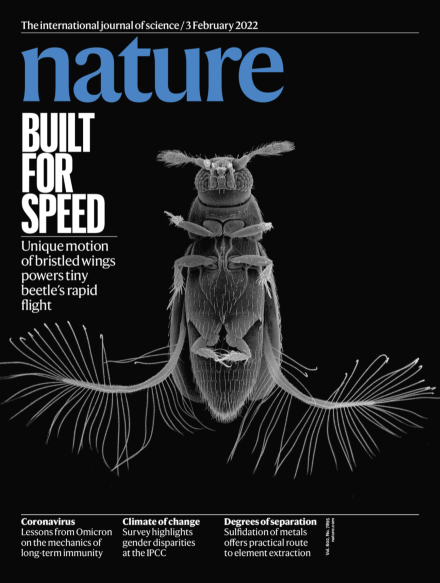
In Nature this week: Built for speed – the unique motion of its bristled wings powers this tiny beetle's rapid flight. Browse the full issue here: https://t.co/uBQSeNry3G pic.twitter.com/qQGLVPwfSn
— nature (@Nature) February 3, 2022

Spineless sea squirts shed light on vertebrate evolution, and an iodine-fuelled engine powering a satellite in space.
In this episode:
00:45 A story of sea squirts, ancient vertebrates and missing genes
When a PhD student set out to study the developmental pathways of a strange sea creature, he hoped to shed light on the origins of vertebrate animals. Instead, researchers found themselves investigating a strange case of missing genes. We hear why gene loss could be a more significant factor in evolutionary processes than was previously thought.
Research article: Ferrández-Roldán et al.
08:17 Research Highlights
The unusual crystal that gives a beetle its glittering green sheen, and the genetics of a fish’s 200 year lifespan.
Research Highlight: Weird crystal makes beetle a living jewel
Research Highlight: Some of Earth’s longest-lived fish show how to reach extreme ages
10:43 An iodine-fuelled engine for satellites
In space, many satellites use xenon-fuelled ‘electric propulsion systems’ to maneuver. However, xenon is rare and requires high-pressure storage systems, so researchers have been working to develop alternative fuels. This week, a team publish details of the first in-space test of an iodine-powered electric propulsion system, which they say has many advantages over xenon systems.
Research article: Rafalskyi et al
16:37 Briefing Chat
We discuss some highlights from the Nature Briefing. This time, issues aboard the Hubble Space Telescope, and what the discovery of a theorised mineral reveals about processes deep within the Earth.
Wired: NASA Tries to Save Hubble, Again
Nature: Diamond delivers long-sought mineral from the deep Earth
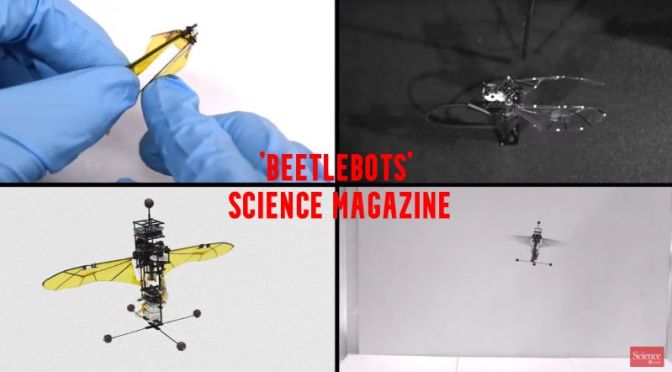
Beetles are virtually crash resistant. Their wings fold up when they collide with objects, and then quickly spring back into place. That helps the insects stay on course and fly straight, rather than spiral to the ground, while exerting little energy. Researchers have now built a winged robot that mimics this capability.
The “beetlebot” keeps flying, even after it crashes into poles, researchers report this month in Science. The energy-efficient robot could even navigate narrow environments, such as collapsed buildings, to aid rescue missions, the team says.

The structure of a beetle’s super-strong exoskeleton could open up new engineering applications, and efforts to address diversity and equality imbalances in academia.
In this episode:
01:17 Insights into an armoured insect
The diabolical ironclad beetle has an exoskeleton so strong, it can survive being run over by a car. Researchers have identified how the structure of the exoskeleton provides this strength, and show that mimicking it may lead to improved aerospace components.
Research Article: Rivera et al.; News and Views: Diabolical ironclad beetles inspire tougher joints for engineering applications
10:42 Coronapod
This week, the UK government announced plans to run a ‘human challenge trial’, where healthy volunteers are deliberately infected with the SARS-CoV-2 virus. We talk about the process, the ethical and procedural hurdles, and whether such an approach will provide any useful data.
News: Dozens to be deliberately infected with coronavirus in UK ‘human challenge’ trials
22:46 Research Highlights
A method to assess the age of RNA, and how southern elephant seals helped to identify supercooled seawater.
Research article: Rodriques et al.; Research article: Haumann et al.
25:20 Efforts to address equity in science
Julie Posselt has been investigating the efforts of academic institutions to assess ingrained imbalances in diversity and equality. We talk to her about these efforts and her new book on the subject.
Book review: How to get more women and people of colour into graduate school — and keep them there
31:43 Briefing Chat
We discuss some highlights from the Nature Briefing. This time, back pay for female professors at Princeton, and a newly uncovered superpower for the tiny tardigrade.



 Boomers Daily