Tag Archives: Affirmative Action

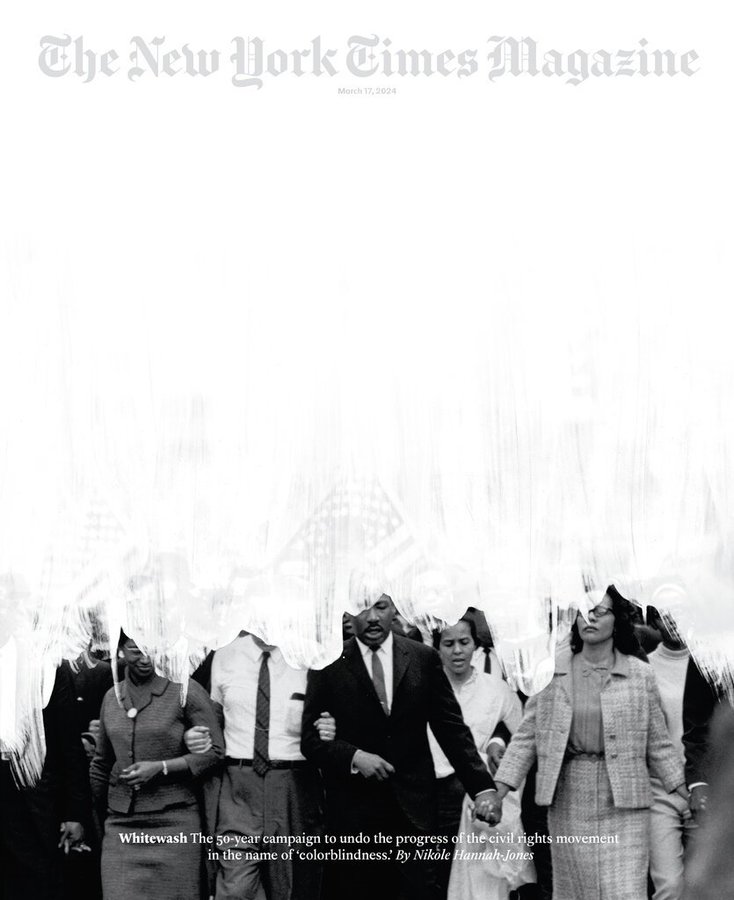
The New York Times Magazine – March 17, 2024

Image

THE NEW YORK TIMES MAGAZINE (March 16, 2024):

The ‘Colorblindness’ Trap: How a Civil Rights Ideal Got Hijacked

The fall of affirmative action is part of a 50-year campaign to roll back racial progress.

By Nikole Hannah

Anthony K. Wutoh, the provost of Howard University, was sitting at his desk last July when his phone rang. It was the new dean of the College of Medicine, and she was worried. She had received a letter from a conservative law group called the Liberty Justice Center. The letter warned that in the wake of the Supreme Court’s decision striking down affirmative action in college admissions, the school “must cease” any practices or policies that included a “racial component” and said it was notifying medical schools across the country that they must eliminate “racial discrimination” in their admissions. If Howard refused to comply, the letter threatened, the organization would sue.

What Deathbed Visions Teach Us About Living

A photo illustration of two peoples’ silhouettes.

Researchers are documenting a phenomenon that seems to help the dying, as well as those they leave behind.

By Phoebe Zerwick

Chris Kerr was 12 when he first observed a deathbed vision. His memory of that summer in 1974 is blurred, but not the sense of mystery he felt at the bedside of his dying father. Throughout Kerr’s childhood in Toronto, his father, a surgeon, was too busy to spend much time with his son, except for an annual fishing trip they took, just the two of them, to the Canadian wilderness. Gaunt and weakened by cancer at 42, his father reached for the buttons on Kerr’s shirt, fiddled with them and said something about getting ready to catch the plane to their cabin in the woods. “I knew intuitively, I knew wherever he was, must be a good place because we were going fishing,” Kerr told me.
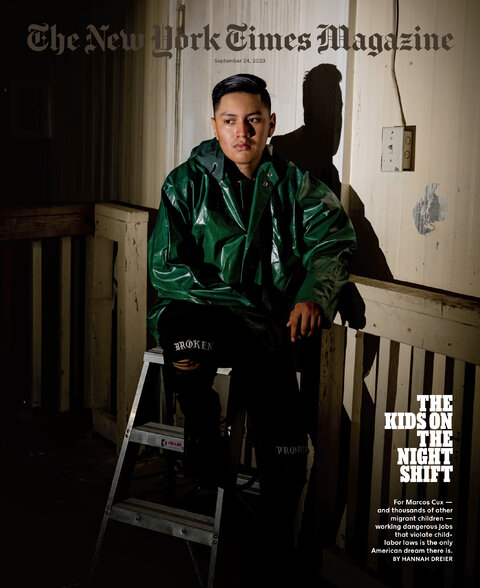
Views: The New York Times Magazine – Sept 24, 2023

Image

THE NEW YORK TIMES MAGAZINE (September 22, 2023): The 9.24.23 Issue features Hannah Dreier on migrant children working in dangerous conditions; McKenzie Funk on Hank Asher, a drug smuggler who became a pioneer in data mining; Sonia Shah on new research that suggests animals are saying more than we think; and more.

The Animals Are Talking. What Does It Mean?

A collection of black and white illustrations of animals are arranged into the shape of a speech bubble.

Language was long understood as a human-only affair. New research suggests that isn’t so.

Can a mouse learn a new song?

Such a question might seem whimsical. Though humans have lived alongside mice for at least 15,000 years, few of us have ever heard mice sing, because they do so in frequencies beyond the range detectable by human hearing. As pups, their high-pitched songs alert their mothers to their whereabouts; as adults, they sing in ultrasound to woo one another. For decades, researchers considered mouse songs instinctual, the fixed tunes of a windup music box, rather than the mutable expressions of individual minds.

A Chile Paste So Good, It’s Protected by the U.N.

Real-deal Tunisian harissa is an anchor to the motherland and a bright, specific accent to countless dishes.

By Eric Kim

Last year, UNESCO officially deemed harissa, the brick red, aromatic chile paste, “an integral part of domestic provisions and the daily culinary and food traditions of Tunisian society.” Keyword: Tunisian.

Views: The New York Times Magazine – Sept 17, 2023

Image

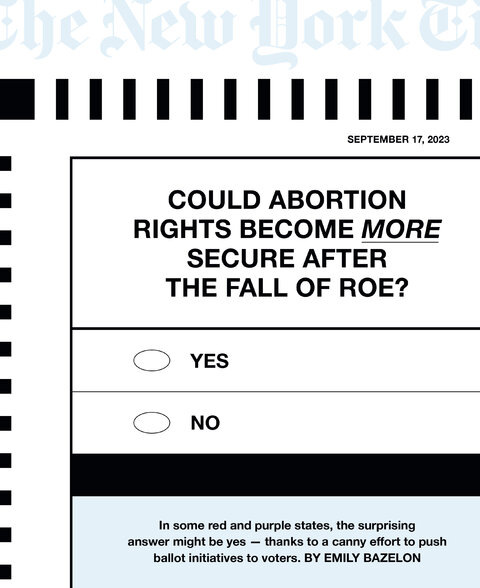
THE NEW YORK TIMES MAGAZINE (September 17, 2023): The 9.17.23 Issue features Emily Bazelon on abortion rights being won through state ballots after the Dobbs decision; Audra D.S. Burch on the death of Elijah McClain in Aurora, Colorado and the city’s deep divide over policing; Teju Cole on Greek tragedies; Dan Brooks on the Italian rock band Måneskin; and more.

The Surprising Places Where Abortion Rights Are on the Ballot, and Winning

After Dobbs, the political ground seems to be shifting in some unpredictable ways.

By EMILY BAZELON

The Trials of Aurora: A Colorado City’s Deep Divide Over Policing

After Elijah McClain died in 2019, the case seemed to be closed. The George Floyd protests — and the backlash to them — would change everything.

By Audra D. S. Burch

One by one, the five men — three police officers and two paramedics — walked up before the judge one afternoon this January. Their lawyers stood beside them, and the wooden benches of the Colorado courtroom were filled with family, friends and fellow police officers and paramedics.

Views: The New York Times Magazine – Sept 10, 2023

Image

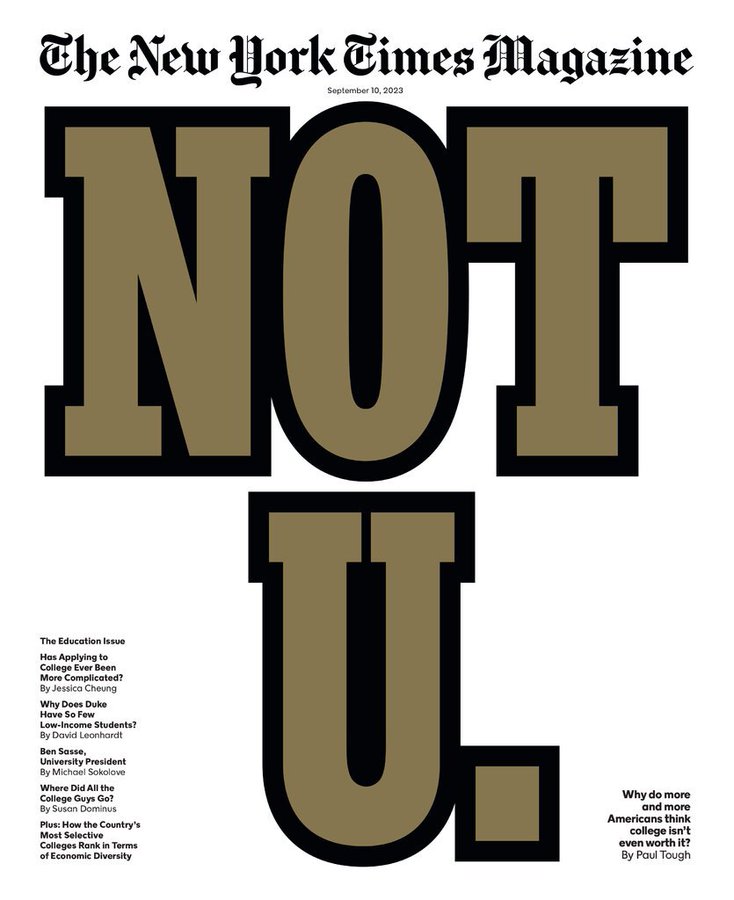
THE NEW YORK TIMES MAGAZINE (September 10, 2023): The Education Issue features Americans Are Losing Faith in the Value of College. Whose Fault Is That?; Affirmative Action Is Still in Effect. For Men, and more….

Americans Are Losing Faith in the Value of College. Whose Fault Is That?

For most people, the new economics of higher ed make going to college a risky bet.

By Paul Tough

A decade or so ago, Americans were feeling pretty positive about higher education. Public-opinion polls in the early 2010s all told the same story. In one survey, 86 percent of college graduates said that college had been a good investment; in another, 74 percent of young adults said a college education was “very important”; in a third, 60 percent of Americans said that colleges and universities were having a positive impact on the country. Ninety-six percent of parents who identified as Democrats said they expected their kids to attend college — only to be outdone by Republican parents, 99 percent of whom said they expected their kids to go to college.

Affirmative Action Is Still in Effect. For Men.

The scene outside a bar that is popular among Tulane students.

Declining male enrollment has led some colleges to adopt an unofficial policy that many find objectionable: “We need to admit men, and women are going to suffer.”

By Susan Dominus

In the spring of 2021, about 2,000 students on the campus of Tulane University in New Orleans received an email they were expecting. They had filled out an elaborate survey provided by Marriage Pact, a matchmaking service popular on many campuses, and the day had come for each of them to be given the name of a fellow student who might be a long-term romantic partner. When the results came in, however, about 900 straight women who participated were surprised by what the email offered: a friend match instead of a love interest. 

Covers: The New Criterion Magazine – October 2022

The New Criterion

October 2022

Affirmative action & the law a symposium


The American affirmative-action regime  by Frank Resartus
An agenda for Congress  by Gail Heriot
The Voting Rights Act after six decades  by James Piereson
Facially neutral, racially biased  by Wen Fa & John Yoo
Democracy & the Supreme Court  by Glenn Harlan Reynolds

New poems  by William Logan, Jessica Hornik & Peter Vertacnik