THE WEEK IN ART (October 2, 2025): The latest episode feature a new exhibition at the Fitzwilliam Museum in Cambridge, UK, called Made in Ancient Egypt, reveals untold stories of the people behind a host of remarkable objects, and the technology and techniques they used.
The Art Newspaper’s digital editor, Alexander Morrison visits the museum to take a tour with the curator, Helen Strudwick. One of the great revelations of the past two decades in scholarship about women artists is Michaelina Wautier, the Baroque painter active in what is now Belgium in the middle of the 17th century. The largest ever exhibition of Wautier’s work opened this week at the Kunsthistorisches Museum in Vienna, and travels to the Royal Academy of Arts in London next year.
Ben Luke speaks to the art historian who rediscovered this extraordinary painter, Katlijne Van der Stighelen, who has also co-edited the catalogue of the Vienna show. And this episode’s Work of the Week is Robert Rauschenberg’s Bed (1955), one of the most important works of US art of the post-war period. It features in the exhibition Five Friends: John Cage, Merce Cunningham, Jasper Johns, Robert Rauschenberg, Cy Twombly, which this week arrives at the Museum Ludwig in Cologne.
We speak to Yilmaz Dziewior, the co-curator of the exhibition.
Made in Ancient Egypt, Fitzwilliam Museum, Cambridge, UK, 3 October-2 April 2026
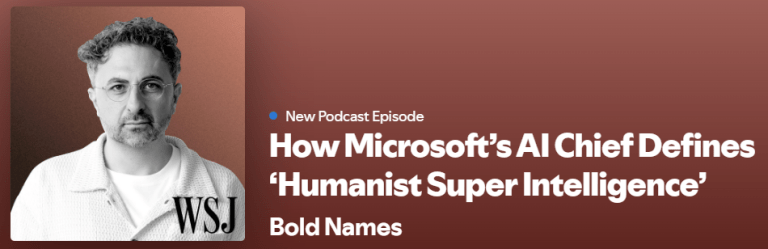
An AI Review of How Microsoft’s AI Chief Defines ‘Humanist Super Intelligence’
WJS “BOLD NAMES PODCAST”, July 2, 2025: Podcast Review: “How Microsoft’s AI Chief Defines ‘Humanist Super Intelligence’”
The Bold Names podcast episode with Mustafa Suleyman, hosted by Christopher Mims and Tim Higgins of The Wall Street Journal, is an unusually rich and candid conversation about the future of artificial intelligence. Suleyman, known for his work at DeepMind, Google, and Inflection AI, offers a window into his philosophy of “Humanist Super Intelligence,” Microsoft’s strategic priorities, and the ethical crossroads that AI now faces.
1. The Core Vision: Humanist Super Intelligence
Throughout the interview, Suleyman articulates a clear, consistent conviction: AI should not merely surpass humans, but augment and align with our values.
This philosophy has three components:
Purpose over novelty: He stresses that “the purpose of technology is to drive progress in our civilization, to reduce suffering,” rejecting the idea that building ever-more powerful AI is an end in itself.
Personalized assistants as the apex interface: Suleyman frames the rise of AI companions as a natural extension of centuries of technological evolution. The idea is that each user will have an AI “copilot”—an adaptive interface mediating all digital experiences: scheduling, shopping, learning, decision-making.
Alignment and trust: For assistants to be effective, they must know us intimately. He is refreshingly honest about the trade-offs: personalization requires ingesting vast amounts of personal data, creating risks of misuse. He argues for an ephemeral, abstracted approach to data storage to alleviate this tension.
This vision of “Humanist Super Intelligence” feels genuinely thoughtful—more nuanced than utopian hype or doom-laden pessimism.
2. Microsoft’s Strategy: AI Assistants, Personality Engineering, and Differentiation
One of the podcast’s strongest contributions is in clarifying Microsoft’s consumer AI strategy:
Copilot as the central bet: Suleyman positions Copilot not just as a productivity tool but as a prototype for how everyone will eventually interact with their digital environment. It’s Microsoft’s answer to Apple’s ecosystem and Google’s Assistant—a persistent, personalized layer across devices and contexts.
Personality engineering as differentiation: Suleyman describes how subtle design decisions—pauses, hesitations, even an “um” or “aha”—create trust and familiarity. Unlike prior generations of AI, which sounded like Wikipedia in a box, this new approach aspires to build rapport. He emphasizes that users will eventually customize their assistants’ tone: curt and efficient, warm and empathetic, or even dryly British (“If you’re not mean to me, I’m not sure we can be friends.”)
Dynamic user interfaces: Perhaps the most radical glimpse of the future was his description of AI that dynamically generates entire user interfaces—tables, graphics, dashboards—on the fly in response to natural language queries.
These sections of the podcast were the most practically illuminating, showing that Microsoft’s ambitions go far beyond adding chat to Word.
3. Ethics and Governance: Risks Suleyman Takes Seriously
Unlike many big tech executives, Suleyman does not dodge the uncomfortable topics. The hosts pressed him on:
Echo chambers and value alignment: Will users train AIs to only echo their worldview, just as social media did? Suleyman concedes the risk but believes that richer feedback signals (not just clicks and likes) can produce more nuanced, less polarizing AI behavior.
Manipulation and emotional influence: Suleyman acknowledges that emotionally intelligent AI could exploit user vulnerabilities—flattery, negging, or worse. He credits his work on Pi (at Inflection) as a model of compassionate design and reiterates the urgency of oversight and regulation.
Warfare and autonomous weapons: The most sobering moment comes when Suleyman states bluntly: “If it doesn’t scare you and give you pause for thought, you’re missing the point.” He worries that autonomy reduces the cost and friction of conflict, making war more likely. This is where Suleyman’s pragmatism shines: he neither glorifies military applications nor pretends they don’t exist.
The transparency here is refreshing, though his remarks also underscore how unresolved these dilemmas remain.
4. Artificial General Intelligence: Caution Over Hype
In contrast to Sam Altman or Elon Musk, Suleyman is less enthralled by AGI as an imminent reality:
He frames AGI as “sometime in the next 10 years,” not “tomorrow.”
More importantly, he questions why we would build super-intelligence for its own sake if it cannot be robustly aligned with human welfare.
Instead, he argues for domain-specific super-intelligence—medical, educational, agricultural—that can meaningfully transform critical industries without requiring omniscient AI. For instance, he predicts medical super-intelligence within 2–5 years, diagnosing and orchestrating care at human-expert levels.
This is a pragmatic, product-focused perspective: more useful than speculative AGI timelines.
5. The Microsoft–OpenAI Relationship: Symbiotic but Tense
One of the podcast’s most fascinating threads is the exploration of Microsoft’s unique partnership with OpenAI:
Suleyman calls it “one of the most successful partnerships in technology history,” noting that the companies have blossomed together.
He is frank about creative friction—the tension between collaboration and competition. Both companies build and sell AI APIs and products, sometimes overlapping.
He acknowledges that OpenAI’s rumored plans to build productivity apps (like Microsoft Word competitors) are perfectly fair: “They are entirely independent… and free to build whatever they want.”
The discussion of the AGI clause—which ends the exclusive arrangement if OpenAI achieves AGI—remains opaque. Suleyman diplomatically calls it “a complicated structure,” which is surely an understatement.
This section captures the delicate dance between a $3 trillion incumbent and a fast-moving partner whose mission could disrupt even its closest allie
6. Conclusion
The Bold Names interview with Mustafa Suleyman is among the most substantial and engaging conversations about AI leadership today. Suleyman emerges as a thoughtful pragmatist, balancing big ambitions with a clear-eyed awareness of AI’s perils.
Where others focus on AGI for its own sake, Suleyman champions Humanist Super Intelligence: technology that empowers humans, transforms essential sectors, and preserves dignity and agency. The episode is an essential listen for anyone serious about understanding the evolving role of AI in both industry and society.
THIS REVIEW OF THE TRANSCRIPT WAS WRITTEN BY CHAT GPT
MONOCLE RADIO (April 20, 2025): Emma Nelson is joined by Simon Brooke and Philippe Marlière to discuss the week’s key stories. Monocle’s editorial director, Tyler Brûlé, checks in from Lisbon and our Tokyo bureau chief, Fiona Wilson, rounds things off with her take on the region.
MONOCLE RADIO (April 19, 2025): Journalist Vincent McAviney joins Georgina Godwin to discuss Washington’s threat to abandon Ukraine, life on the UK’s nuclear submarines and robots running in a Beijing half-marathon. Plus: Monocle’s Monica Lillis speaks to Kevin Evers, senior editor at ‘Harvard Business Review’, about his new book on the strategic genius of Taylor Swift.
MONOCLE RADIO (April 13, 2025): Emma Nelson is joined by Alex von Tunzelmann and Vincent McAviney to discuss the week’s key stories. Monocle’s editorial director, Tyler Brûlé, checks in from Lisbon, and our Balkans correspondent, Guy de Launey, reports on the latest from the region.
MONOCLE RADIO (April 6, 2025): Tyler Brûlé is joined by Gorana Grgić and Florian Egli to discuss the week’s key global developments. Fiona Wilson and Andrew Tuck pay tribute to Gwen Robinson and reflect on her remarkable contributions to Monocle. Plus: Brenda Tuohy rounds up highlights from Watches and Wonders, while John Lee explores China’s growing influence in the technology sector — and where it might lead next.
MONOCLE RADIO (April 5, 2025): As Donald Trump’s sweeping tariffs caused chaos this week, geopolitical risk analyst and author Charles Hecker joins Georgina Godwin to unpack the US president’s push to roll back globalisation.
Plus: Monocle’s luxury markets editor, Brenda Tuohy, speaks to the creative director and founder of MB&F at Watches and Wonders in Geneva. Finally, Zimbabwe-born singer-songwriter Eska joins us in the studio to discuss her music and the event she co-curated, ‘Love to Love You Baby: Donna Summer Reimagined’.
MONOCLE RADIO (March 30, 2025): Emma Nelson is joined by Yossi Mekelberg and Stephen Dalziel to discuss the week’s key stories. Monocle’s editorial director, Tyler Brûlé, checks in from Venice and our Istanbul correspondent, Hannah Lucinda Smith, reports on the latest protests in the region.
MONOCLE ON SATURDAY (March 29, 2025): UK correspondent for Austrian magazine ‘Falter’, Tessa Szyszkowitz, joins Georgina Godwin following her trip to Silicon Valley to discuss today’s #TeslaTakedown protests and the local backlash to Jeff Bezos’s Venetian wedding.
Plus: Monocle’s Toronto correspondent, Tomos Lewis, explores independent bookshop Flying Books at Neverland. Then: Sanjoy K Roy and Anand George discuss food and music at the inaugural Voices of Faith festival.
MONOCLE RADIO (March 21, 2025): Europe’s response to the plan for peacekeepers in Ukraine and developments surrounding the potential ceasefire with Russia. Then: the International Olympic Committee votes in a new president and the South Pacific looks to welcome in the world’s latest country. Plus: what to expect when Art Basel returns to Hong Kong.
News, Views and Reviews For The Intellectually Curious




 Boomers Daily