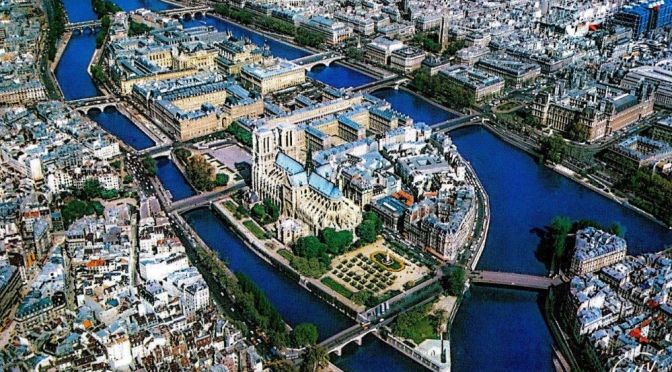
DW Travel (October 29, 2023) – A visit to Paris without seeing sights like the Eiffel Tower, the Louvre or the Sacré-Cœur is almost unimaginable – despite the throngs of tourists. How can one of the world’s most visited cities become more sustainable, for Parisians and tourists alike?
Video timeline:00:00 Intro 00:27 Eiffel Tower 01:55 Louvre Museum 02:27 Sacré-Cœur Basilica, Montmartre 04:52 Seine riverbank 07:26 Pont Neuf 08:17 Bistro “La Timbale”, Montmartre
From the banks of the Seine to Montmartre, DW reporter Swati Bakshi takes you to places in the French capital where you can observe the city’s transition to sustainability.
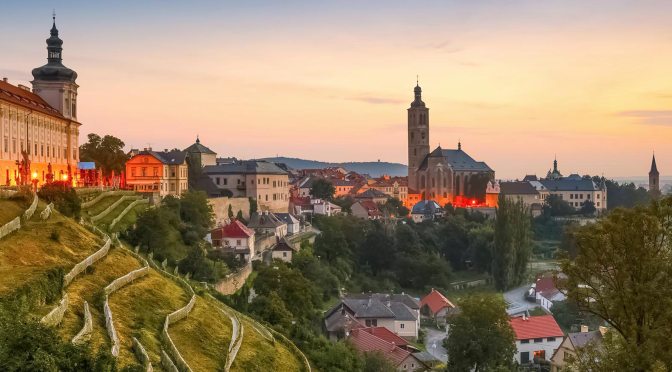
Perception Philosophy Films (October 21, 2023) – Kutná Hora is a city east of Prague in the Czech Republic. It’s known for the Gothic St. Barbara’s Church with medieval frescoes and flying buttresses.
Also notable is Sedlec Ossuary, a chapel adorned with human skeletons. On the site of a former Cistercian monastery is the Gothic and baroque Cathedral of the Assumption. The Czech Museum of Silver recalls the city’s silver-mining history with a replica medieval mine.
3 p.m. Wander through woodlands to a world-class museum
Start your weekend at the Burrell Collection, a glass-roofed art museum that rises out of a meadow in the city’s southern Pollok Country Park like a vast, gleaming greenhouse. The 9,000-piece collection was donated to the city at the close of World War II by William Burrell, a Glasgow shipping merchant, and opened in this specially commissioned building in 1983. The free-entry museum reopened in 2022 after a six-year refurbishment of its red sandstone, glass and wood interiors. Though it is busy, the Burrell offers a peaceful immersion in an unmistakably personal collection, drifting from Degas and Rembrandt to tabernacles, tulip-motif textiles and ancient Chinese roof tiles. The tapestries are especially wonderful, including the palatially sized “Wagner Garden Carpet” made by master weavers in 17th-century Iran.
Saturday
Papercup
10 a.m. Grab a brekkie roll, then discover a Glaswegian jungle
If it’s not raining, take advantage of clear skies with a botanic stroll in Glasgow’s affluent West End. Grab breakfast at Papercup, a small and friendly cafe that has original period details, like egg-and-dart molding and an ornate ceiling rose. Try the brekkie roll with a sausage patty (£5), or eggs on toast with a side of vegan haggis (£8.50). From the cafe, wander to the Glasgow Botanic Gardens, either directly, along Great Western Road, or take the more meandering Kelvin Walkway down by the River Kelvin, crossing the blue, steel Botanic Gardens Footbridge to emerge into the scented gardens on the other bank. Enter the domed Kibble Palace, a spectacular glasshouse in which to explore a jungle of orchids, begonias and ferns, among other leafy treasures.
Hoos
12 p.m. Browse Scandi home goods and woolly Scottish knitwear
Glaswegians have an appetite for sustainable shopping and for secondhand goods of all stripes. Hoos, next to the Botanic Gardens, stocks chic Scandi home goods, while the Glasgow Vintage Co., farther along Great Western Road from Papercup, has a thoughtful selection of second-hand Scottish knitwear alongside show-stopping coats and dresses from the 1970s. Up the hill on Otago Street, above Perch & Rest Coffee, Kelvin Apothecary sells a nice range of gifts including handmade Scottish soaps and wooden laundry and cleaning tools. In the cobbled Otago Lane is the chaotic Voltaire and Rousseau secondhand bookshop, with teetering, vertical book piles. Unlike many Glasgow shops, this store isn’t the most dog-friendly, because of the resident cat, BB, who supervises from his perch at the till.
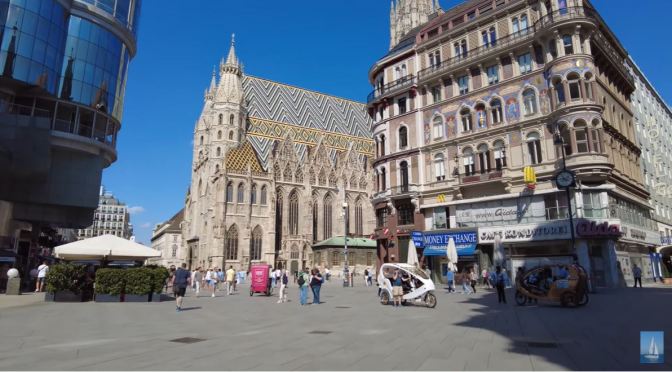
DW Travel (October 8, 2023) – DW’s Hannah Hummel tours Vienna, the Austrian capital – from St. Stephen’s Cathedral to the Prater.
Video timeline: 00:00 Intro 00:33 St. Stephens cathedral 01:02 Old Town 01:44 Hundertwasserhaus 02:31 Naschmarkt, eating Wiener Schnitzel 03:44 Meeting student Leonhard Pichler, why is Vienna so liveable? 05:04 Coffe house Demel 06:16 The Prater
Besides many more attractions, you’ll also discover why the Economist Group once again named Vienna the most livable city in the world. Which of Hannah’s stops in the video do you find most interesting?
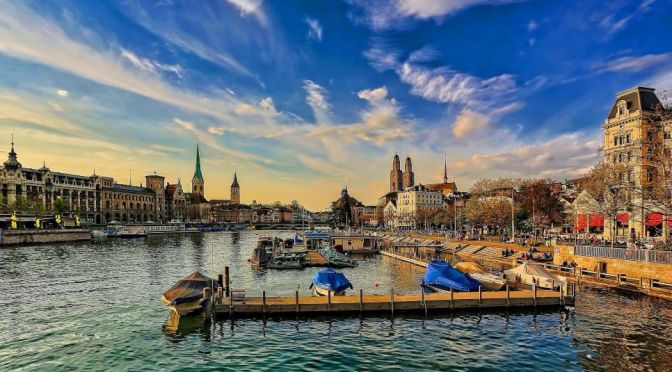
Tourist Car (September 28, 2023) – The city of Zurich, a global center for banking and finance, lies at the north end of Lake Zurich in northern Switzerland. The picturesque lanes of the central Altstadt (Old Town), on either side of the Limmat River, reflect its pre-medieval history. Waterfront promenades like the Limmatquai follow the river toward the 17th-century Rathaus (town hall).
Moveora (September 17, 2023) – Munich, Bavaria’s capital, is home to centuries-old buildings and numerous museums. The city is known for its annual Oktoberfest celebration and its beer halls, including the famed Hofbräuhaus, founded in 1589. In the Altstadt (Old Town), central Marienplatz square contains landmarks such as Neo-Gothic Neues Rathaus (town hall), with a popular glockenspiel show that chimes and reenacts stories from the 16th century.
AirPano VR Films (September 15, 2023) – A 360° aerial tour of the city of Male, capital of The Republic of Maldives, which comprises 26 atolls and nearly two thousand coral islands. Most of them are uninhabited and it is the area where nature reigns supreme.
Malé is the densely populated capital of the Maldives, an island nation in the Indian Ocean. It’s known for its mosques and colorful buildings. The Islamic Centre (Masjid-al-Sultan Muhammad Thakurufaanu Al Auzam) features a mosque, a library and a distinctive gold dome. Near the harbor, a popular fish market offers the day’s catch, and a produce market is stocked with local fruit.
TYLER WALKS (September 10, 2023) – A tour of Havana, Cuba’s capital city. a haven of Spanish colonial architecture in its 16th-century Old Havana core, including the Castillo de la Real Fuerza, a fort and maritime museum. The National Capitol Building is an iconic 1920s landmark. Also in Old Havana is the baroque Catedral de San Cristóbal and Plaza Vieja, whose buildings reflect the city’s vibrant architectural mix.
DW Documentary (September 9, 2023) – The race against climate change is in full swing. Can cities be a solution? The UN says that by the year 2050, some 70 per cent of all people will be urban dwellers. But how can cities sustainably accommodate as many people as possible and still offer a good quality of life?
“Urban living must save the planet!” says Xuemei Bai, an Australian professor for sustainability research. But is it really possible to live more sustainably in the city than in the countryside? What about the suburbs? “The suburbs are a climate killer,” says climate economist Gernot Wagner. In the classic suburb – large plots of land with detached or semi-detached properties – CO2 emissions are two to three times as high as in city centers or rural areas. So, why are cities so crucial for the climate?
The answer is simple: Because they are growing exponentially. The UN says that by the year 2050, more than two thirds of the world’s population will be living in cities. Density is one reason cities have so much potential. In a city, measures such as home redevelopments or electric bus routes impact far more people than they would in rural areas.
So, should we all live in megacities to save the Earth? In Europe, many people are turning their backs on urban life in favor of a home in the suburbs or the countryside. So what should the cities of the future look like, if they are to sustainably accommodate as many people as possible while still offering a good quality of life? After all, skyscrapers aren’t necessarily a good choice. Urban planner Dita Leyh compares a city of high-rise buildings with an asparagus field: “They’re like asparagus tips everywhere.
The spaces in between aren’t really useable. That’s not an interesting public space,” she says. So, what should a city look like then? There’s no single blueprint, because every city has its own challenges, as well as different climactic and social conditions. Can cities really save us? #documentary#dwdocumentary
DW Travel (September 3, 2023) – A tour of Heidelberg, located on the Neckar River in southwestern Germany. It’s known for venerable Heidelberg University, founded in the 14th century, the Gothic Heiliggeistkirche church towers over the cafe-lined Marktplatz, its Altstadt (Old Town) and the red-sandstone ruins of Heidelberg Castle, a noted example of Renaissance architecture, stand on Königstuhl hill.
Video timeline: 00:00 Intro at the Old Bridge 00:43 Heidelberg’s old town and the Neckar 01:52 Why students love Heidelberg 02:42 The Ruprecht Karl University 03:10 Meeting Ariel Noriega from Mexico, Philosophy student, visiting the campus 05:08 The historic auditorium 05:44 Caféteria Zeughaus, how to find accomodation 07:35 Heidelberg castle 08:35 Old student prison, Studentenkarzer 09:39 Meeting Áine Fellenz from Ireland, Politics student
News, Views and Reviews For The Intellectually Curious


 Perception Philosophy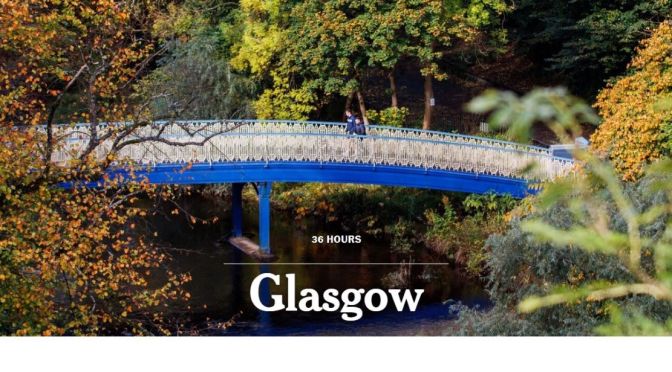

 The New York Times (October 19, 2023) – Glasgow, Scotland’s largest city, crackles with character. It’s a hub of grass-roots energy where


 Tourist Car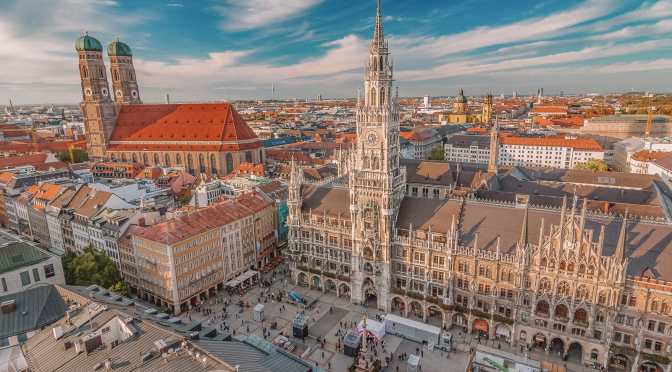
 Moveora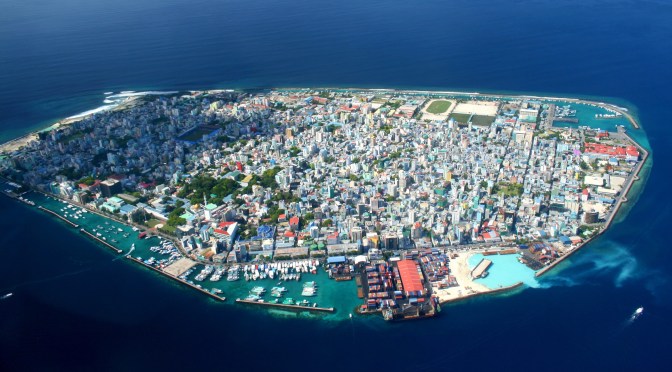
 AirPano VR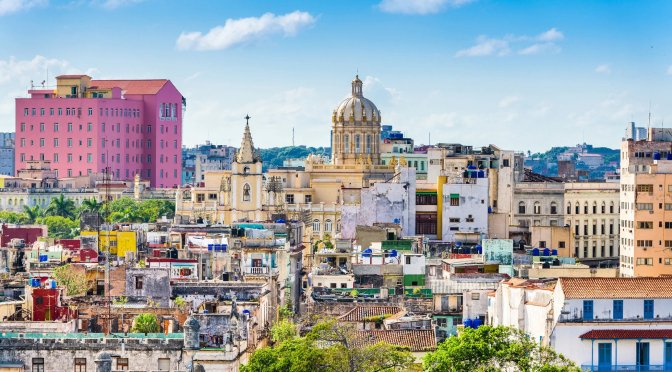
 TYLER WALKS (September 10, 2023) – A tour of Havana, Cuba’s capital city. a haven of Spanish colonial architecture in its 16th-century Old Havana core, including the Castillo de la Real Fuerza, a fort and maritime museum. The National Capitol Building is an iconic 1920s landmark. Also in Old Havana is the baroque Catedral de San Cristóbal and Plaza Vieja, whose buildings reflect the city’s vibrant architectural mix.
 DW Documentary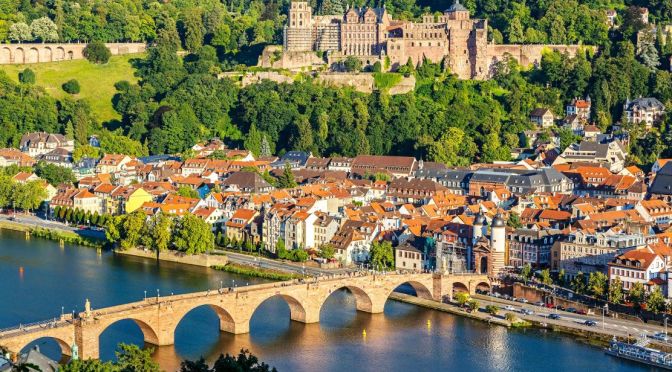
 DW Travel
 Boomers Daily