

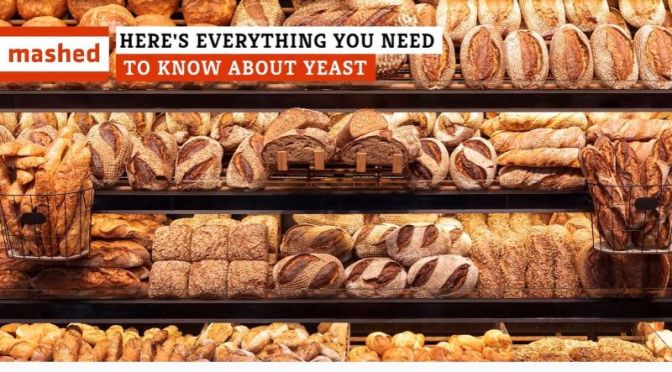
Whether you’re making a recipe for cinnamon rolls or French bread, yeast factors into the equation. Yeast is a required ingredient for almost all bread recipes. While we typically just buy yeast at the grocery store and toss it in our mixing bowl, yeast has quite an interesting backstory.
Yeast are fungi, living organisms found all around us, floating in the air. According to producer Red Star Yeast, yeast is made up of egg-shaped cells, only visible through a microscope. They’re fungi just like the molds found on blue cheese, mushrooms, or even in antibiotics such as penicillin. However, yeast grows in a different form than other fungi, which are typically composed of tubular chains of cells called hyphae. Yeast is found in small clusters of cells, or as an individual cell. And since it’s alive, yeast can also die.
According to Red Star Yeast, their yeast is stamped with a best by date of two years from when the yeast is packaged. Keeping it in a cool, dry place such as your pantry or refrigerator will ensure it’ll live up to that date. If you’re not sure if your yeast is alive, pour it over warm water with a teaspoon of sugar. If it bubbles, it’s still kicking, The Spruce Eats advises.
Also? Yeast has been around for longer than pretty much any of us. In researching the ancient tomb of the Egyptian ruler Scorpion from around 3100 B.C., archaeologists found 700 jars of resinated wine. According to Scientific American, the resin was used to slow the wine’s natural progression into vinegar. Researchers found evidence of the same species as modern-day brewer’s yeast in the jars. While that isn’t solid evidence the ancient Egyptians knew that the addition of yeast could turn their juice into alcohol, it certainly does show that yeast has been prevalent for a very, very long time.
Timeline: It’s alive, and ancient | 0:00 Hundreds of varieties | 1:52 Commercial production | 2:38 Adult beverages | 3:24 Ooh, that smell | 4:36 The amount makes a difference | 5:30 Yeast-free bread | 6:17 Sourdough starter is DIY yeast | 7:01 2020’s yeast shortage | 7:45

Nature reviews: Engineering yeast to produce medicines, immunity to Covid-19, and the mechanism of anaesthetic action.
In this episode:
00:44 Making medicine with yeast
The tropane alkaloids are an important class of medicine, but they are produced agriculturally leaving them vulnerable to extreme weather and world events. Now, researchers have engineered yeast to produce these important molecules. Research Article: Srinivasan and Smolke
06:36 Coronapod
We discuss the complex story of immunity to COVID-19, and how this may affect vaccine development. News Feature: What the immune response to the coronavirus says about the prospects for a vaccine
16:33 Research Highlights
The neurological reason for overindulgence, and the bacteria that harness copper electrodes. Research Highlight: The brain circuit that encourages eating for pleasure; Research Highlight: Microbes with mettle build their own electrical ‘wires’
19:07 The molecular mechanisms of general anaesthetics
Despite over a century of use, there’s a lot we don’t know about how anaesthetics function. This week, researchers have identified how some of them they bind to a specific neuronal receptor. Research Article: Kim et al.
26:34 Briefing Chat
Whilst the Nature Briefing is on its summer holidays, we take a look at some other science from around the web. This time we discuss Elon Musk’s latest showcase of a brain-chip, and the physics behind how boats can float upside down on levitating liquid. New Scientist: Elon Musk demonstrated a Neuralink brain implant in a live pig; Business Insider: Elon Musk’s AI brain chip company Neuralink is doing its first live tech demo on Friday. Here’s what we know so far about the wild science behind it.; Research Article: Apffel et al.; Video: The weird physics of upside down buoyancy
 Boomers Daily