Tag Archives: Wildlife Magazines

National Wildlife Magazine – Winter 2024

The front cover of National Wildlife's Winter issue containing text and an image of a submerged brown booby.

National Wildlife Magazine (December 21, 2023) – The 2023 National Wildlife Photo Contest Winners – Nearly 40,000 entries from more than 4,000 photographers.


An image of a running zebra herd.

GRAND PRIZE
Anup Shah

Chippenham, England

“It is powerful and decisive, the pace compact yet energetic,” says Anup Shah of this year’s spectacular top photo, catching zebras at the edge of a river crossing in Kenya’s Maasai Mara National Reserve. “I wanted the viewer to feel the energy in the path of a galloping herd.” We do, and it’s exhilarating.


An image of three coastal brown bear cubs following their mom.

BABY ANIMALS
FIRST PLACE
Torie Hilley

Ventura, California

Torie Hilley trudged through the mudflats of Alaska’s Lake Clark National Park and Preserve with a professional guide in July 2022, hoping to catch this coastal brown bear and her cubs in a line as they dug for clams. When Hilley spotted the family falling into formation on her last day, she dropped to one knee to preserve the moment. She later learned not all of the cubs survived the following weeks. “It reminded me to never take anything for granted,” she says.


An image of a piping plover chick on a beach.

BABY ANIMALS
SECOND PLACE
Carl D. Walsh

Dayton, Maine

Listed as endangered by Maine, the state’s piping plover population has seen some improvement in recent decades—a hopeful note suggested by the glow surrounding this days-old fledgling. To get this July 2022 photo, Carl D. Walsh “spent a lot of time lying in the sand, trying to capture the right vantage point and backlight” on a Cumberland County beach. “Many thousands of frames were shot,” he says.


An image of a submerged brown booby.

BIRDS
FIRST PLACE
Suliman Alatiqi

Kuwait City, Kuwait
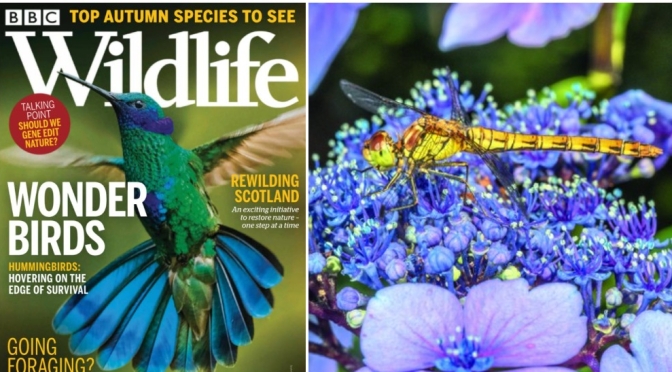
Previews: BBC Wildlife Magazine – November 2022

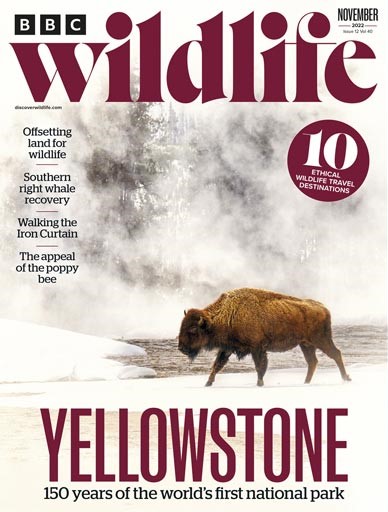
BBC Wildlife Magazine – November 2022

  • Celebrating 150 years of Yellowstone National Park
  • As Remembrance Day approaches, we celebrate the poppy bee
  • Walking the Iron Curtain: how this no-go zone has become a wildlife haven
  • After being hunted almost to extinction, southern right whales are making a mighty comeback
  • Gillian Burke celebrates the hidden brilliance of seeds
  • Mike Dilger on the overwintering geese
  • Mark Carwardine on the need to be sympathetic to different nations’ conservation priorities

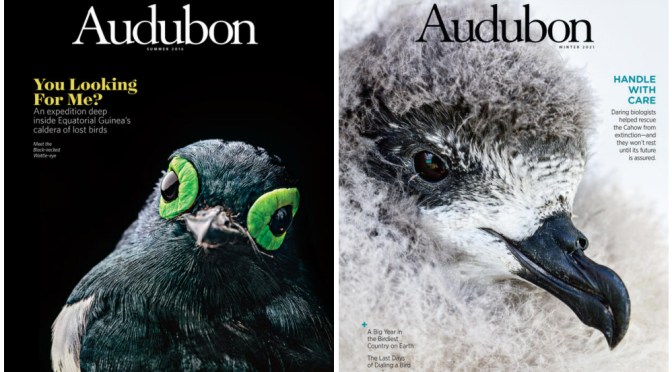
Cover Preview: Audubon Magazine – October 2022

Audubon Magazine Fall 2022:

It’s the Moment of Truth for Saving the Northern Spotted Owl

Preventing the Pacific Northwest icon’s extinction calls for aggressive intervention, including killing another owl species. Will we act fast enough?

Best-Selling Author Jeff VanderMeer Finds That Nature Is Stranger Than Fiction

The novelist attained fame with gripping works of eco-fiction. How hard could it be to rewild his own backyard?

Cover: National Wildlife Magazine – Aug/Sep 2022

Surrounded by golden light, a mule deer stands in grasslands.

National Wildlife Magazine – August/September 2022

Burning Up

Heat, drought and wildfires are ravaging western wildlife while conservationists try to help ecosystems adapt

By Brianna Randall – Conservation, Aug 02, 2022

Dead mussels lie along the Pacific shore of Vancouver, British Columbia, during 2021’s summer heat wave. Scientists estimate that the record-breaking heat killed more than 1 billion marine animals off the coasts of British Columbia and Washington state.
(Photo by Christopher Harley/University of British Columbia)

GASPING SALMON WITH INFECTED LESIONS. Emaciated deer searching sagebrush flats for water. Clams and mussels boiled to death in their shells. Last summer, temperatures in the Northwest soared to record highs in the triple digits, killing more than 1 billion marine animals in the Salish Sea and stressing wildlife from the Pacific to the Rocky Mountains. Simultaneously, ongoing drought in the Southwest—which began in 2000 and is the region’s driest 22-year period in 1,200 years—is causing plants to wither, springs to dry up and wildfires to engulf entire landscapes.