Tag Archives: Villages

Village Walks: Corippo In Ticino, Switzerland (4K)

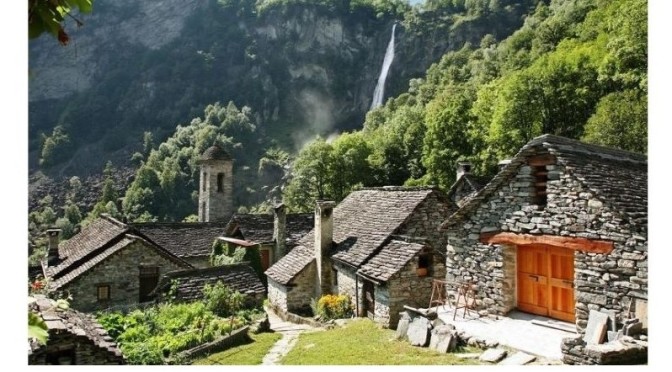
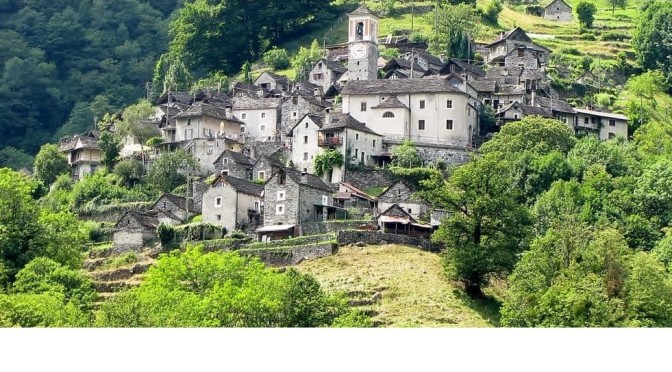
Corippo is a mountain village in the Verzasca valley some 12 kilometers (7.5 mi) from Locarno, at the north end of the artificial Lake Vogorno and 20 km (12 mi) from the border with Italy. The houses are built from the local Ticino granite with slate roofs and have changed little for several hundred years, leading the Italian writer Piero Bianconi to describe Corippo as “Verzasca’s gentlest village”.

Its early 17th century Church of the Blessed Virgin Annunciata (later the Blessed Virgin Carmine) was extended in the late eighteenth century. Corippo’s architectural value has caused the entire village centre to be placed under a conservation order, and in 1975 the European Architectural Heritage Congress named the village as an “exemplary model” for historical preservation. Corippo was originally part of the larger parish and commune of Vogorno (though maintaining a certain degree of autonomy), before becoming a fully independent municipality in 1822. The village first became connected to the wider world in 1883 when a road was built linking it to the Verzasca valley road.
Village Walks: Brienz In Western Switzerland (4K)

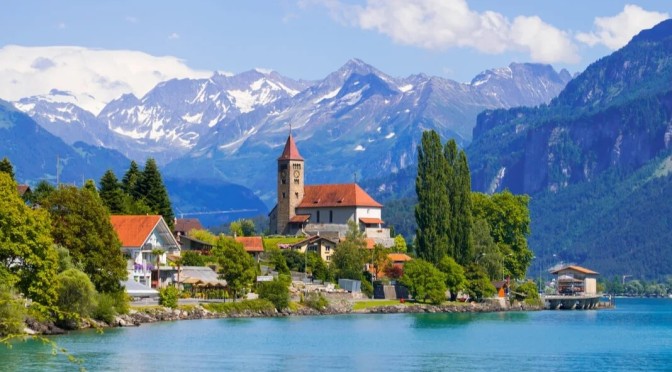
Brienz is a village on the northeast shore of Lake Brienz, in Switzerland’s Bernese Oberland region. The village’s 18th-century wooden chalets and the sculptures dotted throughout the village are testimonials to a woodcarving tradition. North, a steam train runs up Brienzer Rothorn Mountain, with views of the lake and surrounding Alps. East of Brienz, the Ballenberg Open Air Museum offers glimpses of rural life.

The most romantic part of Brienz is the Brunngasse which, having once been awarded the title «most beautiful street in Europe», is well-known abroad. Most of the houses in the street date from the 18th century and are decorated with wood carvings. Brienz, which is well-known as the “village of carving” has a long tradition in wood processing and to this day has a school for carving and violin-making.

Filmed and edited by: Jeka Kiriloff

Village Walks: Rocchetta Nervina In Liguria, Italy

Rocchetta Nervina is a small village in the province of Imperia in Liguria (Italy) with 291 inhabitants. It is built at an altitude of 235 meters, at the bottom of the Barbaira valley, a tributary of the Nervia coming down from the ridge separating the valleys of Nervia and Roya.

Surrounded by mountains, Monte Abelio (1015m), Monte Terca (1070m) and Monte Morgi (870m). Its French twin locality is Sospel. They are located at the same level and at an equal distance (approximately 10 km) on each side of the border.

Rocchetta means small rock or fortress, citadel.Nervina is derived from the name of Nervia. Old fortified town in the 12th century, it was called “Castrum Barbairre”, it was destroyed by the Marquis of Dolceaqua (the same as that of the michettes).

In the middle of the 16th century the castle of Monte Abelio controlled the Roya valley Rochetta is isolated and in a cul-de-sac, its defensive system is particular, access is allowed there thanks to two bridges from medieval times called “humpbacks”.It is still inaccessible today except on foot and of course by Vespa!!!

Village Walks: Sonlerto In Southern Switzerland

The town of Sonlerto lies in Bavona Valley (Val Bavona), arguably the wildest one among the valleys of Ticino. This spectacular side valley is part of the Maggia Valley. The whole region is part of the Lepontine Alps – a mountain range that covers various parts of Switzerland (Valais, Ticino, Uri, Graubünden) and Italy (Piedmont and Lombardy).

The Bavona Valley has seen massive rocks fall from mountains time and time again. Sometimes the stones are as big as houses. Locals then build new houses next to the stones after they fall. Locals refer to it as Splui. As such, it is no surprise that the houses in this area are built from stone.

Harvests: Peppers Turn A Serbian Village ‘Crimson’

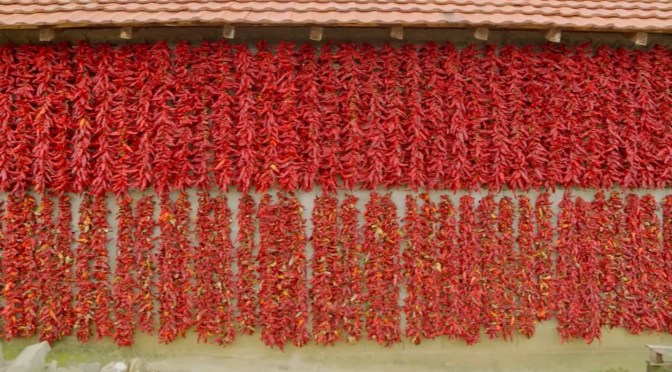
Donja Lokosnica is an unassuming agricultural village in Serbia. That is until it’s time for the annual pepper harvest, where around 250 out of 280 households in the village engage in growing the crimson crop. The sweet peppers are the lifeblood of the small village that produces 60,000 tons of peppers a year.

To learn more about how the Serbian farmers turn the quaint village a rich red, tune in brand new episodes of Europe From Above. Thursdays at 8pm, on National Geographic UK

Village Tours: Todenham In The Cotswolds, England

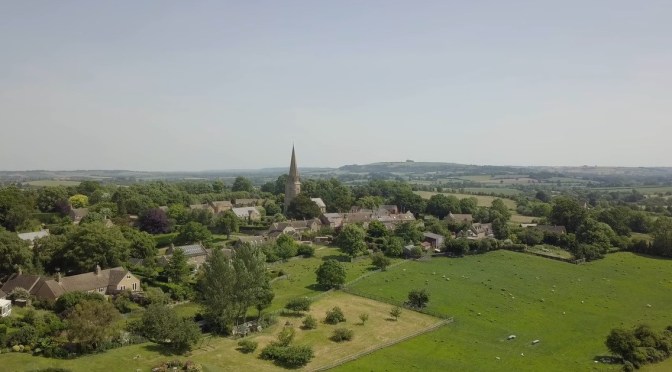
Nestled near Shipston on Stour and just north of Moreton in Marsh, Todenham is a lovely hidden gem, worth visiting in the Cotswolds.

Todenham is a village and civil parish in the Cotswold district of Gloucestershire, England. The village is significant for its Grade I listed 14th-century parish church. 

Village Walks: Mougins In Southeastern France (4K)

Mougins is a commune in the Alpes-Maritimes department in southeastern France. It is located on the heights of Cannes, in the district of Grasse. Mougins is a 15-minute drive from Cannes. The village is surrounded by forests, such as the Valmasque forest. In the village there are pines, olives, and cypress trees.

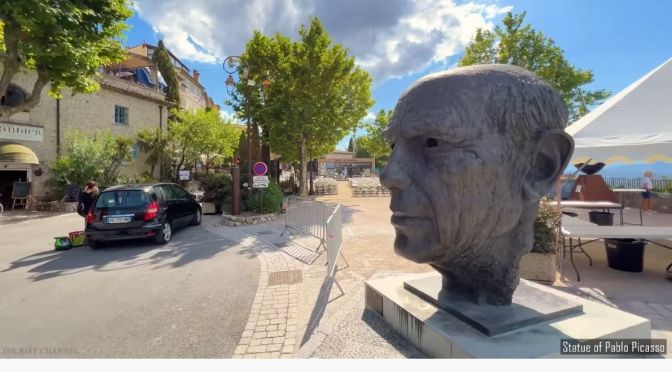
The village of Mougins is where Pablo Picasso lived for the last 12 years of his life and where he died in 1973 at the age of 91. Picasso was buried close to Aix-en-Provence. Picasso first visited Mougins in 1953, when he was living in nearby Cannes with his long-time muse, Francoise Gilot.

Lakeside Village Walks: Morcote, Switzerland (4K)

The former fishing village of Morcote is situated on the shore of Lake Lugano and is undoubtedly one of the most frequently photographed places in Ticino. It was not without just cause that picturesque Morcote was voted Switzerland’s most beautiful village in 2016.

The overall appearance of Morcote is characterised by its division into two parts: a secular part on the Lake and an ecclesiastical part on the slope. Both parts have their own characteristic buildings.

The bank of the lake is lined with numerous imposing buildings such as Palazzo Paleari, as well as a number of simple buildings. The row of houses by the lake, with their magnificent arcades, is one of the most distinctive features of Morcote and characterises the view of the village from the lake in particular. Just behind these, the winding, cobbled laneways of the village centre unfold. Even today, these still clearly reveal its mediaeval origins.

Views: The Lavender Fields Of Montclus, France

The small village of Montclus is a picturesque village in the northern area of the Gard department of Languedoc-Roussillon.

This historic village is situated in a peaceful setting on the banks of the Cèze river surrounded by vineyards, lavender fields and woodlands and on a small hill with almost a complete lack of modern development nearby so it has retained a great deal of its charm and is now listed among the ‘most beautiful villages in France‘.