The strong inverse correlation between lifespan and mutation rate: we accrue mutations at a slower pace than many mammals but have roughly the same number of mutations by the end of our respective lifespans https://t.co/MBgFMkEeUn@Naturepic.twitter.com/H9kXAXXwjs
Cells acquire mutations throughout life, a process that is known to give rise to cancer and has been proposed to contribute to ageing. There is little knowledge, however, about the rate at which mutations accumulate in species other than humans, and whether this rate is influenced by biological traits such as lifespan or body size. In this week’s issue, Alex Cagan, Adrian Baez-Ortega and colleagues address these questions. The researchers studied the speed at which mutations accumulate during life in 16 mammalian species and found that the number of mutations increases by a roughly constant amount each year. They also observed that the molecular processes causing mutations are broadly similar across species. Crucially, the team identified a strong anticorrelation between lifespan and mutation rate: longer-lived species accrue mutations at a slower pace than shorter-lived ones, such that different species have roughly the same number of mutations by the end of their respective lifespans.
In Nature this week: Climate pledges – fully realizing current promises could limit warming to just below 2 °C , but 1.5 °C is still out of reach. Browse the full issue here: https://t.co/eEMf9XL8lBpic.twitter.com/GuaC5pdolG
In this week's issue: A new wave of archaeological investigations is reconstructing intimate details of our ancestors' lives from fossilised footprints.
In this week's issue: Is consciousness a fundamental property of the universe? Most physicists think not. But some are radically rethinking the relationship between matter and mind.
The cover image shows a view of the Milky Way captured at Nambung National Park in Western Australia. To understand how the Galaxy formed requires precision age dating of the stars that it contains. In this week’s issue, Maosheng Xiang and Hans-Walter Rix of the Max Planck Institute for Astronomy in Heidelberg, Germany, present an analysis of the birth dates for nearly 250,000 stars in their subgiant evolutionary phase, when they can serve as precise stellar clocks. The researchers found that the individual ages of the stars ranged from about 1.5 billion to more than 13 billion years old. Tripling the age-dating precision for such a large stellar sample allowed the researchers to infer the sequence of events that initiated our Galaxy’s formation. Using this information, Xiang and Rix were able to determine that the oldest part of our Galaxy’s disk had already begun to form about 13 billion years ago, just 800 million years after the Big Bang, and that the formation of the inner Galactic halo was completed some 2 billion years later.
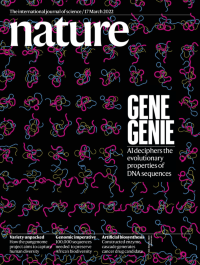
For more than 50 years, scientists have been trying to understand the relationship between DNA sequence, gene-expression phenotype and fitness to decipher principles of gene regulatory evolution. In this week’s issue, Eeshit Dhaval Vaishnav, Carl de Boer, Aviv Regev and their colleagues present a framework for understanding and engineering regulatory DNA sequences that takes a step towards this goal. The researchers built this framework around an ‘oracle’ they developed using a deep neural network model that predicts gene expression given a promoter DNA sequence. The neural network was trained using the expression measurements for tens of millions of promoter sequences. The result was an AI oracle that predicts expression from sequence well enough to study the evolutionary history and future evolvability of regulatory DNA sequences, as well as to design regulatory DNA sequences for synthetic biology applications. The cover offers a visual representation of the evolutionary properties of sequences at the extremes of the evolvability spectrum.










 Boomers Daily