Tag Archives: Poetic Views

Poetic Views: Museum at Wordsworth Grasmere

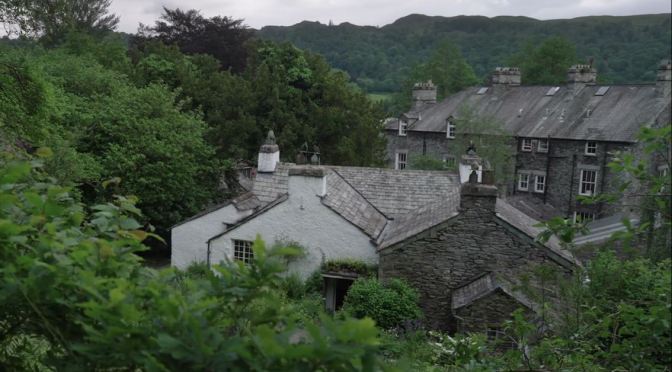
The Museum at Wordsworth Grasmere, the second phase of work at the former Lake District home of the great English Romantic poet William Wordsworth and his sister Dorothy, has opened to the public, with all gallery, exhibition design and interpretative overviews by Nissen Richards Studio.

The first phase of work by Nissen Richards Studio encompassed the conservation and reinterpretation of Dove Cottage itself, where William and Dorothy once lived, plus the new identity for Wordsworth Grasmere and the scheme’s signage and wayfinding.

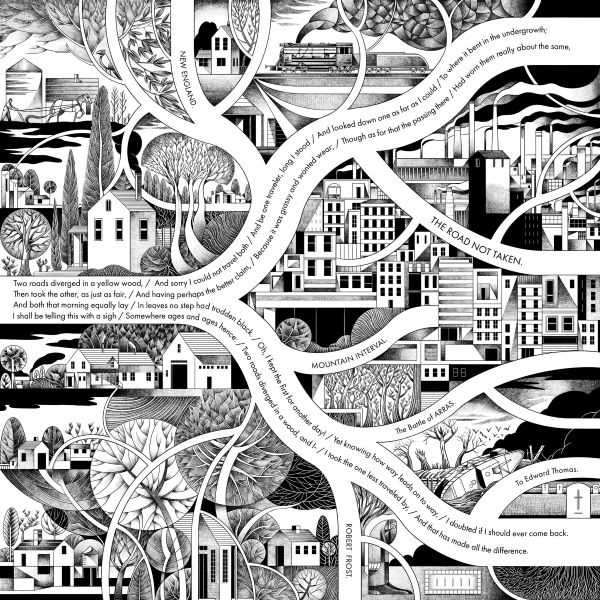
The new visitor journey, designed by Nissen Richards Studio in close collaboration with the Wordsworth Grasmere team, includes a series of threshold moments, such as a totem sign and the setting of words into the walkways, featuring fragments of poems going off in two directions, so that visitors see them clearly on arrival and departure.

The Museum includes a shop and ticketing area, before visitors enter a new, double-height orientation space, where quotations by Wordsworth are set within a dramatic, full-height light wall. Visitors then make their way to a former stable space that houses an immersive introductory film, before stepping over the threshold into Dove Cottage. Visitors return to The Museum via Dove Cottage’s Garden-Orchard, entering an expanded first floor space, loosely arranged into four new galleries. Galleries One and Four are set to one side and Galleries Two and Three to the other, whilst a pause space in between offers views onto the gardens and surrounding landscape.

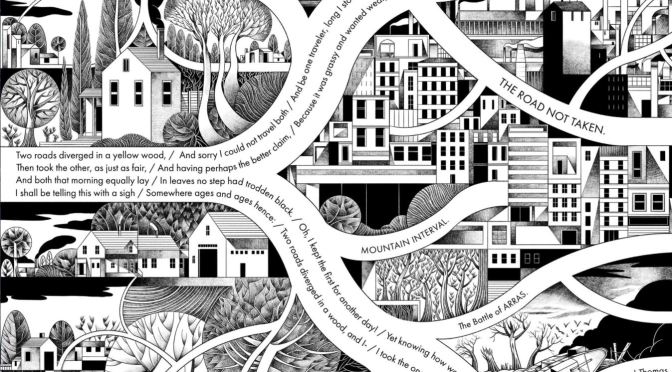
Poems: Robert Frost’s “The Road Not Taken” As Drawn By Sergio Garcia Sanchez

Sergio García Sánchez is a cartoonist, illustrator and professor at the University of Granada, as well as co-author of the graphic novel “Lost in NYC: A Subway Adventure.”

Visualizing Robert Frost’s Seminal Poem
The illustrator Sergio Garcia Sanchez embarks on the road not taken.

Read more

Poetic Views: London’s ‘Maida Vale’ Inspired Lord Byron & Robert Browning

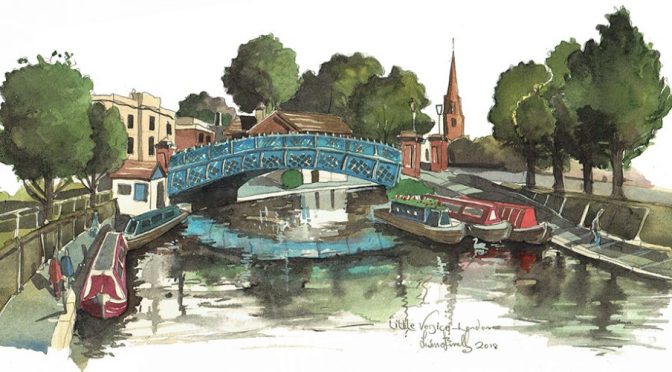
The new crop of Italianate villas, iced white with stucco like giant cakes, and the rows of brick terraces and mansion blocks that followed them soon became home to publishers (Charles Ollier), artists (Sir John Tenniel) and poets: Robert Browning lived at 19, Warwick Crescent for more than 20 years and the pool where the Grand Union and Regent’s canals meet is now called after him.

Watercolor Paintings by Liam O’Farrell

Although Browning has been credited with naming the canal area Little Venice, it was Byron that first (facetiously) compared the basin to the Italian lagoon.

Carla Passino – April 16, 2021

Story has it that the poet used to walk along the Paddington arm of the Grand Union Canal with his publisher, John Murray — helpfully pointing to the bridge where another publisher had once drowned himself — and was inspired to write that ‘there would be nothing to make the canal of Venice more poetical than that of Paddington, were it not for its artificial adjuncts’; a fair point, considering that, at the time, the London canals were lined with warehouses and wrapped in soot.

Even today, however, the elegant terraces halfway up Randolph Avenue, with their tripartite arched windows, are far more reminiscent of the Italian city than Little Venice itself, where the serene buildings and tree-lined banks have a rather more bucolic feel.

Read more at Country Life UK

Liam O’Farrell website