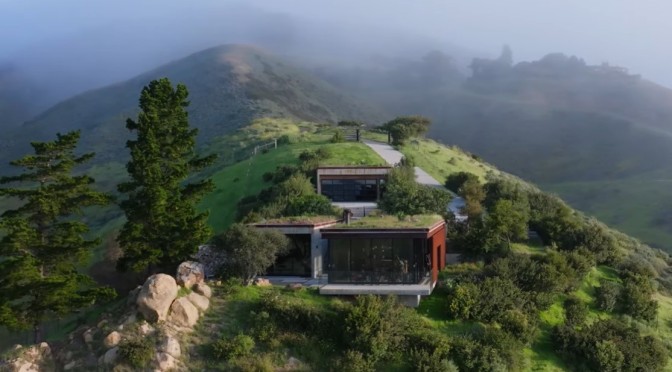
The Local Project (September 15, 2023) – Remote and wild, Off-Grid Residence is an off-grid super house that serves to elevate the ecology of the verdant California ranch it inhabits. Anacapa Architecture honours the home’s ruralness by bringing the sensitively designed dwelling into equilibrium with the landscape, embracing the elements and creating an intimate connection between the inhabitants and the land.
Video timeline:00:00 – Introduction to the Off-Grid Super House 01:06 – A Narrow Ridge Location 01:18 – On Approach to the House 01:44 – The Rooftop Gardens 02:17 – A Walkthrough the Off-Grid Home 02:30 – The Design and Building Constraints 03:38 – A Completely Off-Grid House 04:28 – The Interior Material Palette 04:53 – Immersion in the Environment
Perched atop a knoll situated inside a historic working cattle ranch on the central California coastline, the off-grid super house is the work of Santa Barbara-based studio Anacapa Architecture and co-designer Willson Design. The site is vast and has sweeping vistas of the ocean and rolling hills, and the home sits along a steep ridge, which divides the twin volumes of the garage and the sleeping quarters.
Due to building constraints associated with the historical site, the dwelling is fairly simple, with all living areas contained in one main structure with a basic cooking facility and just one bedroom and one bathroom. There are two gardens atop both roof structures of the off-grid super house that include a mix of local grasses and succulents that are consistent with the greenery of the hillsides beyond.
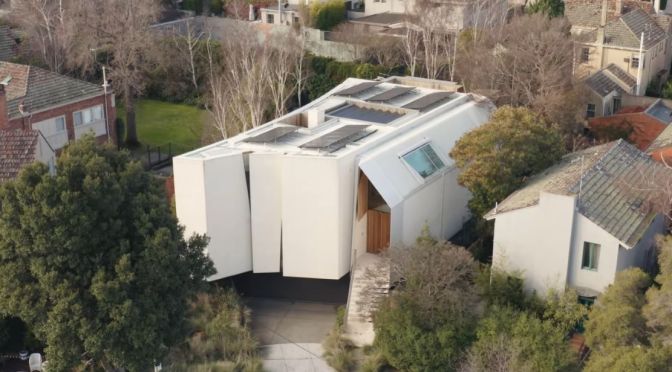
The Local Project – Crafted by John Wardle Architects, this sustainable off-grid house is best explored by means of a house tour. Combining seamless interior design and architecture with a minimal environmental impact, Limestone House forms a cohesive celebration of functionality.
Video timeline:00:00 – Introduction to the Sustainable Off-Grid House 00:41 – The Location and The Vacant Lot 01:22 – Architects Declare 01:39 – The Living Building Challenge 02:06 – Passive House Standards 02:40 – The Shading Systems 03:04 – What’s Behind the Walls 03:19 – The Energy Supply 03:35 – Requirements of the Living Building Challenge 03:50 – The Two Main Materials Used 04:12 – An Interesting History Behind the Timber 04:42 – The Handmade Aspects 05:01 – Floating on a Sea of Native Grasses
Located in the Melbourne suburb of Toorak, Limestone House rests on the Wurundjeri Land of the Kulin Nation. Initially vacant, the project site excited the clients with the possibility of building a sustainable off-grid house. Paying homage to the environmental agenda, the landscape design of Limestone House sees the building float above a sea of native grass. Guiding the design of Limestone House is the Living Building Challenge and Passivehaus, two rigorous standards of sustainability.
In order to satisfy the standards, John Wardle Architects ensures that the home operates as a sustainable off-grid house, harvesting its own water and disposing of all of its waste water. Externally, a set of edible plantings on the terrace meets the requirement for food production on site. The Passivehaus standard sees a tightly-sealed, sustainable off-grid house emerge. While a passive ventilation system consistently delivers fresh air into the home at a slow speed, an airtight barrier seals heat into the dwelling, maximising energy efficiency.
Similarly, high-performance insulation is applied to the walls, roof and floor and the home features triple-glazed windows. Shading systems take the form of motorised venetian blinds to the northeast and west, as well as operable timber louvres at roof level over the courtyard. Internally, the material palette of Limestone House consists primarily of stone and timber. Concrete benchtops and Queensland siltstone complement the calming tonal character of the scheme alongside hydrowood oak. Many of the trees used for the oak come from a valley that was flooded during a 1940s hydroproject – now the timber comprises a bespoke dining room table.
A sustainable off-grid house, Limestone House produces its own energy and a surplus of five per cent that is exported to the grid. While meeting the design brief, John Wardle Architects ensures that the residence forms a unique embracement of natural serenity, in distinction from other sustainable dwellings of the past.
News, Views and Reviews For The Intellectually Curious




 Boomers Daily