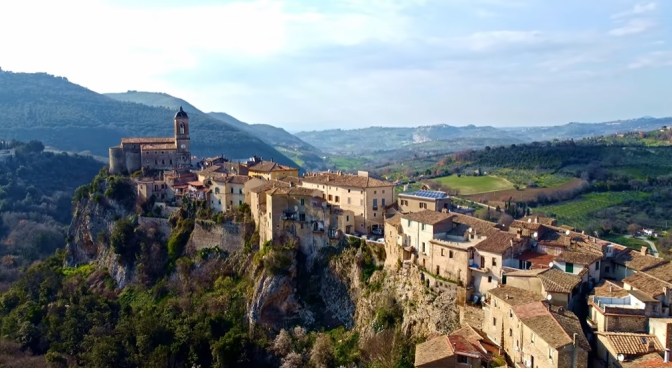
A breathtaking town carved into the Tufo rock, in the heart of the Tuscan Maremma, Pitigliano is one of the most beautiful villages in Italy.
Also known as Little Jerusalem, thanks to the large Jewish community it hosted within its walls in the 16th century, Pitigliano is definitely one for the bucket list next time you’re in Tuscany.
Perched on a cliff of local stone known as ‘tufo’, the town stands majestically at the crossroads of the valleys of the Lente, Meleta and Prochio, with a wonderful view of the wild and unspoiled Tuscan Maremma countryside.
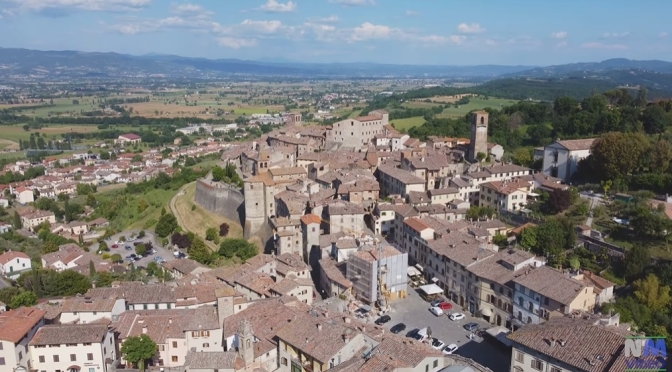
Anghiari is a town in the province of Arezzo in Tuscany and is one of the most beautiful villages in Italy. On 29 June 1440 the plain in front of Anghiari was the scene of a famous battle, which went down in history precisely as the battle of Anghiari between the Florentine army, an ally of the Holy See and commanded by Giovanni Paolo Orsini, and that of the Duke of Milan, led by Niccolò Piccinino. The battle lasted one day and was won by the Florentines, who thus consolidated their dominions in Tuscany and was later painted by Leonardo da Vinci.
Video Timeline: – 00:00 – AERIAL VIEW OF ANGHIARI – 04:11 – BALDACCIO SQUARE – 05:37 – PORTA DEL CATORCIO – 07:20 – PIAZZA DEL POPOLO – 07:42 – PALAZZO PRETORIO – 09:57 – BADIA DI SAN BARTOLOMEO – 14:33 – CHURCH OF SANT’AGOSTINO – 22:32 – VIA DELLA TORRE – 23:04 – CLOCK TOWER – 23:29 – CHURCH OF SANTA MARIA DELLE GRAZIE – 24:18 – “LAST SUPPER”, CANVAS BY GIOVANNI ANTONIO SOGLIANI – 25.10 – “FOOT WASH”, CANVAS BY GIOVANNI ANTONIO SOGLIANI – 25:27 – “DEPOSITION FROM THE CROSS”, CANVAS BY DOMENICO UBALDINI – 26:34 – “OUR LADY OF MERCY”, GLAZED TERRACOTTA BY ANDREA DELLA ROBBIA – 27:47 – ACADEMY OF THE RECOMPOSED THEATER
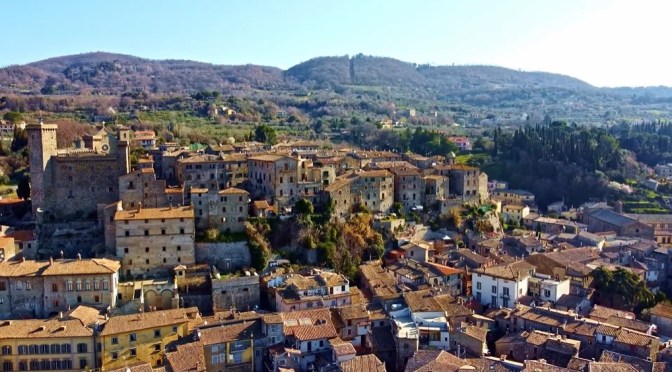
Bolsena is a town and comune of Italy, in the province of Viterbo in northern Lazio on the eastern shore of Lake Bolsena. It is 10 km north-north west of Montefiascone and 36 km north-west of Viterbo. The ancient Via Cassia, today’s highway SR143, follows the lake shore for some distance, passing through Bolsena.
Cetara is a cozy fishermen’s village nested along the Amalfi Coast among verdant citrus groves. The road that leads along the coast from Vietri sul Mare continues the length of the shoreline, overlooked by rugged hills and rocky seashore, past the fascinating villages of Raito and Albori, before continuing on almost straight to reach the ancient charming basin of Cetara.
Cetara’s name is derived from the Latin, Cetaria (meaning tuna-fishing nets), indicating its importance through the ages as a fishing settlement. It was under the political rule of the Republic of Amalfi for centuries. In 1551, Turkish armies raided and enslaved the Cetaresi, killing all those who did not embark with them. After this tragic episode, the survivors built a magnificent watch tower (nowadays used as private residence, but still standing and overlooking the tiny beach), while the majority escaped to Naples.
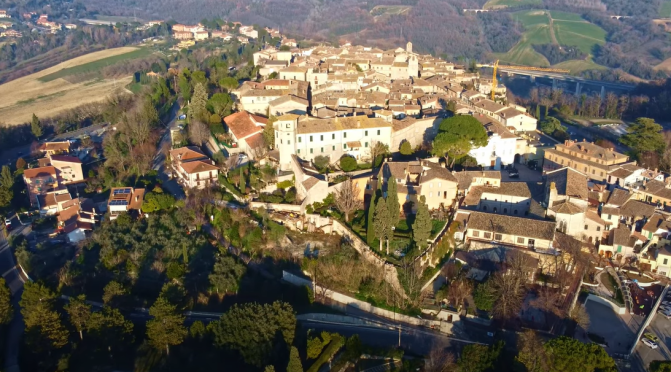
San Gemini is a comune in the province of Terni in the Italian region Umbria. The town is a well-preserved medieval burgh with two lines of walls, built over the remains of a small Roman center along the old Via Flaminia. It is especially known for its mineral waters.
Bassano in Teverina is a comune in the Province of Viterbo in the Italian region Latium. It is inhabited by 1,332 people and is located about 90 kilometres north of Rome and about 20 kilometres northeast of Viterbo.
The origin of the town is extremely uncertain. The ending of the name, derived from the Latin adjectival suffix -anus, takes back to Roman times and, together with the root of the name, seems to remember the family name (Bassus) of a character who owned large estates in the area: Bassus – Bassanus – Bassano.
The town center of Bassano in Teverina arises on a tuff spur set in a slightly rearward position compared to the Tiber Valley, of which it overlooks one part. Downstream from the city center, not far away from the Tiber, lies Lake Vadimo, locally known as the “Pond”, described by Pliny the Younger as “a lying wheel with a regular circumference […] paler, greener and more intense than the sea.”
In Roman times the lake, called Lacus Vladimonis, besides being larger was also considered sacred: near its shores, the Etruscans performed rituals and periodic celebrations, while in its waters the Romans immersed their weapons to make them invincible.
The little center was already inhabited in Etruscan times but was abandoned during the domination of Romans, who conquered the whole surrounding area, taking the territory thanks to two bloody battles: the first in 309 BC, under the leadership of the consul Quintus Fabius Rullianus, and the second in 283 BC, with which they finally defeated Etruscans and Senones.
Blera is a small town and comune in the northern Lazio region of Italy. It was known during the Middle Ages as Bieda, an evolved form of its ancient name, which was restored in the twentieth century. It is the birthplace of Pope Sabinian; Pope Paschal II was also originally thought to be from here.
Ascoli Piceno is a town in central Italy. Piazza del Popolo, an elegant Renaissance square in the center, has travertine paving and the 13th-century Palazzo dei Capitani del Popolo, a palace built over Roman ruins. The Civic Picture Gallery, decorated with Murano glass chandeliers, displays paintings by Titian and Carlo Crivelli. Nearby is the Cathedral of St. Emidio, with a crypt featuring elaborate mosaics.
Pescocostanzo is a comune and town in the Province of L’Aquila in the Abruzzo region of Italy. It is a tourist destination, attracting people from all over Italy due to its landscape and environment. In winter, Pescocostanzo is a destination for skiers and snowboarders.
News, Views and Reviews For The Intellectually Curious




 Boomers Daily