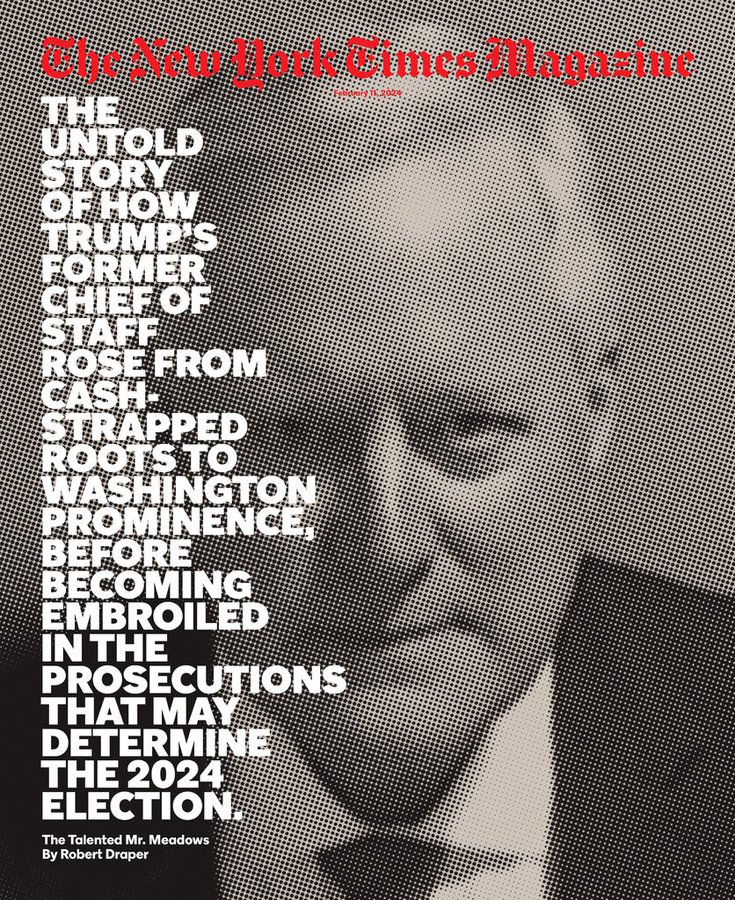
THE NEW YORK TIMES MAGAZINE (February 9, 2024): The new issue features ‘The Untold Story Of How Trump’s Former Chief Of Staff Rose From Cash-Strapped Roots To Washington Prominence, Before Becoming Embroiled In The Prosecutions That May Determine The 2024 Election….
Members of Congress, and candidates for their seats, have been drawn into bitter political clashes over the Israeli-Palestinian conflict.
When George Santos, the indicted fabulist, was expelled from Congress in December, Nassau County Republicans scrambled to hunt up a new nominee. Santos was a catastrophe, but he had also flipped a New York Democratic stronghold, and party leaders wanted the best of him — the charisma, the conservatism and the history-making potential — with none of the debilitating drawbacks.
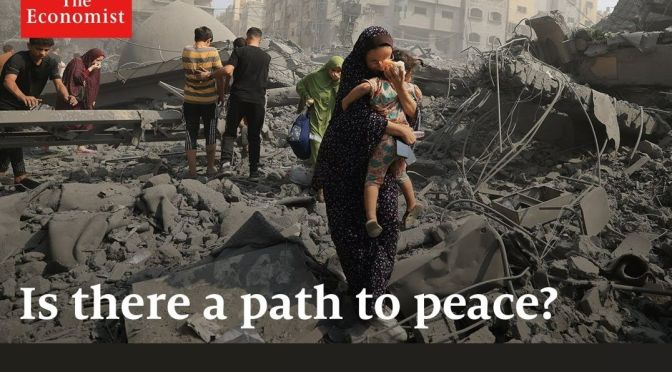
The Economist (February 8, 2024) – Things look bleak in the Middle East after Binyamin Netanyahu scorned America’s push for an end to the fighting. But in private he’s said to be more flexible. Could diplomacy actually work?
Video timeline: 00:00 – The Saudi normalisation deal 00:42 – Israel and Saudi Arabia’s history 01:10 – How to solve the Israeli-Palestinian conflict 02:26 – Will the deal happen?
THE NEW YORK TIMES MAGAZINE (December 2, 2023): The latest issue features Sunday Night Lights – How America’s most spectacular TV show gets made; The Chicken Tycoons vs. the Antitrust Hawks – As part of a broader campaign against anticompetitive practices, the Biden administration has taken on the chicken industry…
Months of preparation, hundreds of staff, convoys of cutting-edge gear: inside the machine that crafts prime time’s most popular entertainment.
By Jody Rosen
Arrowhead Stadium, the home of the Kansas City Chiefs, the N.F.L.’s defending champions, is a very loud place. Players say that when the noise reaches top volume, they can feel vibrations in their bones. During a 2014 game, a sound meter captured a decibel reading equivalent to a jet’s taking off, earning a Guinness World Record for “Loudest crowd roar at a sports stadium.” Chiefs fans know how to weaponize noise, quieting to a churchlike hush when the team’s great quarterback, Patrick Mahomes, calls signals but then, when opponents have the ball, unleashing a howl that can even drown out the sound of the play call crackling through the speaker inside the rival quarterback’s helmet.
As part of a broader campaign against anticompetitive practices, the Biden administration has taken on the chicken industry. Why have the results been so paltry?
By H. Claire Brown
At Kentucky Fried Chicken, sales tend to peak at the same time every year: Mother’s Day. This has been the case since the 1960s, when the chain began to experiment with TV advertising. In a spot from that era, a man in an office answers a phone call from an anonymous male narrator who asks, “Sir, do you have any idea what your wife has to do to run your house?” Cut to a sped-up montage of an impeccably dressed 30-something as she dusts, irons, vacuums and balances the checkbook. Newly enlightened, the husband shows his appreciation by stopping at Kentucky Fried Chicken on his way home. Cut to a close-up of a happy wife biting into a drumstick. “Colonel Sanders fixes Sunday dinner seven days a week, and it’s finger-lickin’ good.”
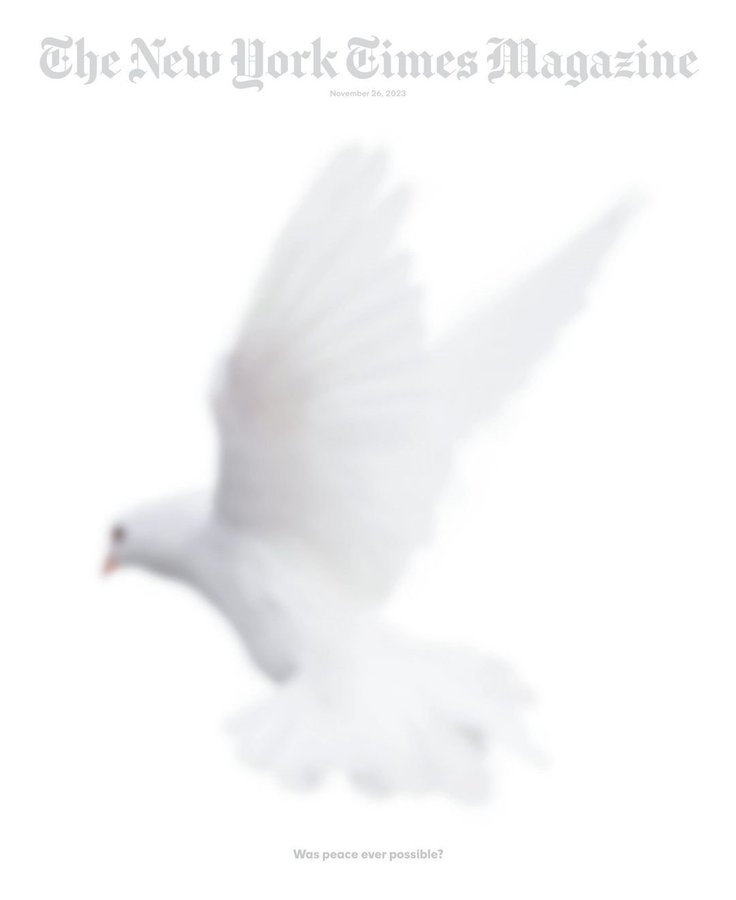
THE NEW YORK TIMES MAGAZINE (November 17, 2023): The latest issue features Was Peace Ever Possible in the Israel-Palestine Conflict?; Finding a Moral Center in This Era of War; The Beatles Are Still Charting the Future of Pop. It Looks Bleak – Their latest song points toward a future where no golden goose need ever stop laying, and more…
Thirty years ago, a negotiated settlement of the Israeli-Palestinian conflict seemed achievable. The story of how it fell apart reveals why the fight remains so intractable today.
Phil Klay, as both a participant and a writer, has been thinking deeply about war for a long time. In his two acclaimed works of fiction, the book of short stories “Redeployment,” which won a 2014 National Book Award, and the novel “Missionaries” (2020), and in the nonfiction collection “Uncertain Ground: Citizenship in an Age of Endless, Invisible War” (2022), Klay has interrogated, to profound effect and with a deeply humane and moral sensibility, what war does to our hearts and minds, individually and collectively, here and abroad. “I’m interested in the kinds of stories that we tell ourselves about war,” says Klay, who is a 40-year-old veteran of the Iraq war.



 The Economist




 Boomers Daily