Tag Archives: Health Care

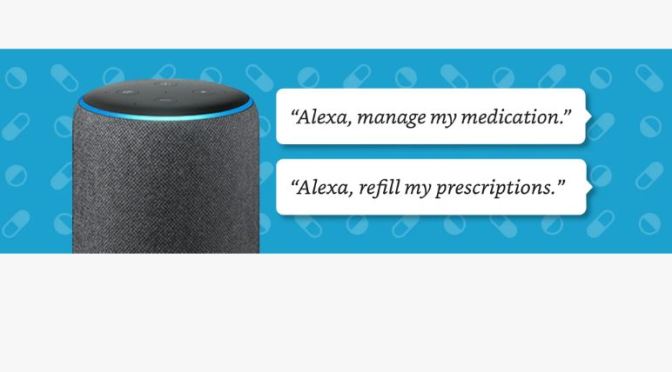
Health Care: Amazon Alexa “Medicine Tracker” Reminds People To Take And Refill Prescriptions

From a Becker’s Hospital review news release:
Amazon Alexa Medicine TrackerAny customer with an active prescription and an Alexa-enabled device will be able to access the medication management skill on the device, a Giant Eagle spokesperson told CNBC. Rachel Jiang, who leads the Amazon Alexa health and wellness team, said the company began developing the skill after noticing that customers were using the devices to create medication reminders.

Beyond a simple reminder, the skill also offers more information about medication regimens and can be used to order refills. When the skill is installed, Alexa, which was confirmed earlier this year to be HIPAA-compliant, will prompt users to set up a profile and passcode, which must be delivered each time Alexa is asked a question about a medication.

Amazon and Pittsburgh-based supermarket and pharmacy chain Giant Eagle have formed a partnership that will allow Amazon Echo devices to offer Giant Eagle pharmacy patients medication reminders, CNBC reports.
To read more: https://www.beckershospitalreview.com/healthcare-information-technology/amazon-alexa-will-now-remind-giant-eagle-pharmacy-patients-to-take-medication.html?oly_enc_id=9129H5611090H0N


Health: UnitedHealthcare To Open Medicare Centers In Walgreens In 2020

From a Becker’s Hospital Review online release:

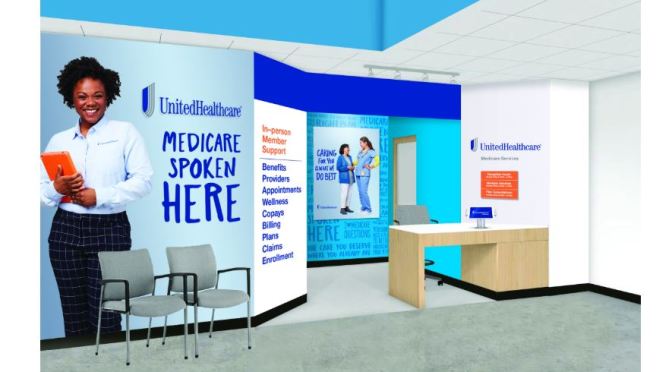
UnitedHealthcare Medicare WalgreensThe purpose of the centers is to increase customers’ understanding of Medicare, match them with people who can talk with them about their benefits or new plans to enroll in, and access in-store annual wellness visits.
In addition, Walgreens and UnitedHealthcare are partnering for a new AARP Medicare Advantage Walgreens health plan. The health plan aims to deliver lower prescription drug costs to members, as many of the plans have $0 premiums and $0 copays on primary care visits, preventive care and some generic drugs. The 46 plans will be sold across 24 states.


Under a multiyear agreement, UnitedHealthcare will open 14 Medicare service centers in Walgreens stores across the U.S., the organizations said Nov. 25.

UnitedHealthcare, the health insurance arm of UnitedHealth Group, will operate Medicare service centers in Walgreens stores across five cities: Las Vegas, Phoenix, Cleveland, Denver and Memphis, Tenn. The centers are slated to open in January 2020.

To read more: https://www.beckershospitalreview.com/payer-issues/unitedhealth-to-open-medicare-centers-in-walgreens-stores.html?oly_enc_id=9129H5611090H0N

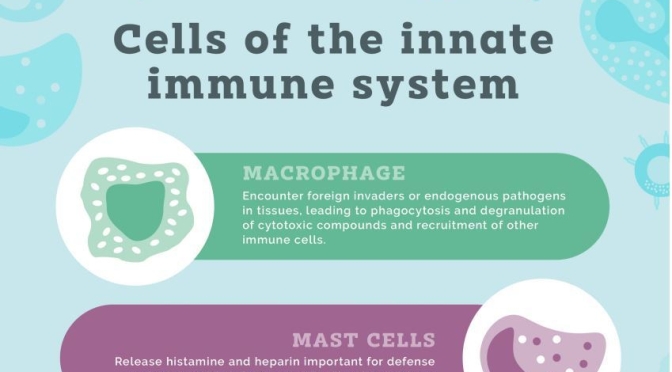
Health Infographics: Harnessing “Innate Immunity” To Treat Cancer

Cisbio-Harnessing Innate Immunity to Treat Cancer-page-0

Website: https://go.technologynetworks.com/harnessing-innate-immunity-to-treat-cancer?utm_campaign=NEWSLETTER_TN_Breaking%20Science%20News&utm_source=hs_email&utm_medium=email&utm_content=79929068&_hsenc=p2ANqtz–ty7bQqqE59QchUxLDf8dobyKGn6xuBbMimHky4x8fwAR2VD9njUGTWl6rnVLXsO2r9f6QeP9n6X4TiEvSEgMxvfCrUw&_hsmi=79929068

Health Care: VillageMD Opens First Primary Clinic Called Village Medical At Walgreens In Houston

From a Becker’s Hospital Review online release:

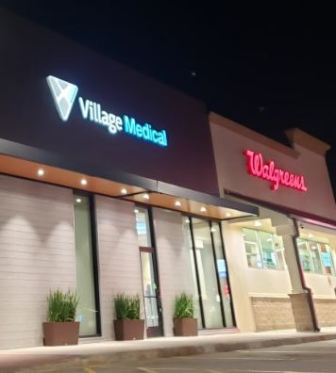
VillageMD Village Medical Primary ClinicsThe VillageMD primary care clinic, called Village Medical at Walgreens, is the first of five sites to open in Houston. Four more clinics are slated to open by the end of the year. The Village Medical clinics are located next to Walgreens stores and offer services including annual preventive care, women’s health services, vaccinations, diagnostic testing, smoking cessation, chronic care management and some specialty care. The clinics offer same-day, walk-in appointments, as well as house calls and virtual visits. The clinics are staffed by primary care physicians, nurses, pharmacists and social workers.

Chicago-based primary care company VillageMD is celebrating the opening Nov. 20 of its first primary care clinic at a Walgreens store in Houston, the company announced on Twitter. The Village Medical at Walgreens opening comes just weeks after Walgreens announced plans in October to shutter nearly 160 in-store health clinics.

To read more: https://www.beckershospitalreview.com/hospital-physician-relationships/walgreens-opens-first-villagemd-site.html?oly_enc_id=9129H5611090H0N


Podcasts: “Intitute For Clinical And Economic Review” (ICER) Is Helping To Lower Drug Prices (WSJ)

Wall Street Journal PodcastsAn obscure think tank in Boston is getting drug companies to lower their prices – using something called a QALY. WSJ’s Denise Roland explains what a QALY is, and why it’s controversial.
Health Care System: Life-Saving Drug Shortages At U.S. Hospitals Reach “Unfathomable” Levels

From a Becker’s Hospital Review online release:

Massachusetts General Hospital“This is the fourth time in the last two years we’ve had to activate our hospital’s emergency operations plan for a major drug shortage,” Dr. Biddinger told NBC News. “It’s almost unfathomable in modern medicine. I never thought we would get to a point in the U.S. healthcare system where we wouldn’t have essential medicines to be able to treat patients.”

Drug shortages are increasing and lasting longer, according to an FDA report published Oct. 29. Of 163 drugs running low in 2013-17, over 62 percent were due to manufacturing or product quality problems.

Hospitals nationwide are facing shortages of crucial, lifesaving drugs, with 116 drugs currently running low, according to the FDA and cited by NBC News.

Boston-based Massachusetts General Hospital is a prime example, getting as close as two weeks away from canceling a lifesaving cardiac surgery due to a lack of herapin, a blood-thinner, according to Paul Biddinger, MD, chief of the division of emergency preparedness at Massachusetts General Hospital.

To read more: https://www.beckershospitalreview.com/pharmacy/it-s-almost-unfathomable-in-modern-medicine-us-hospitals-running-low-on-lifesaving-drugs.html?oly_enc_id=9129H5611090H0N

Health Care Costs: $250+ Per Visit “Facility Fees” Increasingly Charged By Medical Practices

From a New York Times online article:

Facility FeeFor new patients, whose visits entail more work than those of established patients, facility fees typically range from $131 to $322 per visit; for established patients, they are slightly lower. In surgical centers and free-standing emergency rooms, the facility fee can be thousands of dollars.
A facility fee is an additional charge that some medical practices can add to the cost of each doctor visit. The additional charge usually comes as a surprise because, unlike an exam or a test or treatment, the facility fee is not tied directly to hands-on care.

The purpose of the facility fee is to compensate hospitals for the expense of maintaining the physical premises. Hospital-owned, off-campus medical practices are also allowed to charge the facility fee to cover specific regulatory requirements, such as building codes, disaster preparedness, equipment redundancy and other items that are largely invisible to patients.

To read more: https://www.nytimes.com/2019/11/01/well/live/why-was-my-doctor-visit-suddenly-so-expensive.html

Health: Important Facts Regarding Flu Vaccines And Influenza Virus

From a The Week online article:

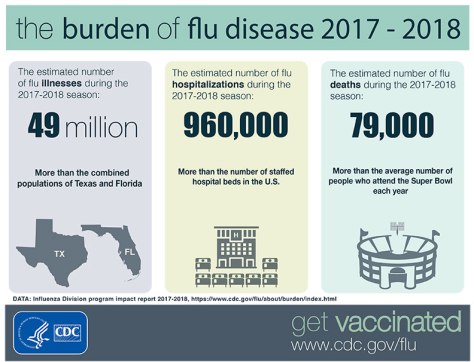
The disease kills 12,000 Americans during mild flu seasons and up to 56,000 in severe ones, with 90 percent of the victims over 65 years old. 

Although the U.S. has one of the highest vaccination rates in the world, only 45 percent of adults and 63 percent of children get flu shots each year. Scientists estimate that if the vaccination rates were boosted to between 80 and 90 percent, it could effectively stop seasonal flu from spreading because of herd immunity. 

burden-flu-infographic-update

How does the vaccine work?
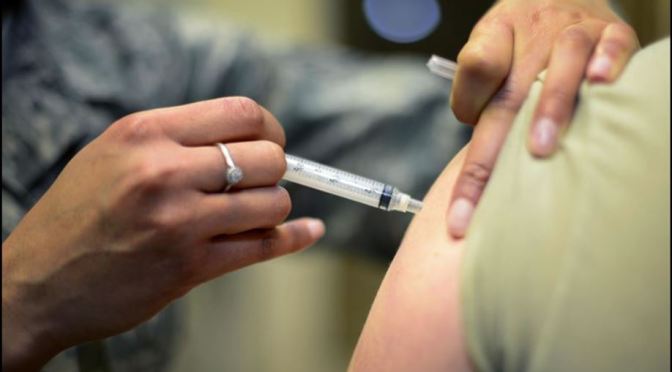
The flu vaccine contains inactive or weakened versions of three or four different strains of the influenza virus. Most people receive the vaccine via injection, but there is also a nasal spray available. The weakened viruses can’t cause serious illness, but they trigger and train the immune system to fight off the invading microorganisms. White blood cells generate an army of antibodies, which attack and destroy the vaccine viruses by attaching themselves to parts of the virus known as antigens. The vaccine antigens have the same shape as real flu antigens, so the immune system now has antibodies that match up with the real flu virus. That experience teaches the immune system to recognize future flu infections and quickly make antibodies to attack the invading viruses. It takes about two weeks after receiving the vaccine to develop immunity, which is why doctors recommend getting it early in the flu season, which begins in October and can last as late as May.

To read more: https://theweek.com/articles/874101/flu-vaccine-everything-need-know

Health Care Technology: Facebook Unveils Tool For “Preventative Health”

From a The Verge online article:

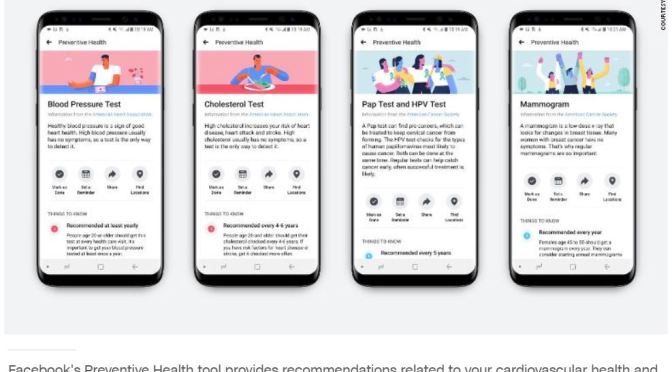
Facebook Preventative HealthThe tool is simply called Preventive Health, and is now available to Facebook users in the United States. It takes a user’s age and sex from their Facebook profile and provides them with a list of recommended screenings based on those two data points.

“Let’s say you’re 52 years old,” Freddy Abnousi, Facebook’s head of health care research, tells The Verge. “One of the things that will come to you — based on the American Cancer Society’s recommendations — is that you should have a colorectal cancer screening.” Abnousi says that the app will then give you more information about what kinds of tests are available, from a colonoscopy to a stool test or a CT scan. Abnousi hopes that users will then take what they’ve learned and talk to their primary care physician about what would be best for them. Users can also adjust the age and sex in the tool to get different screening recommendations without having it affect anything on their profile.

To read more: https://www.theverge.com/2019/10/28/20936541/facebook-preventative-health-cancer-heart-disease-flu-tool