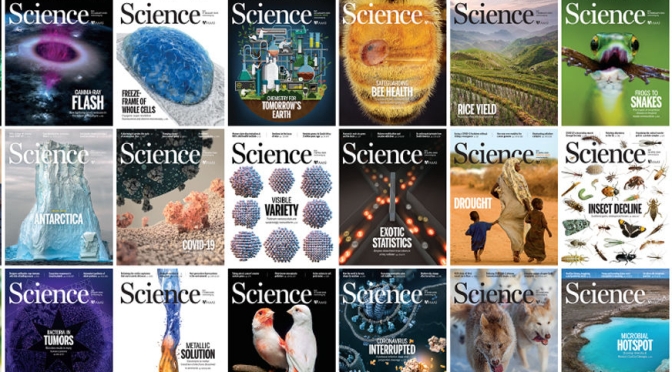
Science Magazine – June 30, 2023 issue: Vapor from liquid nitrogen wafts over a rat kidney awaiting a groundbreaking preservation method at the University of Minnesota. Scientists there have learned how to cool the organ to –150°C and rewarm it while minimizing freezing damage, enabling it to work after being transplanted.
The quest for a longer life continues – raising the question of whether we can escape death. The team discusses a rare gene variant that may explain why centenarians live so long – and how we might be able to use it to create age-defying drugs.
Spring is rolling around earlier and earlier. The team examines a new study which shows that since the 1980s, the warming climate has brought the season forward by a month – which could have major ecological implications. They also discuss a study which looks at the impact of marine heatwaves on things like coral and fish populations.
Rocks are important 🪨 Geology can play a vital role in the climate fight.
Sustainable geoscience Professor Chris Jackson (@seis_matters) speaks to @rowhoop on the #podcast ahead of his appearance at New Scientist Live in Manchester.
Science Staff Writer Adrian Cho joins host Sarah Crespi to talk about plans for the next generation of gravitational wave detectors—including one with 40-kilometer arms.
The proposed detectors will be up to 10 times more sensitive than current models and could capture all black hole mergers in the observable universe.
Sarah also talks with Pavani Cherukupally, a researcher at Imperial College London and the University of Toronto, about her Science Advances paper on cleaning up oil spills with special cold-adapted sponges that work well when crude oil gets clumpy.
First up, host Sarah Crespi talks with Staff Writer Adrian Cho about new gravitational wave detections from the first half of 2019—including 37 new black hole mergers. With so many mergers now recorded, astrophysicists can do different kinds of research into things like how new pairs of black holes come to be and how often they merge.
Sarah also talks with Sarah Davidson, data curator at the Max Planck Institute of Animal Behavior, about results from an Arctic animal tracking project that includes 3 decades of location information on many species, from soaring golden eagles to baby caribou taking their first steps. The early results from the Arctic Animal Movement Archive show that researchers can use the database as a baseline for future Arctic investigations and to examine the effects of climate on ecosystems in this key region.
In 2015, the Laser Interferometer Gravitational Wave Observatory (LIGO) facilities in the US directly detected ripples in space-time known as gravitational waves. These waves were produced by the final spiral of two oribiting black holes that smashed into each other, sending ripples across the universe.
In this Podcast Extra, Benjamin Thompson speaks to Cole Miller from the University of Maryland about the quest to detect gravitational waves, which were first hypothesised by Albert Einstein back in 1916.
News, Views and Reviews For The Intellectually Curious





 In 2015, the Laser Interferometer Gravitational Wave Observatory (LIGO) facilities in the US directly detected ripples in space-time known as gravitational waves. These waves were produced by the final spiral of two oribiting black holes that smashed into each other, sending ripples across the universe.
 Boomers Daily