
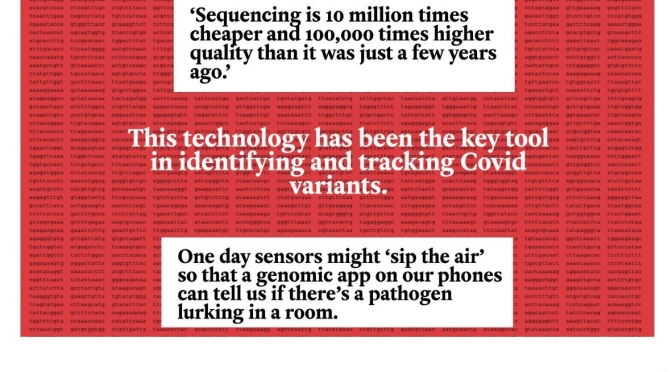
The advent of commercial genome sequencing has recently, and credibly, been compared to the invention of the microscope, a claim that led me to wonder whether this new, still relatively obscure technology, humming away in well-equipped labs around the world, would prove to be the most important innovation of the 21st century.

And unexpectedly, Covid-19 has proved to be the catalyst. “What the pandemic has done is accelerate the adoption of genomics into infectious disease by several years,” says deSouza, the Illumina chief executive. He also told me he believes that the pandemic has accelerated the adoption of genomics into society more broadly — suggesting that quietly, in the midst of chaos and a global catastrophe, the age of cheap, rapid sequencing has arrived.


 “A simple example would be copper and fiber wires. When you’re putting wires in a new facility, it’s easier to put in many more than you need that moment because putting them in 5 years from now or 10 years from now is quite hard. Something like 85 percent of our copper wires and fiber optic cables are dark right now because we know we’re going to need them in the future.”
 Boomers Daily