This spring, Barbara and Joe, a retired couple in their 60s, sat down with me at a bistro in suburban Connecticut to talk about their relationship. That they were sitting there together at all was something of a triumph. In the past few days, they had hurled at each other the kinds of accusations that couples make when they are on the brink of mutual destruction. They were bruised from the words that had been exchanged, and although they sat close to each other, their energy was quiet and heavy.
In an interview, the basketball star reveals her humiliation — and friendships — in Russian prison, and her path to recovery.
By J Wortham
On the March afternoon when I met Brittney Griner in Phoenix, the wildflowers were in peak efflorescence, California poppies and violet cones of lupine exploding everywhere. Griner was in bloom too. She was practicing with some local ballers brought in by her W.N.B.A. team, the Mercury, to prepare its players for the start of the season in May. On the court, Griner was loose, confident, trading jokes with the other players between runs.
American investors are gobbling up the storied teams of the English Premier League — and changing the stadium experience in ways that soccer fans resent.
You know so much more about yourself and your desires when you’re older that dating apps — even with all their frustrations — can bring unanticipated pleasure.
Alvin Bragg, the Manhattan D.A., campaigned as the best candidate to go after the former president. Now he finds himself leading Trump’s first prosecution — and perhaps the only one before the November election.
The Playwright Who Fearlessly Reimagines America
In her new play, ‘Sally & Tom,’ Suzan-Lori Parks brings exuberant provocation to the gravest historical questions.
Meena Danishmal asks if Seneca’s account of the good life is really practical.
According to the Oxford English Dictionary, the adjective ‘stoical’ means “resembling a Stoic in austerity, indifference, fortitude, repression of feeling and the like”. This gives us some idea of what it is like to be a Stoic. Indeed, the key teaching, arguably the fundamental point, of Stoicism, is that we should focus on controlling the things that are under our control, such as our thoughts, emotions, and actions, whilst accepting those things we cannot control, such as most things that are happening in the world. How did they get there?
To consider this question let’s look at the ideas of the Roman philosopher and statesman Lucius Annaeus Seneca the Younger (4 BCE-65 CE). As a top advisor to the paranoid and murderous Emperor Nero, he probably found Stoicism a particularly practical guide to life.
As a Stoic, Seneca believed the soul (Latin: anima or animus) to be a finer form of matter than the body; but matter it is. It was also described as a spark of the fire which had consumed the original matter. With such an understanding of the soul, where does the soul reside within the body? Stoics provided a rather simple answer: everywhere. The soul was considered to be a vital force that animates the whole body. The soul was also the source of reason, virtue, and moral character, which is what Stoic philosophy is built upon, as the rational soul guides individuals towards living in accordance with nature.
For us to understand this concept further, it’s vital to grasp the Stoic conception of reality. Stoics see the universe as interconnected and interwoven, and this unified cosmos as governed by rational principles. Within this holistic perspective, the soul is seen as part of the divine rational order of the universe. This understanding forms the basis of Stoic ethics, which emphasises the importance of cultivating reason and virtue in all aspects of life. This encouragement to align thoughts, actions, and desires with principles of reason, is a way for the soul to flourish.
A new, high-tech approach called ECPR can restart more hearts and save more lives. Why aren’t more hospitals embracing it?
By Helen Ouyang
Greg Hayes, an emergency first responder in Chanhassen, Minn., was picking up takeout sushi when a 911 call came in: A 61-year-old had stopped breathing at home. Hayes and his team jumped in their ambulance and were soon pulling up in front of a suburban two-story house, where paramedics and other first responders were also arriving. All of them grabbed their equipment and raced through the open garage to find a man, gray and still, on the living-room floor with his wife and stepdaughter nearby.
When people think about stages of life that can strain relationships, they often reflect on the first sleepless years of child rearing or the phase of parenting that involves rebellious teens. Retirement, typically anticipated as a time of relaxation, might not come to mind, but this transition away from work can also be stressful, coinciding with reinventions and re-evaluations that can cause couples to suddenly experience new tensions. It can also be a time of renewed connection and relationship growth. Often, it’s both at once.
When it’s a quick trip from the schlocky pleasures of Cancún to the remote cities of the Maya, is something lost along the way?
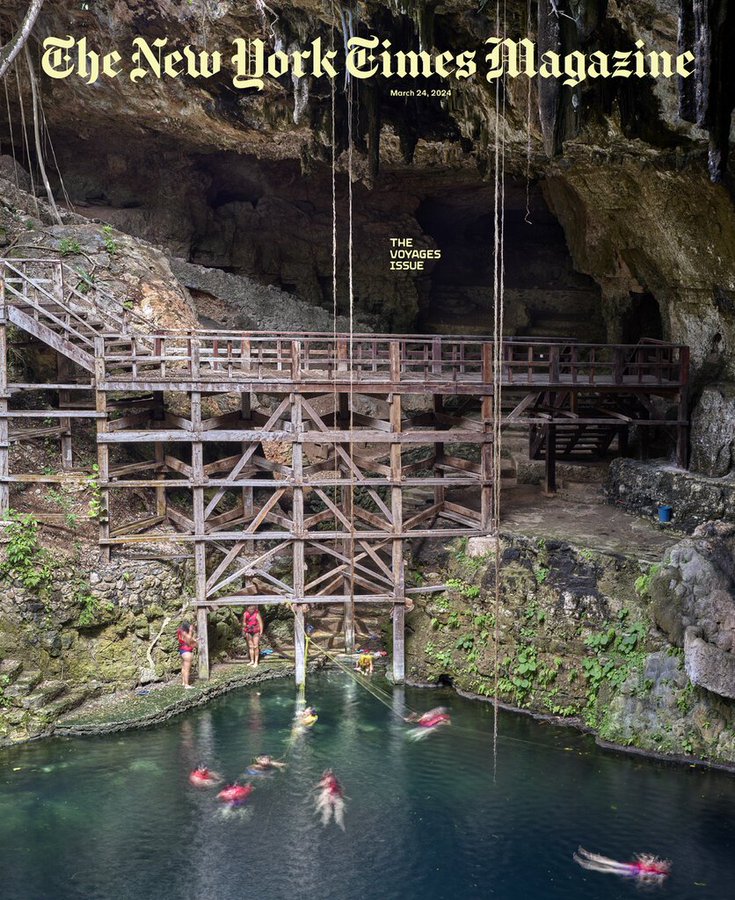
El Tren Maya, which links five states in southern Mexico, is one of the country’s most-debated infrastructure projects. Carved through the Yucatán Peninsula at great expense, the 966-mile loop pits the megaproject ambitions of Mexico’s departing president, Andrés Manuel López Obrador, against the will of environmentalists and Indigenous leaders seeking to preserve a pristine environment of jaguars, ancient ruins and sacred underwater caves.
Why had immigrants, seekers and pilgrims been drawn for centuries to the treacherous shores of Mona Island? I set off to find out.
By Carina del Valle Schorske
Every year, I spend a month or two in Puerto Rico, where my mother’s family is from. Often I go in winter, with the other snowbirds, finding solace among palm trees. But I’m not a tourist, not really. I track the developers that privatize the shoreline; I follow the environmental reports that give our beaches a failing grade. I’m disenchanted with the Island of Enchantment, suspicious of an image that obscures the unglamorous conditions of daily life: frequent blackouts, meager public services, a rental market ravaged by Airbnb. Maybe that’s why I turned away from the sunshine and started to explore caves with my friends Ramón and Javier, seeking out wonders not yet packaged for the visitor economy. I’ve been learning to love stalactites and squeaking bats, black snakes and cloistered waterfalls — even, slowly, the darkness itself.
News, Views and Reviews For The Intellectually Curious














 Boomers Daily