

Printed in 1085: The Chinese Buddhist Canon from the Song Dynasty
April 29–Dec. 4, 2023
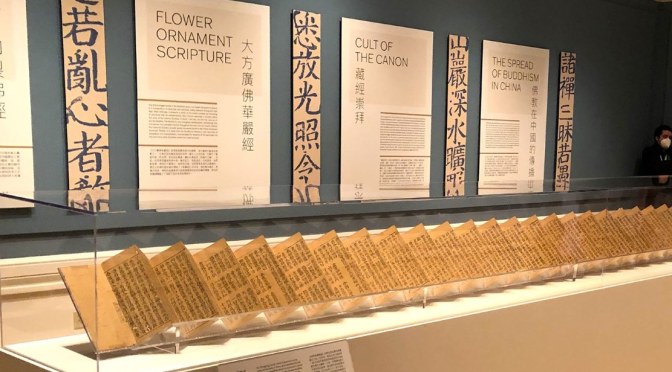
The oldest printed book in The Huntington’s collection, the Scripture of the Great Flower Ornament of the Buddha, is on display in “Printed in 1085: The Chinese Buddhist Canon from the Song Dynasty” in the Library West Hall.
The exhibition delves into the circumstances of the book’s creation and its religious significance while broadening visitors’ understanding of Chinese textual tradition. Additional materials related to the text are on display to provide historical context.
The book is in a specially designed display case that allows Huntington visitors to have a unique experience when viewing the sacred text. Though the book was meant to be read by flipping from one page to the next, in the exhibition it is expanded in a custom case designed for maximum visibility, offering a rare opportunity to view the miraculously preserved relic and observe its unique bibliographic characteristics and exquisiteness.
More than 900 years old, the book is part of the 5,850-volume Great Canon of the Eternal Longevity of the Chongning Reign Period. Produced during the Song dynasty (960–1279) between 1080 and 1112, the accordion-style book fully unfolds to a length of 31 feet. It is one of the longest sutras, or collections of aphorisms, in the Buddhist canon and is a compendium of doctrines and ritual practices widely followed throughout East Asia.
The text presents a vision of the entire universe as consisting of elements that all interpenetrate (like mirrors reflecting in mirrors) within the body of the Cosmic Buddha. According to Li Wei Yang, curator of Pacific Rim Collections at The Huntington, it reflects the notion that “I am you, you are me; we all are Buddha.” It is not known whether the Buddha himself actually spoke the words found in the Scripture of the Great Flower Ornament.
Rather, it is likely that his followers, over centuries of adaptation and interpretation, incorporated the essence of his teachings into this and many other Buddhist works that have survived.
 Boomers Daily