
Tag Archives: Chemists

Research Preview: Nature Magazine – May 18, 2023

Volume 617 Issue 7961

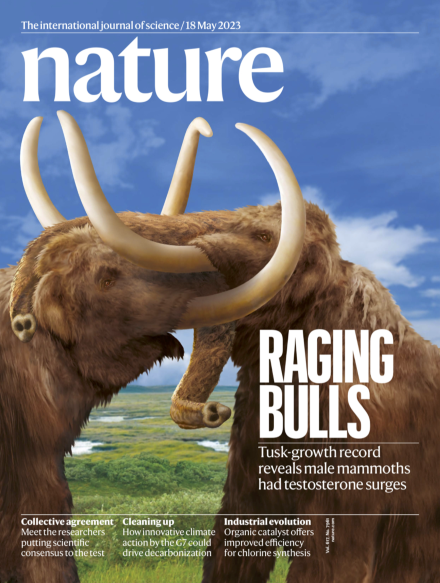
nature Magazine – May 18, 2023 issue: The cover shows an artist’s impression of two male mammoths fighting. During episodes of musth, adult male elephants undergo periods of elevated testosterone levels associated with aggression and competition for mating. In this week’s issue, Michael Cherney and his colleagues show that male woolly mammoths (Mammuthus primigenius) experienced similar episodes of musth. 

The ocean is hotter than ever: what happens next?

Record temperature combined with an anticipated El Niño could devastate marine life and increase the chances of extreme weather.
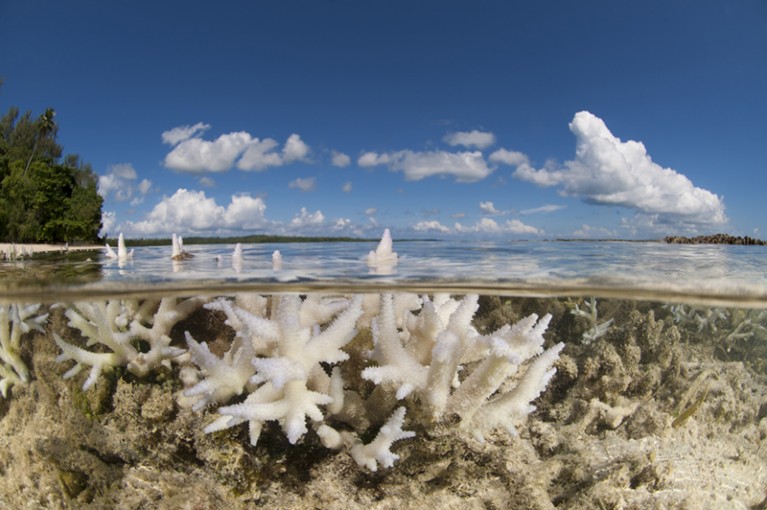
Split level of shallow bleaching corals and island, New Ireland, Papua New Guinea, June 2010

The global ocean hit a new record temperature of 21.1 ºC in early April, 0.1 ºC higher than the last record in March 2016. Although striking, the figure (see ‘How the ocean is warming’) is in line with the ocean warming anticipated from climate change. What is remarkable is its occurrence ahead of — rather than during — the El Niño climate event that is expected to bring warmer, wetter weather to the eastern Pacific region later this year.

For chemists, the AI revolution has yet to happen

Machine-learning systems in chemistry need accurate and accessible training data. Until they get it, they won’t achieve their potential.
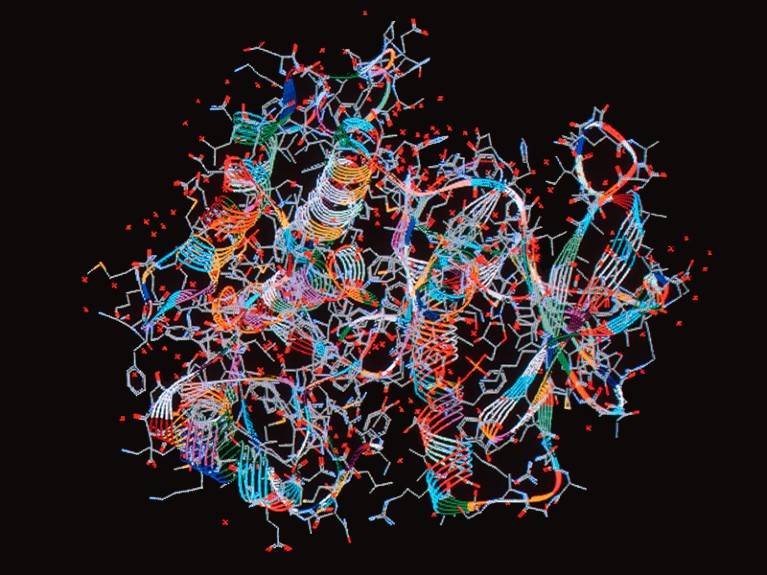
Cancer protein. Computer model of the enzyme protein tyrosine kinase, which is involved in cancer cell formation.

Many people are expressing fears that artificial intelligence (AI) has gone too far — or risks doing so. Take Geoffrey Hinton, a prominent figure in AI, who recently resigned from his position at Google, citing the desire to speak out about the technology’s potential risks to society and human well-being.
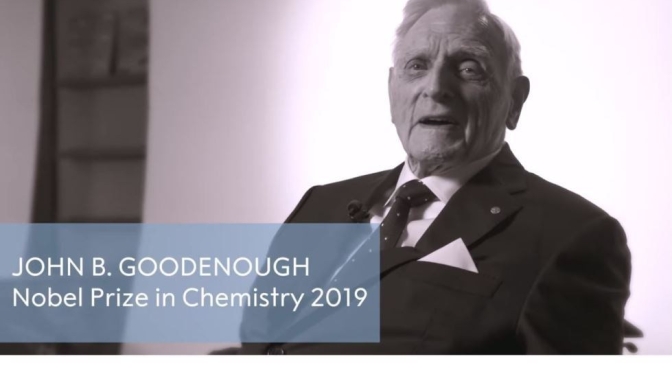
Interviews: 97-Year Old Nobel Prize Chemist John B. Goodenough On Wisdom, Love And Life

Interview with the 2019 Nobel Laureate in Chemistry John B. Goodenough, 6 December 2019

0:07 – What advice would you give to a younger version of yourself?  0:32 – How do you recognise a good teacher?  0:58 – Do you see yourself as a mentor now?  1:33 – What qualities do you think you need to be a successful scientist?   3:04 – How do you cope with failure?   3:16 – How has your dyslexia shaped you?  3:44 – How important has nature been for you?      4:40 – Has music played an important role in your life?   5:06 – How did your interest in poetry start?   6:14 – How did you meet your wife?   7:06 – What life advice can you share?   8:30 – How do you remember so much of your life?   8:47 – How does it feel to be back in Stockholm after 80 years?   9:21 – How has living through World War II influenced you? 10:03 – What is your relationship with your lab colleagues?   11:18 – What are the characteristics of a very good team?  11:55 – What is your relationship with Akira Yoshino?   12:28 – How has the scientific landscape has changed over the years?   13:42 – What environment encourage creative thinking?   14:48 – What research are you working on now?   15:39 – What are your thoughts on sustainability?   16:37 – What future do you see for sustainable batteries?

John Bannister Goodenough born July 25, 1922) is an American materials scientist, a solid-state physicist, and a Nobel laureate in chemistry. He is a professor of mechanical engineering and materials science at the University of Texas at Austin. He is widely credited with the identification and development of the lithium-ion battery, for developing the Goodenough–Kanamori rules in determining the sign of the magnetic superexchange in materials, and for seminal developments in computer random access memory.