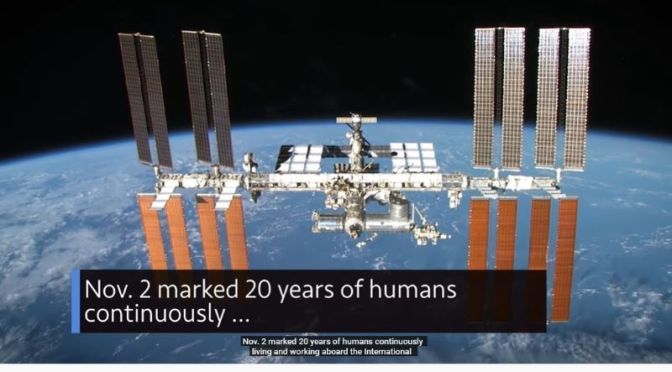
Marking 20 years of humans aboard the space station, getting out the vote from space, and preparations continue for NASA and SpaceX’s next crew launch … a few of the stories to tell you about – This Week at NASA!
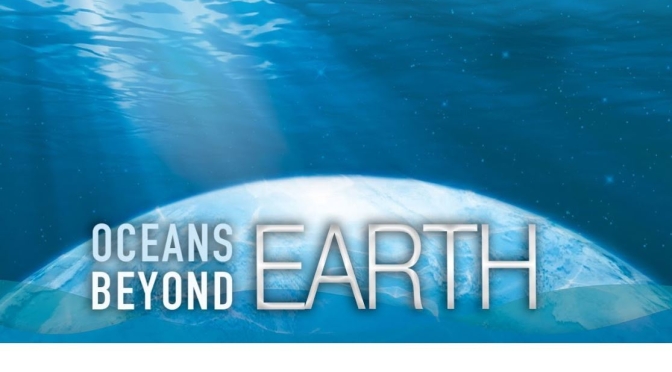
Our planet is a beautiful water-filled world, teeming with life. But did you know that Earth is not the only world in our solar system with an ocean? Here’s what you need to know about Ocean Worlds.
A special type of aurora, draped east-west across the night sky like a glowing pearl necklace, is helping scientists better understand the science of auroras and their powerful drivers out in space. Known as auroral beads, these lights often show up just before large auroral displays, which are caused by electrical storms in space called substorms.
Until now, scientists weren’t sure if auroral beads are somehow connected to other auroral displays as a phenomenon in space that precedes substorms, or if they are caused by disturbances closer to Earth’s atmosphere. But powerful new computer models, combined with observations from NASA’s Time History of Events and Macroscale Interactions during Substorms – THEMIS – mission, have provided the first direct evidence of the events in space that lead to the appearance of these beads and demonstrated the important role they play in our local space environment.
In 2015, after a nine-and-a-half-year journey, NASA’s New Horizons spacecraft raced past Pluto, beaming images of the dwarf planet back to Earth.
Five years after the mission, researchers are poring over images of Pluto’s far-side, which was shrouded in shadow during New Horizon’s flypast. They hope that these images will help give a better understanding of how Pluto was born and even whether a hidden ocean resides beneath the world’s icy crust.
Why are there so many attempts to get to Mars at the moment? The United Arab Emirate’s Hope satellite was despatched last week and now China has launched its first rover mission to the red planet. Nasa’s Perseverance Rover is scheduled to take off on 30th July. Well, summer 2020 is a popular time for missions to the red planet because of the way the planets align – but how long does it take to get there? Landing on Mars is known as the “seven minutes of terror”, and there are lots of reasons why. Here BBC Science Correspondent Laura Foster explains how long it takes to get there and why it’s so difficult. Video by Megan Fisher, Terry Saunders and Laura Foster
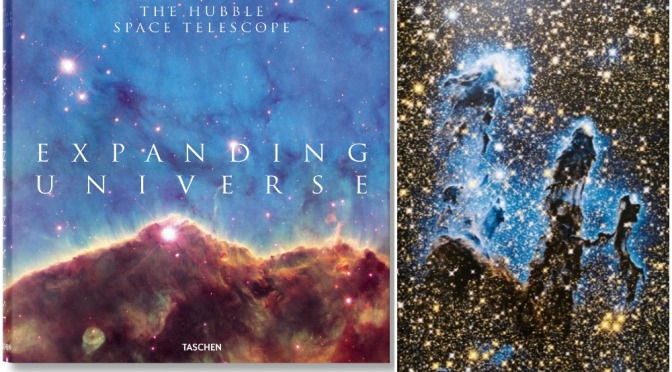
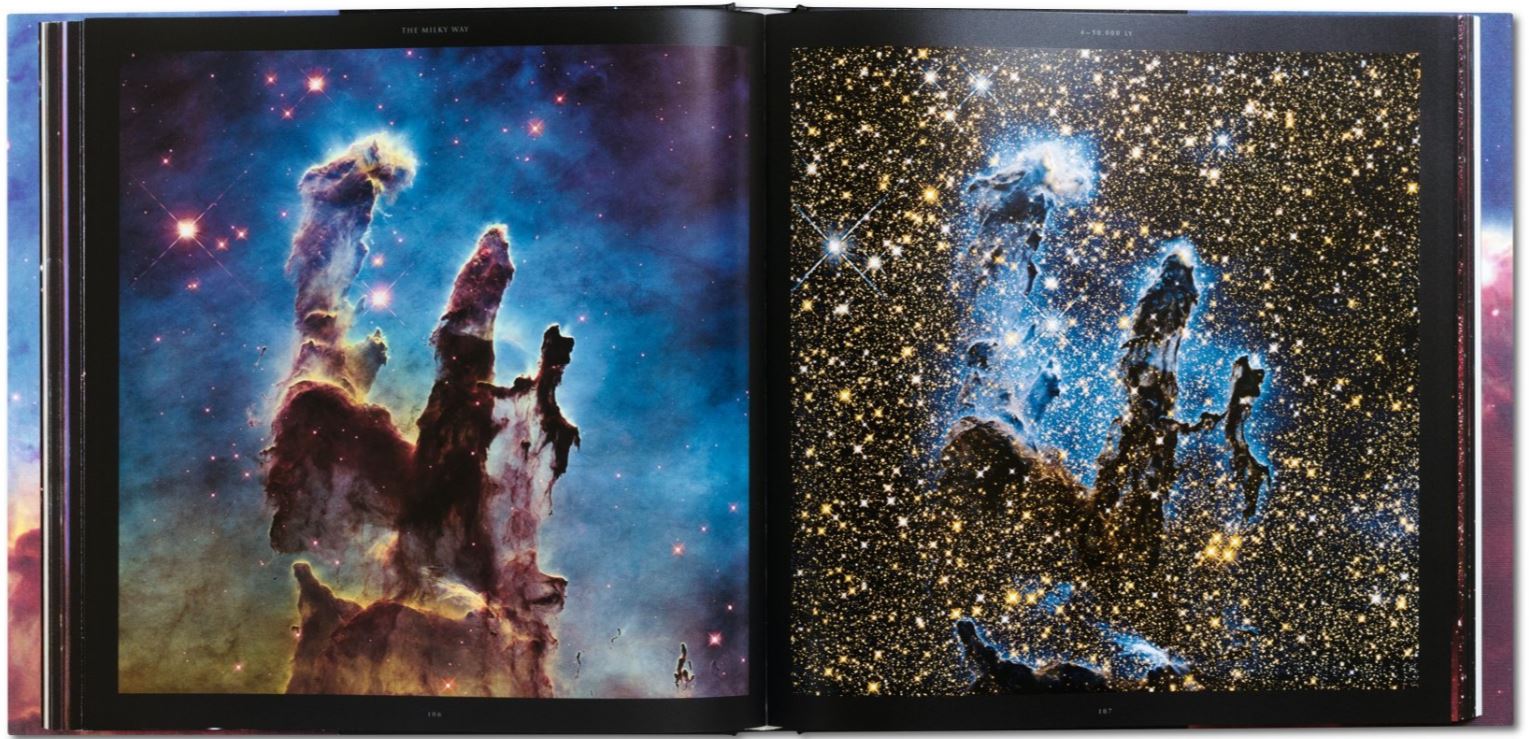
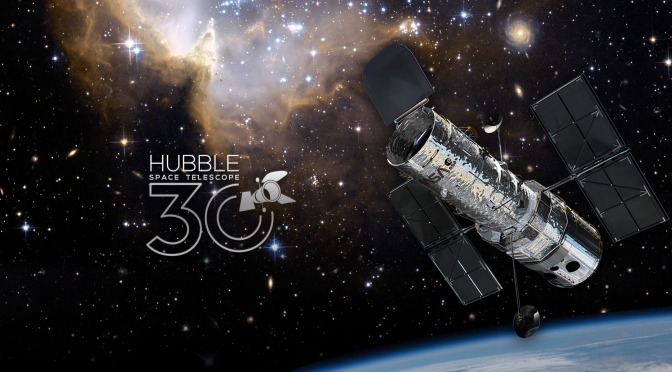
With investigations into everything from black holes to exoplanets, the Hubble Telescope has changed not only the face of astronomy but also our very sense of being in the universe. On the 30th anniversary of its launch into low-earth orbit, this updated edition of Expanding Universe presents 30 brand new images, unveiling more hidden gems from the Hubble’s archives.
Ultra-high resolution and taken with almost no background light, these pictures have answered some of the most compelling questions of time and space while also revealing new mysteries, like the strange “dark energy” that sees the universe expanding at an ever-accelerating rate.
The collection is accompanied by an essay from photography critic Owen Edwards and an interview with Zoltan Levay, who explains how the pictures are composed. Veteran Hubble astronauts Charles F. Bolden, Jr. and John Mace Grunsfeld also offer their insights on Hubble’s legacy and future space exploration.
The contributors
Charles F. Bolden, Jr., Major General, USMC (Ret.), is a former Administrator of NASA, where he oversaw the completion of the International Space Station. He spent 14 years as a member of NASA’s Astronaut Corps, and commanded and piloted the Space Shuttle Discovery on STS-31, which launched the Hubble Space Telescope into orbit.
Owen Edwards has written about photography for more than 30 years for numerous publications including American Photographer, New York Times Magazine, and Smithsonian.
John Mace Grunsfeld, PhD, is an astrophysicist and a NASA astronaut. He has flown five times on the Space Shuttle, including three Hubble servicing missions. He has served as the Associate Administrator for the Science Mission Directorate, the NASA Chief Scientist, and as the Deputy Director of the Space Telescope Science Institute.
Zoltan Levay is a retired principle science visuals developer at the Space Telescope Science Institute, where he worked with astronomers and communicators worldwide to publicize science results from NASA’s Hubble Space Telescope.
An instrument on the International Space Station is providing new insights into some of the Universe’s most baffling objects. Neutron stars have puzzled scientists for decades. It’s known that these ultra-dense objects are born from the remnants of supernovae, yet what’s under their surface, and what processes that go on within them, remain a mystery.
Now, an instrument called the Neutron Star Interior Composition Explorer is providing new information to help answer these questions, ushering in a new era of research into these strange stars.
On April 24, 2020, the Hubble Space Telescope celebrates its 30th year in orbit by premiering a never-before-seen view of two beautiful nebulas named NGC 2020 and NGC 2014.
Hubble’s senior project scientist, Dr. Jennifer Wiseman, takes us on a tour of this stunning new image, describes the telescope’s current health, and summarizes some of Hubble’s contributions to astronomy during its 30-year career.
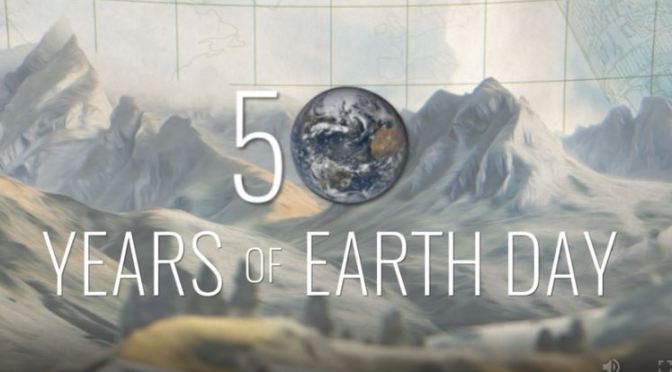
It’s been five decades since Apollo 8 astronaut William Anders photographed Earth peaking over the Moon’s horizon. The iconic image, dubbed Earthrise, inspired a new appreciation of the fragility of our place in the universe. Two years later, Earth Day was born to honor our home planet. As the world prepares to commemorate the 50th anniversary of Earth Day, NASA reflects on how the continued growth of its fleet of Earth-observing satellites has sharpened our view of the planet’s climate, atmosphere, land, polar regions and oceans.



 In 2015, after a nine-and-a-half-year journey, NASA’s New Horizons spacecraft raced past Pluto, beaming images of the dwarf planet back to Earth.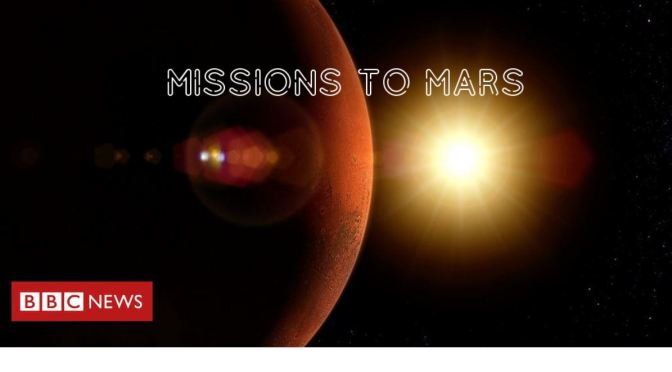
 Boomers Daily