Tag Archives: Van Eyck

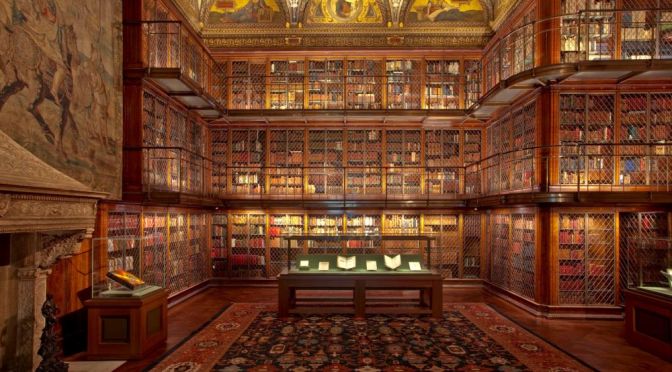
Morgan Library Exhibits: ‘Van Eyck To Mondrian’

Building on the Morgan’s tradition of presenting to the American public distinguished works from outstanding institutions abroad, Van Eyck to Mondrian: 300 Years of Collecting in Dresden focuses on the exceptional drawing collection of the Kupferstich-Kabinett, Dresden.

Established by Augustus II the Strong, Elector of Saxony, in 1720, the museum is one of the oldest and finest depositories of works on paper in the world. The exhibition celebrates pivotal moments and key traditions in the history of European draftsmanship. Most remarkably, it will feature Jan van Eyck’s Portrait of an Elderly Man (ca. 1435–40)—an exceptionally rare drawing by the great Netherlandish Renaissance painter, which has never before traveled to the United States.

The Kupferstich-Kabinett’s strength in Northern Renaissance and Baroque drawings will be further showcased through works by Lucas Cranach the Elder, Hans Holbein the Younger, Rembrandt, and Rubens, while the museum’s rich holdings of Southern European works will be represented by Correggio, Bronzino, Sofonisba Anguissola, and others.

Among works produced in the nineteenth and twentieth centuries, highlights include studies by Caspar David Friedrich, Goya, Käthe Kollwitz, Gustav Klimt, Otto Dix, and Piet Mondrian.
New Museum Exhibitions: “Van Eyck – An Optical Revolution” At MSK Ghent

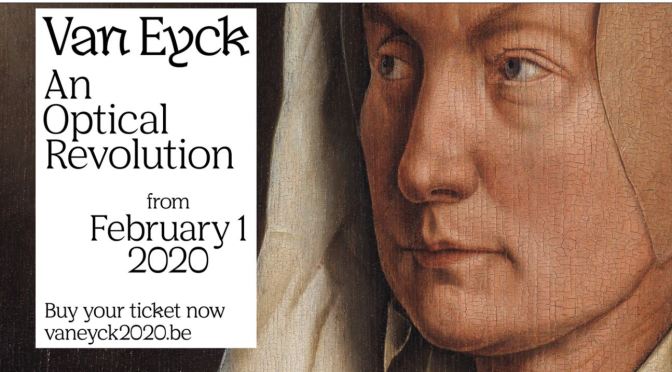
Worldwide, only approximately twenty works by Van Eyck have been preserved. Quite exceptionally, over half of these will travel to Ghent in 2020 for the exhibition ‘Van Eyck. An optical revolution’ at the Museum of Fine Arts (MSK). In what promises to be an unmissable, tour de force of an exhibition, the world of Van Eyck and his revolutionary gaze will be brought to life like never before.

Jan van Eyck, Portrait of a Man with a Blue Chaperon, c. 1428-30 (Muzeul National Brukenthal, Sibiu, Romania)

The pinnacle of Late Medieval art
Van Eyck distinguished himself from his peers and triggered an optical revolution. With his matchless technique, scientific knowledge and unrivalled observational skills, he elevated oil painting to unprecedented heights and determined the future course of Western art. Never before had a painter made reality so tangible: all that seems to be missing from his portraits is his subjects’ breath, while his landscapes reveal the world in all its facets. Van Eyck trained his eye on the tiniest details before casting it wide again to create unforgettable panoramas.

His masterpiece, ‘The Adoration of the Mystic Lamb’ (1432, St Bavo’s Cathedral, Ghent), bears witness to all three of these qualities. The restoration of the outer wings of the altarpiece will play a central role in the exhibition. Undertaken by the Royal Institute for Cultural Heritage (KIK), the project commenced at the Museum of Fine Arts Ghent in 2012. Visitors will have the opportunity to get close to the work and admire the spectacular results.


MSK Kent LogoIn dialogue with Van Eyck’s contemporaries
In order to contextualise Van Eyck’s optical revolution, his paintings will be shown alongside works by his most talented contemporaries from Germany, France, Italy and Spain. These artists also moved in exalted circles and received prestigious commissions. The exhibition focuses on the artistic similarities and differences between their works, thus delving deeper into the historical context in which they were created.

‘Van Eyck. An optical revolution’ unravels the myths about the artist and considers his technique, his oeuvre and his influence from a fresh perspective. This exhibition will awaken a sense of wonder among visitors, comparable to that which people would have felt when they saw his works for the first time: a once-in-a-lifetime experience.

Read more